What is a lone worker tracking app?
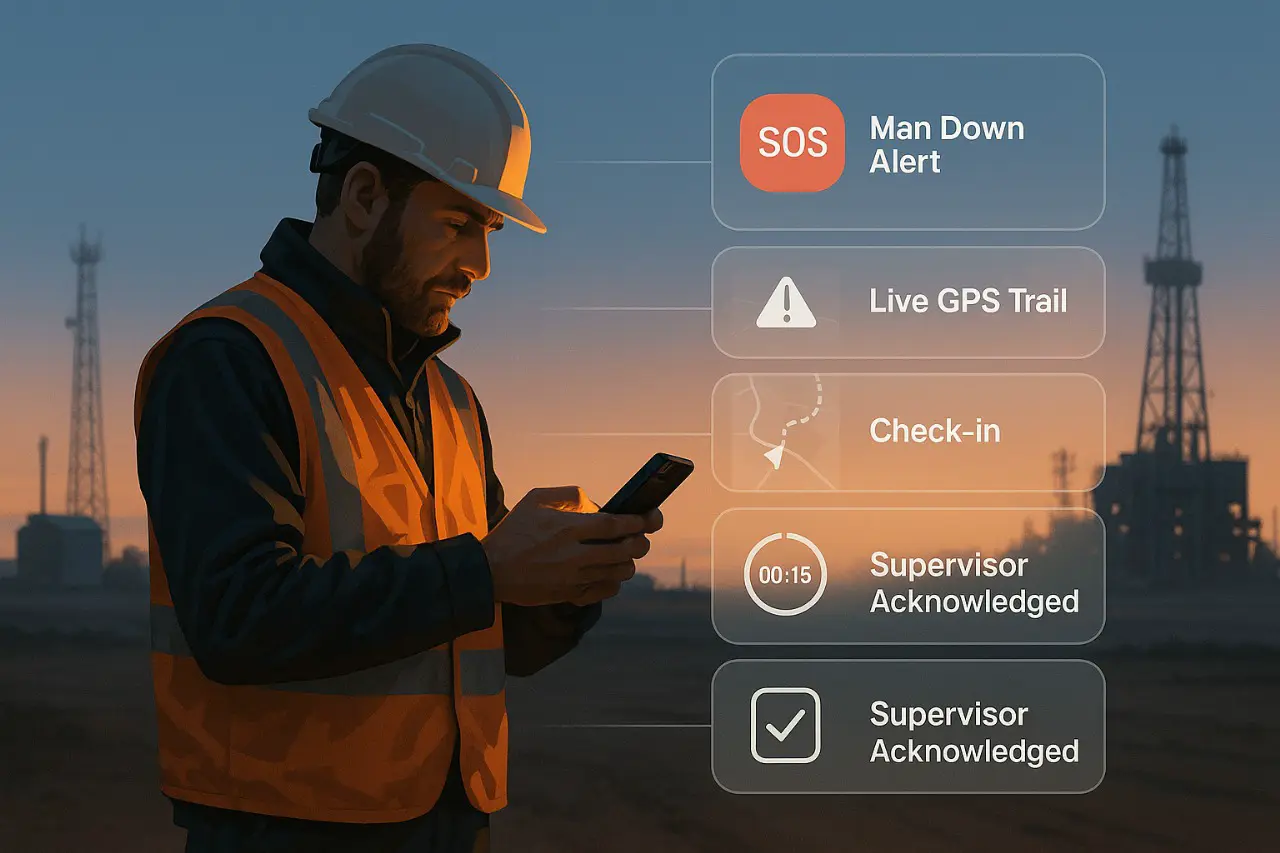
A lone worker tracking app is a worker safety application that uses real-time location monitoring, automated emergency detection, and structured welfare check-ins to protect employees who work without direct supervision - and to provide employers with the documented evidence they need to demonstrate legal duty-of-care compliance. Under UK law (HSW Act 1974 and MHSWR 1999), employers must manage the risks to lone workers, which requires monitoring systems that include regular contact at pre-agreed intervals and a means for the worker to signal for help. A lone worker tracking app discharges these duties through GPS location, SOS/panic, man-down detection, timed check-ins with auto-escalation, and immutable audit trails. PETRAN is Ombrulla’s industrial-grade lone worker tracking platform, deployed across Oil & Gas, Construction, Maritime, Utilities, Manufacturing, and Facilities Management.
How does a lone worker safety app improve worker protection?
A lone worker safety app improves worker protection through three mechanisms: faster emergency detection, faster response, and better evidence. Detection includes SOS, silent duress, man-down detection, and missed check-in escalation. Response transmits GPS location, battery level, and context via redundant channels with acknowledgement. Evidence logs every event in an immutable audit trail for compliance and investigation.
What features should I look for in a lone worker app?
Key features include SOS and silent duress, sensor-based man-down detection, timed check-ins with escalation, live GPS tracking with geofencing, offline capability, satellite fallback, audit trails aligned to ISO 45001, enterprise integrations, privacy controls, and no-code workflow configuration.
Does the lone worker tracking app work offline or in low signal?
Yes. PETRAN uses an offline-first design that stores events locally and syncs when connectivity returns. LTE-M and NB-IoT support low-signal environments, while satellite fallback enables coverage in remote or offshore locations.
How does SOS and silent duress work in a lone worker app?
SOS is triggered via app or wearable and sends GPS, battery, and context to responders through redundant networks with acknowledgement. Silent duress uses a covert PIN to trigger alerts without visible indication, ensuring safety in confrontational situations.
Can the app detect falls or inactivity (man-down)?
Yes. PETRAN uses sensor fusion (accelerometer, gyroscope, barometer) to detect falls with high accuracy. After detection, a grace period allows user confirmation before auto-escalation. Inactivity monitoring also triggers alerts if movement stops beyond a defined threshold.
What is geofencing in a worker safety app?
Geofencing creates virtual boundaries that trigger alerts when workers enter, exit, or dwell in zones. It enables restricted area control, time-in-zone tracking, and proactive risk mitigation in hazardous environments.
How is worker privacy handled in lone worker tracking?
PETRAN ensures privacy through on-duty tracking only, role-based access control, configurable data retention, worker transparency, and regional data residency to comply with GDPR requirements.
Which devices and hardware are supported?
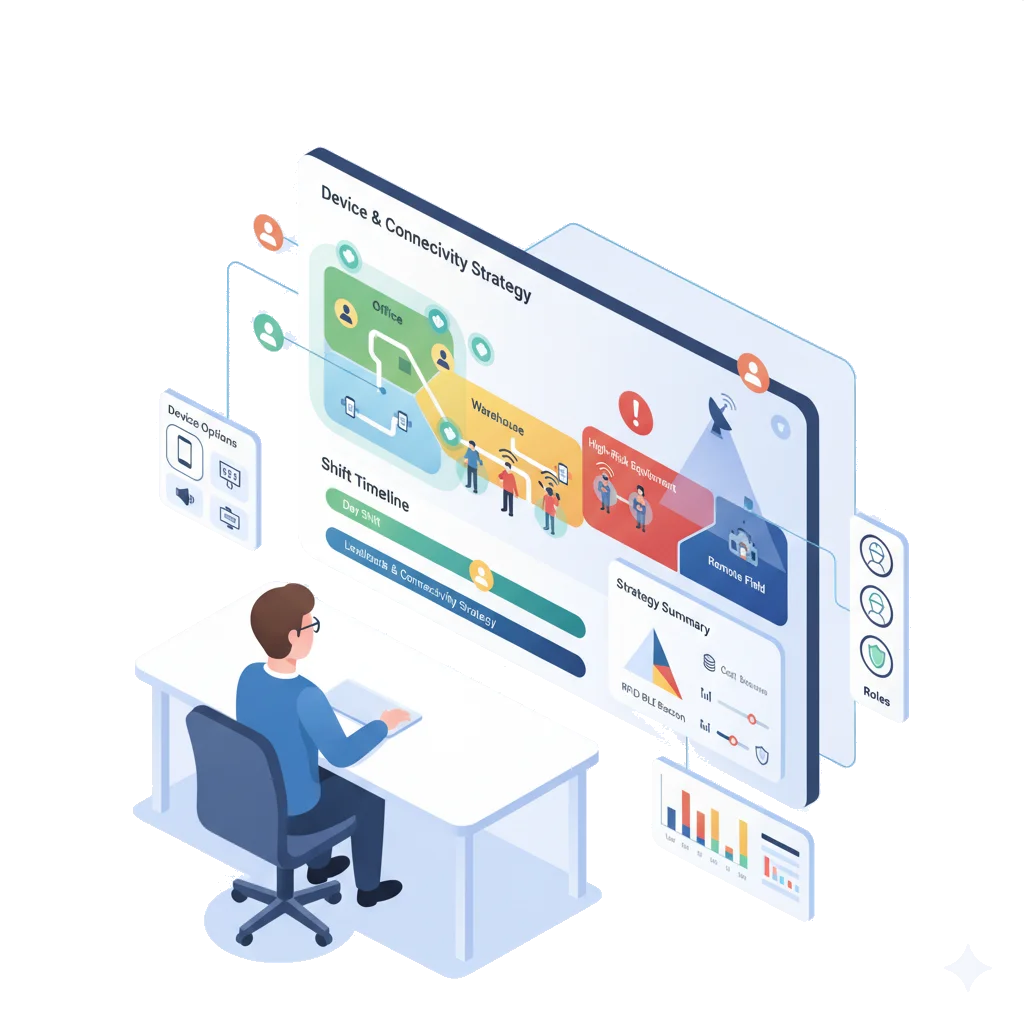
Supported devices include iOS/Android smartphones, BLE panic badges, RFID/NFC checkpoints, and satellite communicators. PETRAN unifies all device data into a single dashboard.
Can we integrate the lone worker tracking app with our systems?
Yes. PETRAN integrates with CMMS/EAM, EHS platforms, HRIS, MDM, and messaging tools using APIs and webhooks, enabling automated workflows and synchronized data across systems.
How does the system reduce false alarms?
False alarms are reduced through adaptive thresholds, grace periods, confirmation prompts, and analytics-driven tuning, ensuring accuracy without compromising response speed.
Will lone worker tracking drain battery on worker phones?
No. PETRAN uses adaptive GPS sampling and smart data sync to minimize battery usage, typically consuming only 5–10% per shift.
What industries benefit most from a lone worker safety app?
Industries include Oil & Gas, Construction, Maritime, Utilities, Manufacturing, Facilities Management, Healthcare, Logistics, Mining, and Agriculture-where lone worker risk is highest.
How fast can we deploy a lone worker app?
A pilot can go live in 1–3 days for mobile-only setups. Full enterprise rollout typically takes 4–12 weeks depending on scale and hardware requirements.
Is the solution compliant and audit-ready?
Yes. PETRAN provides a complete audit trail of all safety events, meeting requirements for HSW Act, MHSWR, RIDDOR, and ISO 45001 compliance.
How is lone worker tracking data secured?
Security includes TLS encryption, AES-256 storage, SSO integration, MDM enforcement, MFA access, and regional data residency to meet enterprise and regulatory standards.
Can supervisors communicate with lone workers through the app?
Yes. PETRAN supports chat, auto-dial calls, and templated responses, all logged within the incident timeline for full traceability.
What is the difference between a worker safety app and a GPS tracker?
A GPS tracker only shows location. A worker safety app adds SOS, man-down detection, check-ins, communication, and audit trails-providing complete duty-of-care compliance.