
Deep Learning for Predictive Maintenance in Industrial IoT Systems
Abstract
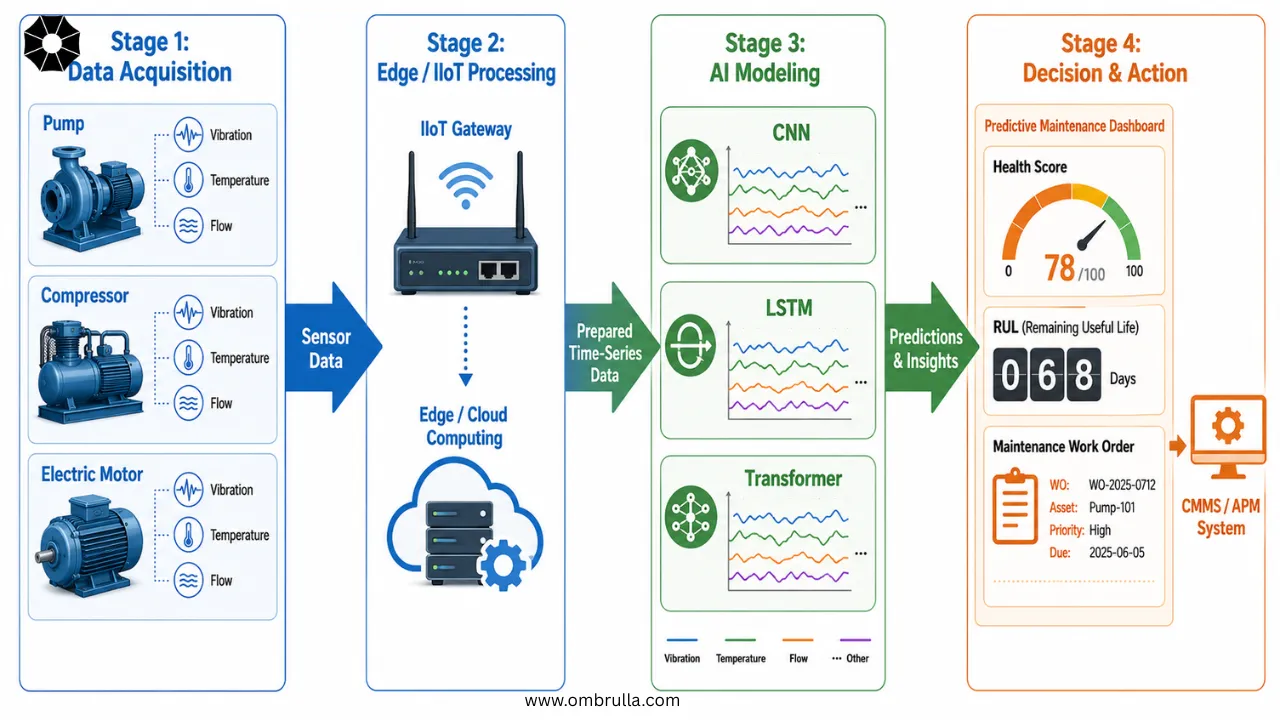
Industrial plants are increasingly instrumented with high-frequency sensors that measure vibration, temperature, pressure, current, and flow across rotating equipment, compressors, and pumps. Under Industry 4.0 and the Industrial Internet of Things (IIoT), this sensor data underpins predictive maintenance (PdM) strategies that move organizations beyond reactive and time-based maintenance toward condition-based and prescriptive intervention. Traditional signal-processing pipelines combined with shallow machine learning models, such as hand-crafted statistical features feeding random forests or support vector machines, struggle to scale to the volume, multivariate correlation structure, and non-stationarity of industrial time series. Deep learning, and in particular Convolutional Neural Networks (CNNs), Long Short-Term Memory (LSTM) networks, and Transformer architectures, has emerged as a powerful alternative for data-driven predictive maintenance.
This paper surveys and compares CNN, LSTM, and Transformer architectures for time-series sensor analysis in industrial predictive maintenance. We characterize the IIoT data landscape, including vibration-based condition monitoring and Remaining Useful Life (RUL) estimation; describe representative architecture patterns for one-dimensional CNNs, recurrent sequence models, and self-attention mechanisms applied to multivariate sensor streams; and review applications to rotating machinery and turbomachinery, including LSTM autoencoders for anomaly detection, hybrid CNN-LSTM pipelines, and Transformer-based RUL and anomaly-detection models. We position these models within asset performance management (APM) and predictive maintenance software platforms, and compare the three architecture families along the dimensions of accuracy, data requirements, interpretability, inference latency, and deployment complexity. We conclude by outlining open challenges in self-supervised learning, domain adaptation, federated learning, and uncertainty-aware decision support, and provide practical guidance for engineers designing deep learning pipelines for rotating equipment, compressors, and pumps in operational industrial environments.
Introduction
Asset-intensive industries, including power generation, oil and gas, chemicals, metals, water treatment, and discrete manufacturing, depend heavily on rotating equipment, compressors, and pumps. Unplanned failures in these assets cause production downtime, safety hazards, and in some cases environmental incidents. predictive maintenance (PdM) seeks to anticipate such failures by continuously monitoring condition indicators and forecasting degradation before a catastrophic event occurs, rather than relying on fixed time intervals or reacting only after failure.
The growth of Industrial IoT (IIoT) has fundamentally changed the data landscape available for this task. Low-cost vibration, temperature, pressure, current, and ultrasonic sensors now stream high-frequency measurements into plant historians and cloud platforms at a scale that was not previously economical. In parallel, commercial predictive maintenance software has matured considerably, integrating analytics with maintenance work-order management inside cloud-based and hybrid architectures.
Despite this growth in data availability, many organizations continue to rely on manual thresholding and static alarm rules. Such approaches are brittle under changing operating conditions and cannot exploit the complex correlations that exist across multiple sensor channels. Deep learning offers a data-driven alternative to this limitation, for three broad reasons:
- -Convolutional Neural Networks (CNNs) learn discriminative features directly from raw or transformed signals, and are particularly effective at fault classification from vibration or acoustic signatures.
- -Long Short-Term Memory (LSTM) networks model temporal dependencies and non-linear degradation processes in multivariate time series, enabling both Remaining Useful Life (RUL) prediction and sequence-based anomaly detection.
- -Transformer architectures capture long-range and cross-channel dependencies through self-attention, and have shown promising results for RUL estimation and anomaly detection in industrial equipment.
Recent reviews of deep learning applied to rotating machinery report substantial performance gains over traditional signal-processing pipelines, while also highlighting persistent challenges around labeled data availability, model interpretability, and production deployment. Motivated by this, the present paper addresses three research questions:
1. How do CNN, LSTM, and Transformer architectures differ conceptually when applied to time-series sensor analysis in industrial predictive maintenance?
2. For rotating equipment, compressors, and pumps, what empirical patterns emerge across these architecture families in terms of accuracy, latency, and robustness to operating-condition variation?
3. How can these models be integrated into IoT predictive maintenance and asset performance management (APM) platforms in practice?
Related Work
Predictive maintenance research draws on three overlapping literatures: classical condition-based maintenance and signal processing, machine-learning-based fault diagnosis, and, more recently, deep-learning-based approaches to fault classification, anomaly detection, and RUL estimation.
Classical condition monitoring relies on hand-engineered statistical and spectral features (root-mean-square amplitude, kurtosis, spectral peaks, envelope analysis) combined with shallow classifiers such as support vector machines and random forests. These approaches remain widely used in industry due to their interpretability and modest data requirements, but their performance is bounded by the quality of manually designed features and tends to degrade under varying operating conditions.
A substantial body of work has since demonstrated that CNNs can learn discriminative representations directly from raw or minimally processed vibration and acoustic signals, often matching or exceeding feature-engineering pipelines on bearing- and gear-fault benchmarks. Parallel work has applied LSTM and other recurrent architectures to model degradation trajectories and to perform RUL regression on benchmark datasets such as the NASA C-MAPSS turbofan dataset, frequently combined with autoencoder structures for unsupervised anomaly detection. More recently, Transformer-based architectures originally developed for natural language processing have been adapted to multivariate industrial time series, exploiting self-attention to capture long-range and cross-sensor dependencies without the sequential inductive bias of recurrent models.
Existing surveys typically focus on a single architecture family or a narrow application domain (for example, bearing fault diagnosis alone). The present paper differs by providing a structured, side-by-side comparison of CNN, LSTM, and Transformer architectures across a common set of evaluation dimensions, while explicitly connecting model-level design choices to deployment within commercial predictive maintenance and asset performance management platforms.
Industrial IoT Data Landscape for Predictive Maintenance
Sensors and Signal Characteristics
Typical IIoT-enabled predictive maintenance deployments instrument rotating equipment and pumps with several classes of sensors:
- -Accelerometers for vibration monitoring, commonly sampled at 1 to 10 kHz.
- -Temperature sensors mounted at bearings, windings, or casings.
- -Pressure and flow sensors for pumps and compressors.
- -Electrical measurement sensors (voltage, current, power factor) for motors and drives.
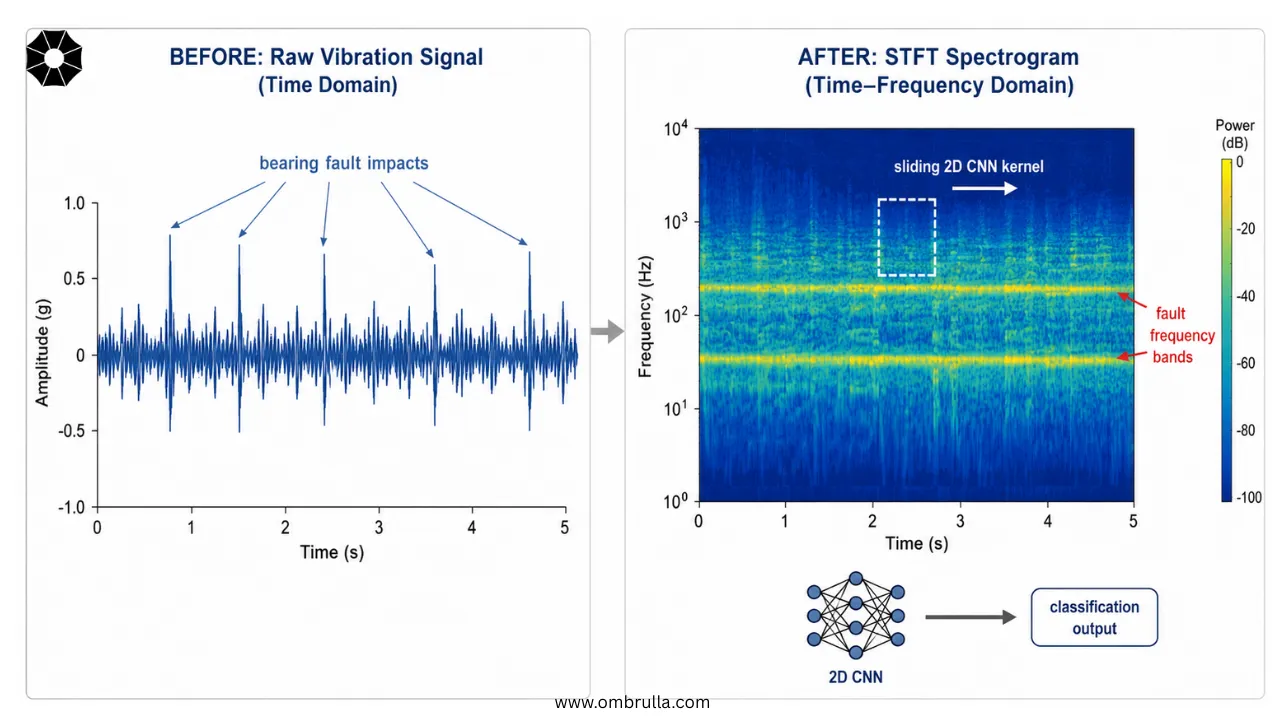
These sensors are typically networked through a combination of wired and wireless industrial protocols into edge gateways and, subsequently, cloud platforms for continuous monitoring. Raw time-series data captured this way are frequently noisy, non-stationary, and strongly influenced by operating conditions such as load, rotational speed, and process state. Domain experts have traditionally converted such signals into engineered features, including RMS amplitude, kurtosis, spectral peaks, and envelope-based metrics; deep learning architectures, in contrast, can operate directly on raw time-domain streams or on time-frequency representations such as short-time Fourier transform (STFT) spectrograms.
Maintenance Strategies and Business Context
Industrial maintenance strategies can be organized along a maturity spectrum: reactive (run-to-failure), time-based preventive, condition-based, and predictive or prescriptive. Systematic reviews of Industry 4.0 maintenance practice consistently identify predictive maintenance as a key lever for improving Overall Equipment Effectiveness (OEE), reducing unplanned downtime, and minimizing total maintenance cost.
Within modern asset performance management (APM) practice, deep learning models are embedded inside APM platforms to generate equipment health scores, RUL estimates, and risk-ranked maintenance recommendations, which subsequently feed Computerized Maintenance Management Systems (CMMS) and broader work-management processes.
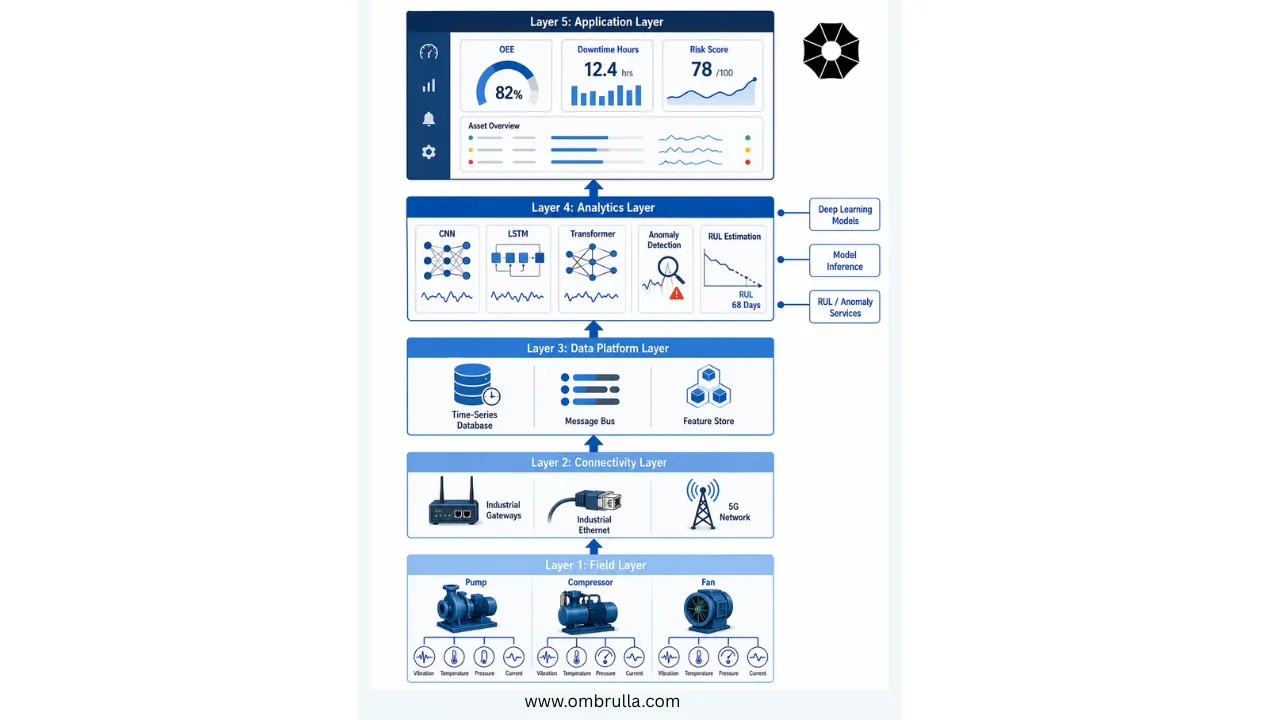
Table 1 summarizes the principal sensor modalities used across rotating equipment, compressors, and pumps, together with typical sampling rates and the failure modes they are most informative for.
| Sensor Modality | Typical Sampling Rate | Primary Asset Types | Failure Modes Detected |
|---|---|---|---|
| Tri-axial accelerometer (vibration) | 1-10 kHz | Motors, pumps, compressors, turbines | Bearing defects, imbalance, misalignment, looseness |
| Temperature (RTD/thermocouple) | 0.1-1 Hz | Bearings, windings, casings | Overheating, lubrication failure, insulation degradation |
| Pressure transducer | 1-100 Hz | Pumps, compressors | Cavitation, surge, blockage, seal leakage |
| Flow meter | 1-10 Hz | Pumps, compressors, pipelines | Partial blockage, efficiency loss, process upset |
| Electrical (voltage/current/power factor) | 1-10 kHz | Motors, drives | Winding faults, rotor bar defects, load imbalance |
| Acoustic / ultrasonic | 20-100 kHz | Bearings, valves, compressors | Early-stage bearing wear, leak detection |
Deep Learning Foundations for Time-Series Predictive Maintenance
Why Deep Learning?
Deep learning replaces hand-engineered features with representations learned directly from data, which can capture subtle failure precursors and cross-sensor dependencies that are difficult to specify manually. Reviews focused on rotating-machinery fault diagnosis report that CNN- and LSTM-based models outperform traditional feature-engineering pipelines across diverse datasets and fault types, particularly as the number of sensor channels and fault classes grows.
For industrial predictive maintenance, three task families dominate the literature:
- -Fault classification and diagnosis, for example identifying bearing inner- or outer-race faults, shaft misalignment, or rotor imbalance.
- -Anomaly detection, typically unsupervised or semi-supervised detection of previously unseen operating behavior.
- -Remaining Useful Life (RUL) prediction for components such as bearings, seals, or compressor wheels.
Deep models for these tasks may be trained on labeled fault data, on simulated degradation trajectories, or on partially labeled field data using supervised, self-supervised, or semi-supervised learning paradigms, depending on data availability.
Model Families Considered in This Survey
This survey focuses on three architecture families that dominate current AI predictive maintenance research and deployment:
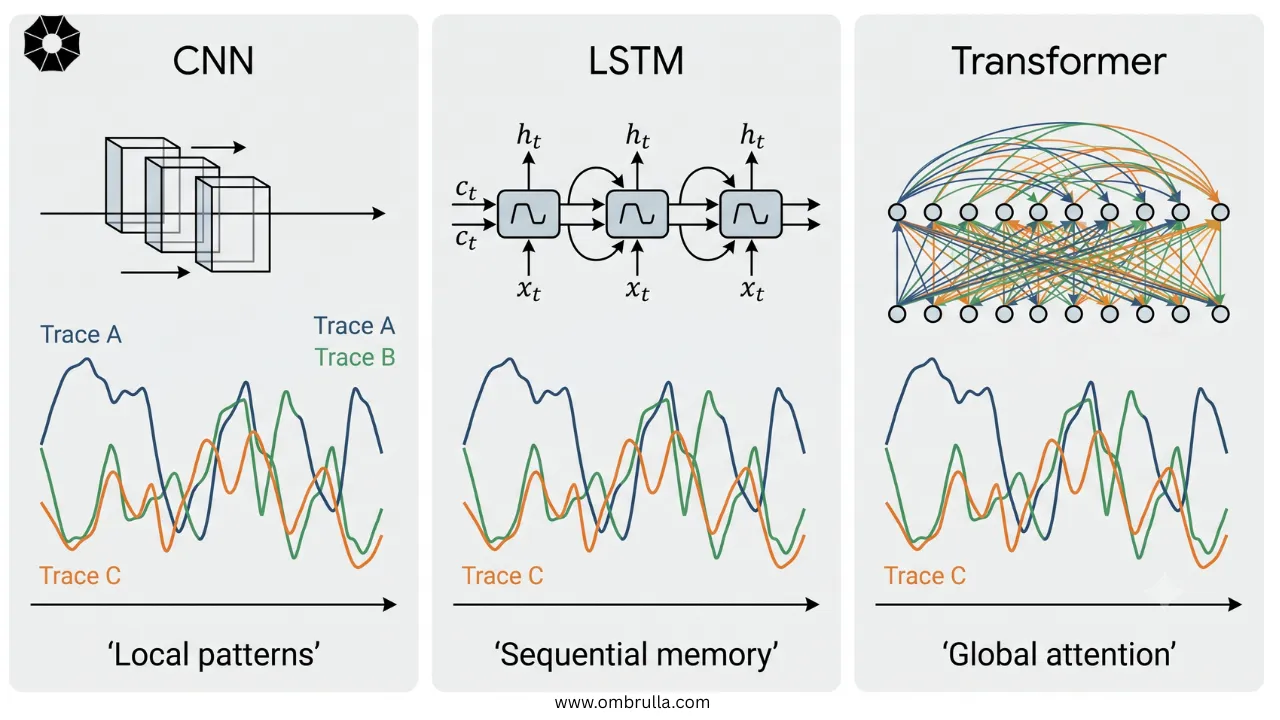
- -Convolutional Neural Networks (1D/2D): exploit local receptive fields and weight sharing, and are effective for fixed-window classification on raw or transformed signals.
- -LSTM and recurrent variants: gated recurrent architectures designed to capture temporal dependencies and sequence dynamics over extended horizons.
- -Transformers: self-attention architectures that capture long-range, cross-channel interactions and support parallelizable training.
Convolutional Neural Networks for Sensor Time Series
One-Dimensional CNNs on Raw Signals
CNNs can be applied directly to one-dimensional time-series windows, for example one to two seconds of vibration data. Convolutional filters learn local patterns, such as characteristic frequency bands or impact signatures associated with bearing defects or cavitation in pumps. Studies on deep-learning-based predictive maintenance of rotational machinery report that 1D CNNs can achieve high classification accuracy using raw or only minimally pre-processed signals, reducing the dependence on hand-crafted feature extraction.
Three design choices are central to 1D CNN performance in this setting:
- -Input window length and stride: must provide sufficient context to capture defect signatures while remaining compatible with latency constraints.
- -Number of filters and depth: trades off representational expressiveness against inference cost, which is especially relevant for edge deployment.
- -Multi-channel input handling: multivariate signals, such as tri-axial vibration or multiple sensor locations, can be stacked as input channels analogous to color channels in image CNNs.
CNNs on Time-Frequency Representations
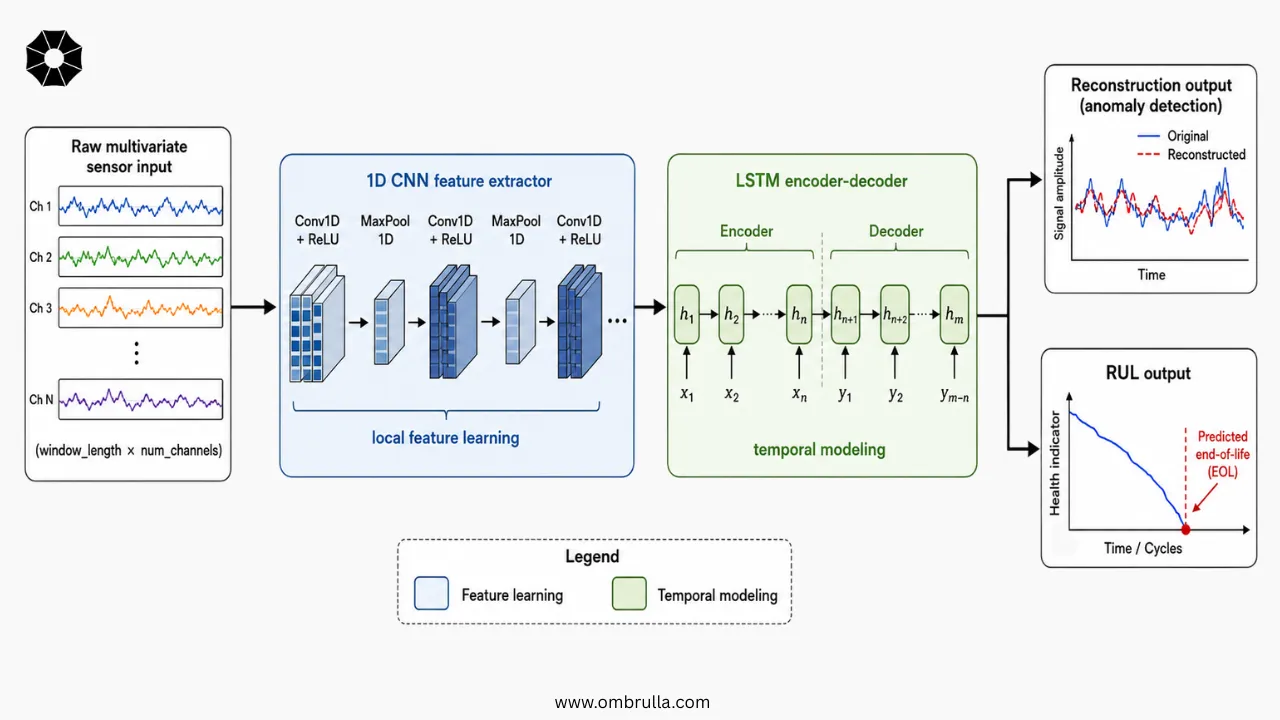
An alternative formulation converts the time series into a two-dimensional time-frequency representation, such as an STFT spectrogram or wavelet scalogram, and applies a 2D CNN. Hybrid CNN-LSTM-autoencoder architectures using STFT inputs have demonstrated strong performance for rotor defect detection and for vibration-based anomaly detection more broadly.
This approach offers two principal advantages: visual patterns such as spectral ridges and localized hotspots in the spectrogram may be easier for a CNN to learn than equivalent patterns in the raw time domain, and off-the-shelf image architectures such as ResNet or EfficientNet can be repurposed with minimal modification. The corresponding trade-offs are the additional pre-processing overhead of computing the STFT and a potential loss of fine-grained temporal resolution introduced by windowing.
LSTM and Recurrent Architectures
LSTMs for Degradation Modeling and RUL Estimation
LSTM networks extend standard recurrent neural networks with gating mechanisms that mitigate the vanishing-gradient problem, making them well suited to modeling long-term dependencies in equipment degradation. In predictive maintenance of rotating machinery, LSTM autoencoders and sequence-to-one regressors have been applied to two related tasks: modeling normal operating behavior and flagging anomalies when reconstruction error spikes, and predicting the RUL of a component from a sequence of historical sensor readings, in some cases combined with Bayesian inference to obtain calibrated uncertainty estimates.
The NASA C-MAPSS turbofan degradation dataset is a widely used benchmark for RUL estimation; LSTM- and, more recently, Transformer-based models trained on this dataset are frequently used as reference implementations when developing new AI predictive maintenance methods.
Hybrid CNN-LSTM Architectures
Hybrid architectures stack a CNN feature extractor, operating on either raw or frequency-domain inputs, ahead of an LSTM sequence model, thereby capturing both local signal patterns and longer-term temporal dynamics within a single pipeline. CNN-LSTM-autoencoder architectures of this type have been deployed for vibration-based anomaly detection in manufacturing equipment, achieving robust performance across multiple fault types and operating regimes.
Transformer Architectures for Industrial Time Series
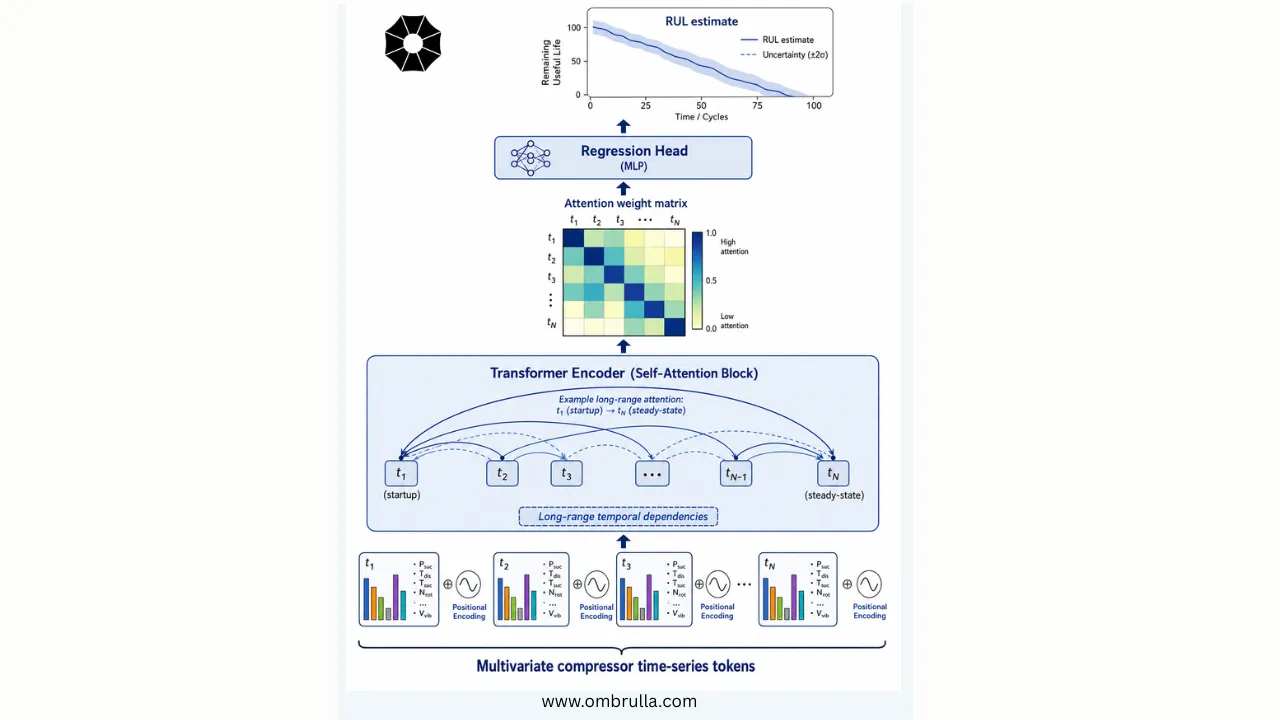
Transformers, originally developed for natural language processing, are increasingly applied to industrial time series. Self-attention allows the model to learn which time steps and which sensor channels are most relevant to predicting a fault or estimating RUL, without imposing the sequential inductive bias inherent to recurrent architectures.
Transformers for RUL and Fault Prediction
Several lines of recent work illustrate this trend. Triple-phase boost Transformer models have been proposed for multivariate time-series classification and unsupervised anomaly detection in industrial equipment, demonstrating strong performance on benchmark datasets. Transformer-based RUL frameworks pre-train an encoder via masked reconstruction or contrastive objectives on machine sensor data, and subsequently fine-tune the model for RUL prediction on a smaller labeled dataset. Transformer-driven deep reinforcement learning frameworks couple a Transformer that predicts RUL with a reinforcement-learning agent that optimizes the resulting maintenance policy.
These studies generally report improved accuracy and robustness relative to LSTM baselines in long-sequence settings, at the cost of higher computational and memory requirements during both training and inference.
Advantages and Challenges
Transformer architectures offer several advantages for AI predictive maintenance applications. Their global receptive field captures long-term degradation trends and seasonal effects that may be difficult for recurrent models to retain. Multi-head attention can model cross-sensor relationships, for example the interaction between vibration amplitude and process pressure during a transient event. Pre-training on large unlabeled IIoT datasets can yield representations that transfer effectively to downstream PdM tasks with limited labeled data.
These advantages are accompanied by three notable challenges. Computational complexity scales quadratically with sequence length in the standard self-attention formulation, although sparse and hierarchical attention variants mitigate this constraint. Transformers are comparatively data-hungry, and small labeled PdM datasets may not fully exploit the capacity of a large model. Finally, while attention maps provide a partial window into model behavior, engineers responsible for safety-critical decisions may still prefer the relative simplicity of CNN or LSTM models for certain applications.
Comparative Analysis of CNN, LSTM, and Transformer Models
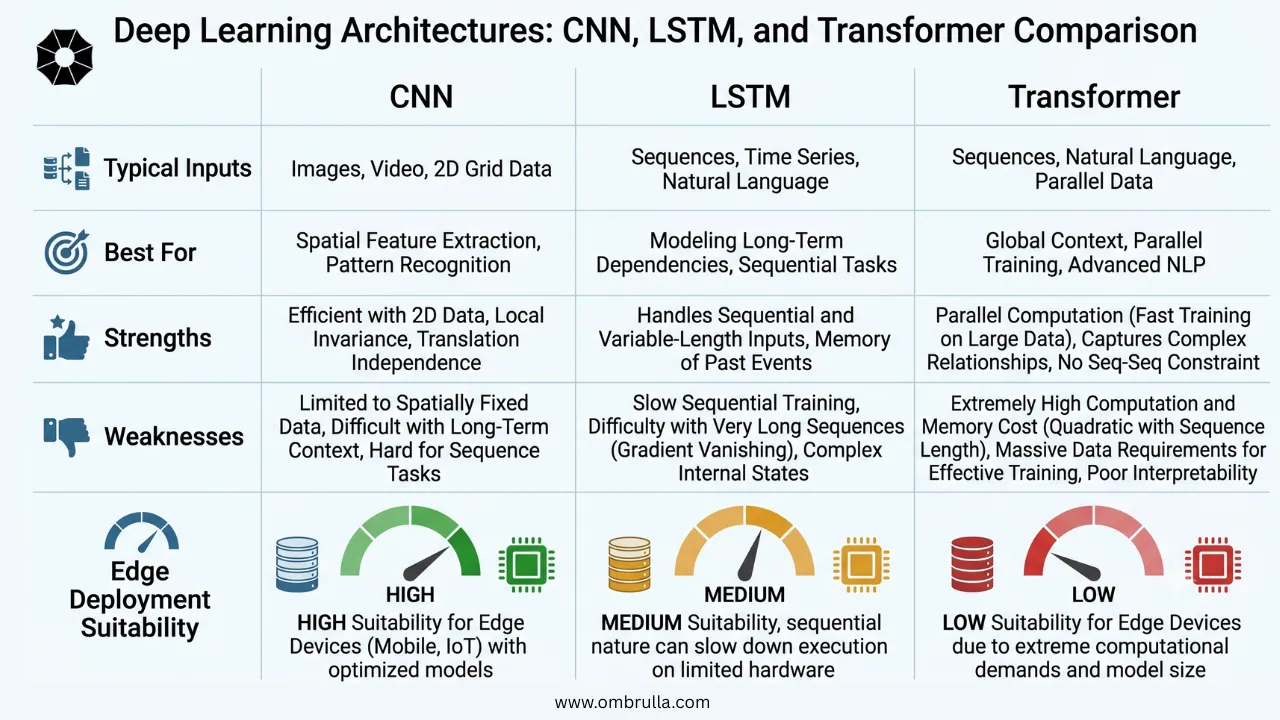
Having introduced each architecture family individually, we now compare them along the dimensions most relevant to practical IoT predictive maintenance deployment: the scope of temporal modeling, inference latency, data requirements, interpretability, and deployment footprint.
- -Local versus global modeling: CNNs excel at capturing local patterns within a fixed window; LSTMs and Transformers capture longer-range dependencies, with Transformers offering the most direct mechanism for long-horizon, cross-channel interactions.
- -Inference latency: CNNs are typically the fastest of the three families at inference time; LSTMs are slower due to their sequential computation; Transformer latency varies considerably and can be reduced through efficient or sparse attention mechanisms.
- -Data requirements: Transformers generally require larger training datasets to realize their full benefit; CNNs and LSTMs can perform acceptably with smaller labeled datasets, particularly when augmented with simulated fault data.
- -Interpretability: CNN filters can sometimes be associated with specific frequency ranges; LSTM hidden states are largely opaque, although time-aligned saliency methods provide partial insight; Transformers offer attention maps as a form of partial explanation.
- -Deployment footprint: compressed CNNs and small LSTMs are comparatively easy to deploy on edge devices and embedded predictive maintenance solutions, whereas Transformers are more commonly deployed server-side or on GPU-accelerated infrastructure.
Operationalizing Deep Learning in Predictive Maintenance Platforms
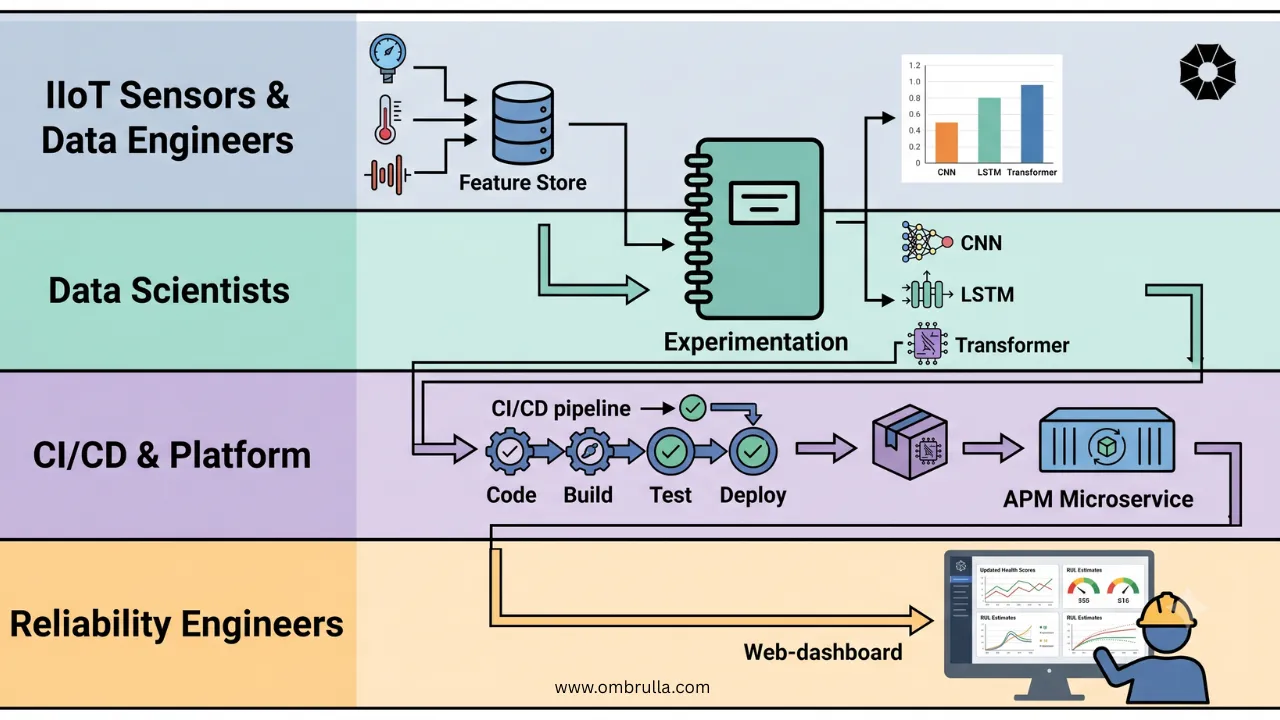
Deep learning models deliver organizational value only when integrated into predictive maintenance software, APM platforms, and existing maintenance workflows. This section discusses how model families described in Sections 5 to 7 are embedded within such platforms, and outlines the engineering pipeline required to take a model from prototype to production.
APM and PdM Platforms
Major asset performance management vendors and cloud IoT platforms incorporate AI predictive maintenance models, including deep learning components, into their commercial offerings. These platforms typically provide a common set of capabilities: data ingestion and historian integration; model management and scoring services; dashboards presenting health indices, risk scores, and recommended actions; and integration with CMMS systems for automated work-order generation. Within this context, CNN, LSTM, and Transformer models function as pluggable analytics components inside predictive maintenance solutions, feeding real-time asset health information into industrial predictive maintenance dashboards used by reliability engineers and plant operators.
Architecting an End-to-End AI PdM Pipeline
An end-to-end AI predictive maintenance pipeline typically comprises five stages:
- -Data engineering: streaming and batch ingestion from sensors, historians, and event logs; data-quality checks; time alignment and resampling across heterogeneous sources.
- -Feature and label pipeline: windowing, normalization, and optional STFT or wavelet transforms; label generation from failure logs, alarm records, or derived RUL targets.
- -Model training and selection: controlled experiments comparing CNN, LSTM, and Transformer baselines; hyperparameter tuning and cross-validation, typically using a leave-one-machine-out protocol.
- -Model deployment: containerized microservice or edge deployment; ongoing monitoring of model drift, predictive performance, and resource consumption.
- -Decision integration: thresholding, risk scoring, and recommended maintenance actions surfaced through predictive maintenance software to maintenance planners.
Application Templates: Rotating Equipment, Compressors, and Pumps
This section translates the architectural discussion in Sections 5 to 8 into concrete application templates for three asset classes that dominate industrial predictive maintenance practice. Table 3 summarizes these templates; the surrounding text provides supporting context for each.
Rotating Equipment: Motors, Turbines, and Fans
Rotating equipment is the classic domain for industrial predictive maintenance. Vibration-based condition monitoring, augmented with deep learning, has achieved high fault-detection accuracy and earlier anomaly detection relative to threshold-based alarms. A representative template uses tri-axial vibration, bearing temperature, and power-consumption data as inputs; a CNN or CNN-LSTM model for fault classification covering bearing defects and imbalance; and an LSTM or Transformer model for RUL prediction based on run-time history. Outputs typically include fault-type probabilities, RUL distributions, and recommended inspection or repair dates.
Compressors
Compressors are critical assets in oil and gas, petrochemical, and refrigeration applications, where failure can be both catastrophic and expensive. The predictive maintenance literature emphasizes combining pressure, temperature, vibration, and flow signals to detect surge conditions, fouling, and mechanical faults. A representative template uses suction and discharge pressure, temperature, flow, vibration, and motor current as inputs; an LSTM or Transformer model for anomaly detection relative to the compressor's normal operating map; and a CNN applied to time-frequency vibration data for specific mechanical fault types. Outputs include anomaly scores, efficiency-loss or surge-risk warnings, and RUL estimates for bearings and seals.
Pumps
Pumps are ubiquitous across nearly all process industries, with cavitation, seal failure, and bearing wear among the most common failure modes. A representative template uses vibration, suction and discharge pressure, motor current, flow, and temperature as inputs; a 1D CNN to distinguish cavitation, normal operation, and misalignment; and an LSTM or Transformer to detect flow or pressure anomalies indicative of upstream process issues. Outputs typically include root-cause hints, such as suspected cavitation or likely partial blockage, accompanied by severity scores.
In all three templates, the underlying models are embedded within predictive maintenance solutions or APM platforms, enabling asset performance management strategies that explicitly balance risk, cost, and production constraints.
Table 3 below consolidates the three application templates for direct comparison.
| Asset Class | Input Signals | Model Configuration | Representative Outputs |
|---|---|---|---|
| Rotating equipment (motors, turbines, fans) | Tri-axial vibration, bearing temperature, power consumption | CNN or CNN-LSTM for fault classification; LSTM/Transformer for RUL | Fault-type probabilities, RUL distribution, recommended inspection date |
| Compressors | Suction/discharge pressure, temperature, flow, vibration, motor current | LSTM/Transformer for anomaly detection vs. operating map; CNN on time-frequency vibration data | Anomaly score, surge/efficiency-loss warning, bearing/seal RUL estimate |
| Pumps | Vibration, suction/discharge pressure, motor current, flow, temperature | 1D CNN for cavitation/normal/misalignment classification; LSTM/Transformer for flow-pressure anomalies | Root-cause hint (e.g., cavitation suspected), severity score |
Evaluation Methodology
Technical Metrics
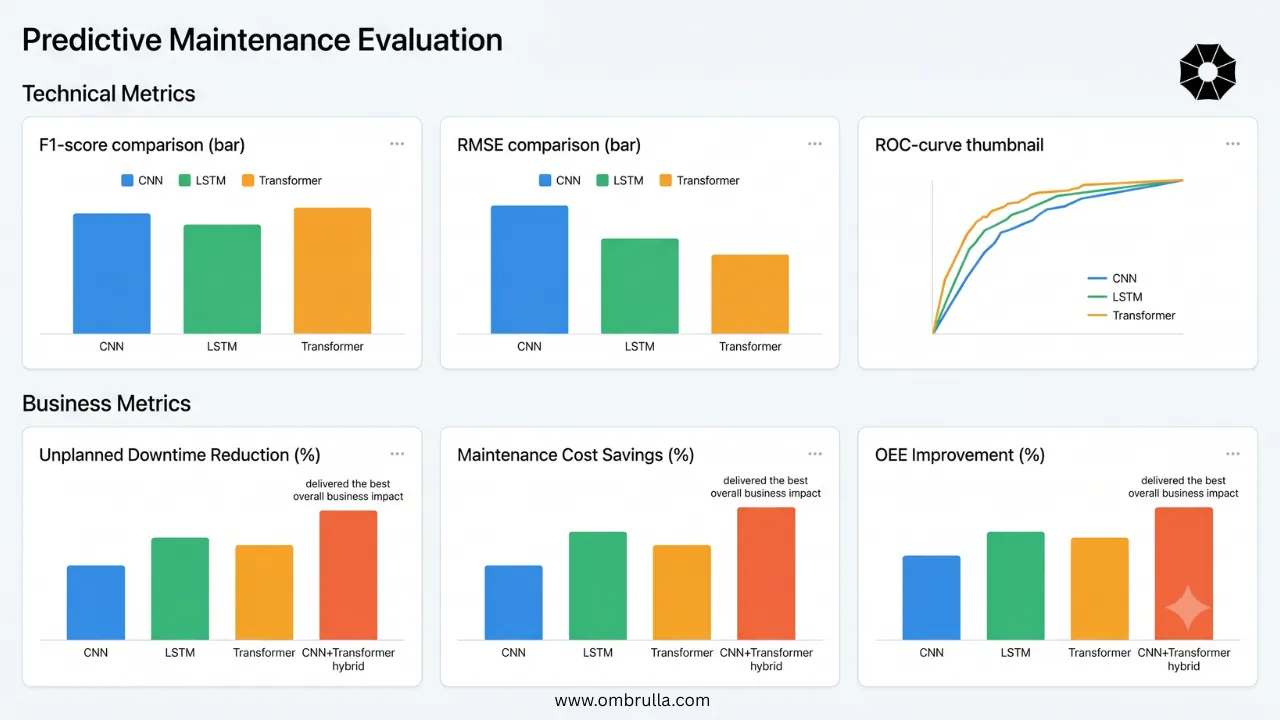
Evaluating deep learning models for AI predictive maintenance requires task-appropriate metrics. For classification tasks, standard metrics include accuracy, precision, recall, F1-score, the confusion matrix, and per-class ROC-AUC. For RUL regression, root-mean-square error (RMSE) and mean absolute error (MAE) are standard, often supplemented with asymmetric scoring functions that penalize late predictions more heavily than early ones, reflecting the higher operational cost of a missed failure relative to an overly conservative estimate. For anomaly detection, ROC-AUC, PR-AUC, and time-to-detect metrics computed on simulated or historical fault events are most informative. Cross-validation across multiple machines and operating conditions, for example using a leave-one-machine-out protocol, is critical for assessing generalization beyond the specific units used during training.
Operational and Business Metrics
Because predictive maintenance initiatives must demonstrate value beyond offline model scores, operational key performance indicators (KPIs) are equally important. These include reduction in unplanned downtime, maintenance cost savings relative to preventive or reactive baselines, improvement in safety and environmental incident rates, and impact on OEE and production throughput. Analyses of the APM software market consistently emphasize that predictive maintenance software and APM platforms are adopted and retained when they demonstrably improve reliability, availability, and performance, rather than purely on the basis of offline model accuracy.
Practical Challenges and Best Practices
Deployment of deep learning models for industrial predictive maintenance raises several recurring challenges beyond model architecture choice.
- -Data labeling and class imbalance: failure events are rare relative to normal operation. Common mitigation strategies include framing the problem as anomaly detection, applying data augmentation to simulate rare fault conditions, and using cost-sensitive loss functions that weight rare failure classes more heavily.
- -Domain shift: models trained on one plant or equipment type often fail to generalize to others due to differing operating regimes or sensor configurations. Transfer learning, domain adaptation techniques, and per-site fine-tuning are common remedies.
- -Concept drift: as assets age or operating conditions change over time, the underlying data distribution shifts. Continuous monitoring, periodic retraining, and systematic tracking of model performance in production are necessary to maintain accuracy.
- -Interpretability and trust: maintenance engineers may be reluctant to act on the output of an opaque model. Attention visualizations, saliency maps, and rule-based summaries can help build the trust required for operational adoption.
Based on these recurring challenges, four best practices are recommended for practitioners:
- -Start with well-bounded use cases and high-quality sensor instrumentation rather than attempting plant-wide deployment immediately.
- -Benchmark baseline CNN and LSTM models before adopting more complex Transformer architectures.
- -Align model outputs explicitly with existing maintenance workflows and human decision-making processes.
- -Wrap models inside robust predictive maintenance software with clear user interfaces and well-designed alerting logic.
Open Research Directions
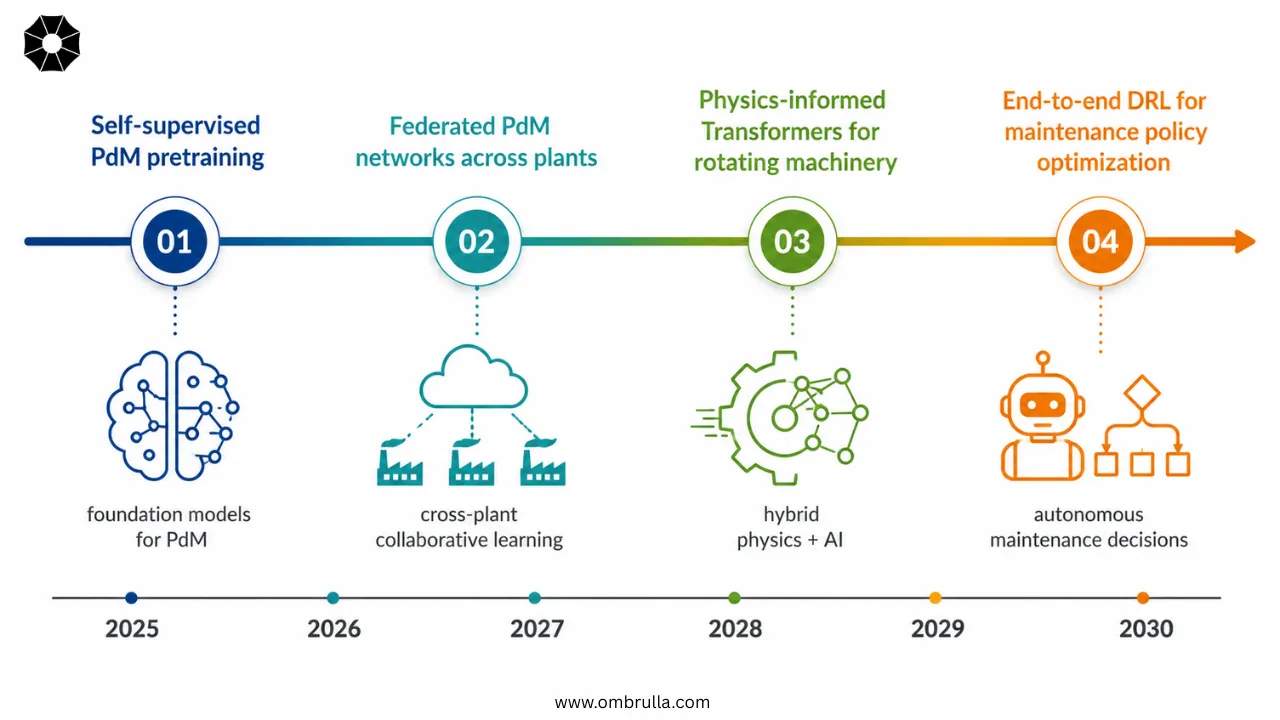
Several research directions appear particularly promising for advancing AI predictive maintenance over the coming years:
- -Self-supervised and contrastive learning on large unlabeled industrial time-series corpora, reducing reliance on scarce labeled fault data.
- -Federated and privacy-preserving learning across multiple plants or organizations, enabling collaborative model development without sharing raw sensor data.
- -Physics-informed and hybrid models that combine deep learning with first-principles models of rotating machinery and fluid dynamics.
- -Decision-aware modeling, integrating RUL predictions with reinforcement learning for optimal maintenance scheduling, and incorporating cost models directly into training objectives.
Conclusion
Deep learning, through CNN, LSTM, and Transformer architectures, is reshaping predictive maintenance in Industrial IoT systems. For rotating equipment, compressors, and pumps, these models deliver improved fault detection, anomaly detection, and RUL prediction relative to traditional approaches, enabling more effective AI predictive maintenance strategies. Reviews and case studies in rotating machinery consistently report gains in accuracy and earlier detection of subtle degradation signatures when deep learning methods are adopted.
Model choice, however, is not one-size-fits-all. CNNs typically offer the best trade-off between predictive performance and inference latency in edge deployment scenarios; LSTMs are well suited to applications requiring explicit sequence modeling; and Transformers extend the state of the art in complex, long-horizon tasks but require greater data volume and computational resources. The most effective predictive maintenance solutions combine these architectures with strong data engineering, disciplined MLOps practice, and integration into the predictive maintenance software and APM platforms that maintenance teams already use.
For practitioners, a pragmatic adoption strategy is to begin with clearly scoped use cases in rotating equipment, compressors, or pumps; build baseline models using 1D CNNs and LSTMs on representative sensor data; experiment with Transformer architectures once data scale and task complexity warrant the additional investment; and integrate the selected models into IoT predictive maintenance and asset performance management workflows, with careful evaluation against both technical and business KPIs. Executed well, deep learning in industrial predictive maintenance turns raw sensor streams into actionable foresight, allowing organizations to reduce downtime, extend asset life, improve safety, and realize new value from their IIoT investments.
References
1. Li, X., Zhang, W., and Ma, H. "A review of the application of deep learning in intelligent fault diagnosis of rotating machinery." Measurement, 2023. https://link.springer.com/article/10.1007/s10462-022-10293-3
2. Alexakis, C., et al. "Predictive Maintenance of Machinery with Rotating Parts Using Convolutional Neural Networks." Electronics, 13(2):460, 2024. https://www.mdpi.com/2079-9292/13/2/460
3. Ali, M. I., Lai, N. S., and Abdulla, R. "Predictive Maintenance of Rotational Machinery Using Deep Learning." International Journal of Electrical and Computer Engineering, 14(1), 2024.
4. "CNN-LSTM-AE Based Predictive Maintenance Using STFT for Rotating Machinery." Journal of Manufacturing Systems, 2023.
5. "A Predictive Maintenance Model Using Long Short-Term Memory Neural Networks and Bayesian Inference." Engineering Applications of Artificial Intelligence, 2023.
6. "Deep Learning for Predictive Maintenance in Rotating Machinery." Journal of Fluid Machinery and Mechanical Design, 2023.
7. "Artificial Intelligence in Predictive Maintenance of Rotating Machinery: A Review." Saudi Journal of Engineering and Technology, 2023.
8. "A Triple-Phase Boost Transformer Model (THOR) for Time-Series Multi-Label Fault Prediction." Neurocomputing, 2024.
9. Heinrich, F. "Pretraining Transformers for Predictive Maintenance in Manufacturing." M.Sc. Thesis, FAU Pattern Recognition Lab, 2024.
10. "Multivariate Time Series Generation Based on Dual-Channel Transformer for RUL Prediction." Knowledge-Based Systems, 2024.
11. Zhang, Y., et al. "TranDRL: A Transformer-Driven Deep Reinforcement Learning Enabled Framework for Predictive Maintenance." arXiv:2309.16935, 2023. https://arxiv.org/abs/2309.16935
12. Pasupuleti, S. "Scalable Predictive Maintenance System for Industrial Equipment Using Transformer-Based Time Series Modeling." GitHub project, 2024. https://github.com
13. Vicencio, A., et al. "Systematic Review of Predictive Maintenance Practices in the Manufacturing Industry." Journal of Industrial Information Integration, 2025.
14. GAO Tek. "Industrial Equipment Monitoring – Predictive Maintenance IoT." Technical overview, 2024.
15. Intuz. "IoT in Predictive Maintenance: A Complete Overview." Whitepaper, 2025.
16. WIKA. "Predictive Maintenance of Rotating Machinery in Industrial IoT." Product brochure, 2024.
17. Cutsforth. "Implementing Predictive and Prescriptive Digital Maintenance Technologies for Rotating Equipment." Technical paper, 2025.
18. Anvil. "AI in Predictive Maintenance for Rotating Machinery." 2025.
19. International Journal of Research and Analytical Reviews. "IoT-Based Predictive Maintenance System for Industrial Machinery." 2025.
20. Gartner. "Asset Performance Management Software Market Definition and Reviews." Gartner Peer Insights, 2025.
21. GE Vernova. "Asset Performance Management (APM) Software." Product documentation, 2025. https://www.gevernova.com/software/products/asset-performance-management/meridium
22. Prometheus Group. "RapidAPM – AI/ML Asset Performance Management Platform." Data sheet, 2025. https://www.prometheusgroup.com/solutions/asset-performance-management-software
23. Manufacturing Digital. "Top 10 Predictive Maintenance Platforms." 2024.
24. SoftwareConnect. "Top 7 Predictive Maintenance Software (2025 Reviews)." 2025.
25. Coast App. "7 Best Predictive Maintenance Software for 2025." 2025.
26. Ombrulla. "AI Predictive Maintenance for Transformers." Solution page, 2025. https://ombrulla.com