Work Place Safety, Supercharged by RTLS
Real Time Employee Tracking and employee monitoring that protects people, proves compliance, and improves productivity—powered by PETRAN.

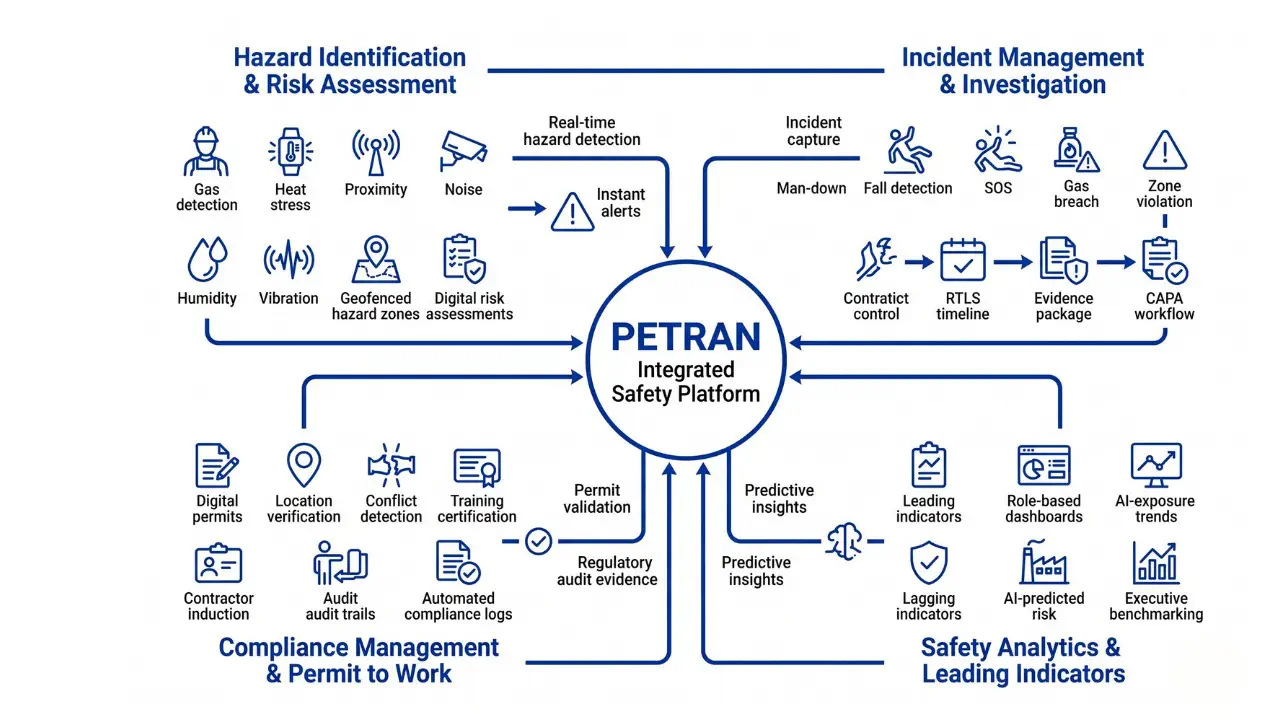
High‑risk operations demand more than clipboards. Ombrulla's PETRAN Platform unifies RTLS, sensors, and workflows into one safety layer. Our worker monitoring software converts location, motion, and gas data into timely alerts and audit‑ready evidence—reducing incidents, downtime, and liability while elevating safety culture.
Real time employee tracking, near‑miss capture, and faster response shrink medical, insurance, and downtime spend.
Location‑verified permits, automated logs, and digital trails simplify internal/external audits.
Live command‑center views and RTLS‑based muster keep operations resilient during emergencies.
Role‑based dashboards surface leading indicators so leaders can target corrective actions that move TRIR and productivity.
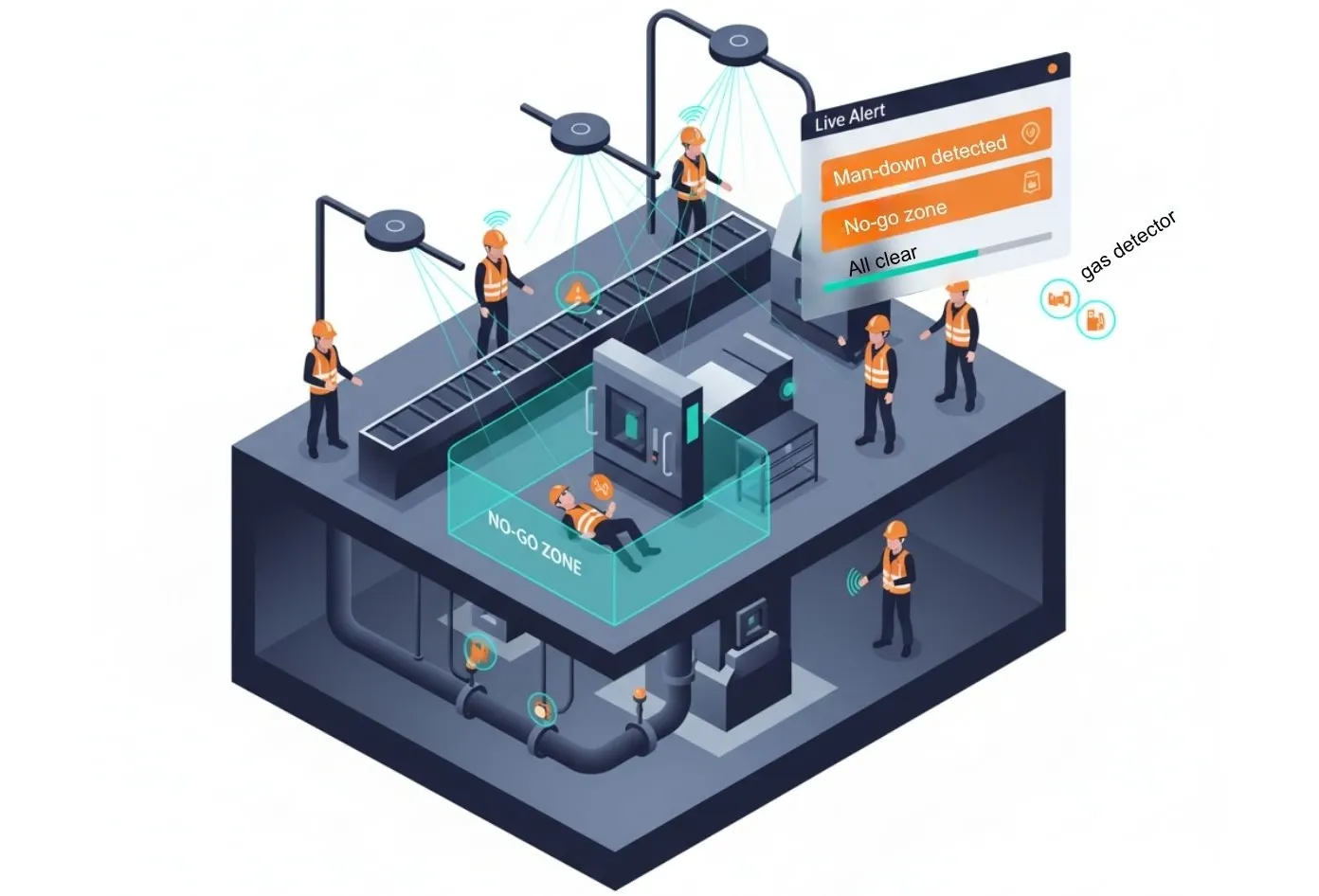
A single, integrated safety layer that continuously monitors people, places, and permits—delivering fast, coordinated responses to keep every shift incident-free.

IoT personal and area detectors track gas leaks, environmental hazards, body temperature, and other hazardous materials in real time. When thresholds are exceeded, the system triggers instant alarms, musters, and automatic permit lockouts to prevent exposure and reduce accidents.

No-Movement, Fall Detection, and SOS are natively supported through PETRAN's device-agnostic layer, enabling rapid rollout across multiple brands and models—without vendor lock-in. This ensures consistent event handling, faster response times, and simpler fleet management.
UWB indoors, GPS outdoors; motion/no‑motion monitoring

WBGT proxies and activity-adjusted monitoring

O₂, H₂S, CO, LEL, VOCs; TWA/STEL compliance

IMU‑based detection with automatic alerts

Vehicles, energized zones, restricted areas

Temperature, humidity, noise, light, vibration

Battery charge, heartbeat monitoring, sensor faults
Delivers continuous room-to-yard positioning by blending UWB precision indoors with GPS/RTK outside and BLE assist for seamless handoffs across facilities.
Onboards mixed fleets of wearables, tags, and industrial sensors in minutes via a single pipeline that normalizes payloads, metadata, and health across protocols.
Tracks heart rate, temperature, and fatigue proxies alongside portable/fixed gas readings to detect health risks and leaks in real time and trigger immediate alerts.
Runs sub-second models at the edge for no-motion, fall, and proximity-risk detection to cut latency, preserve bandwidth, and act before incidents escalate.
Orchestrates geo-fences, lone-worker windows, time-in-zone, and digital permit-to-work with tiered escalation trees for instant, policy-driven responses.
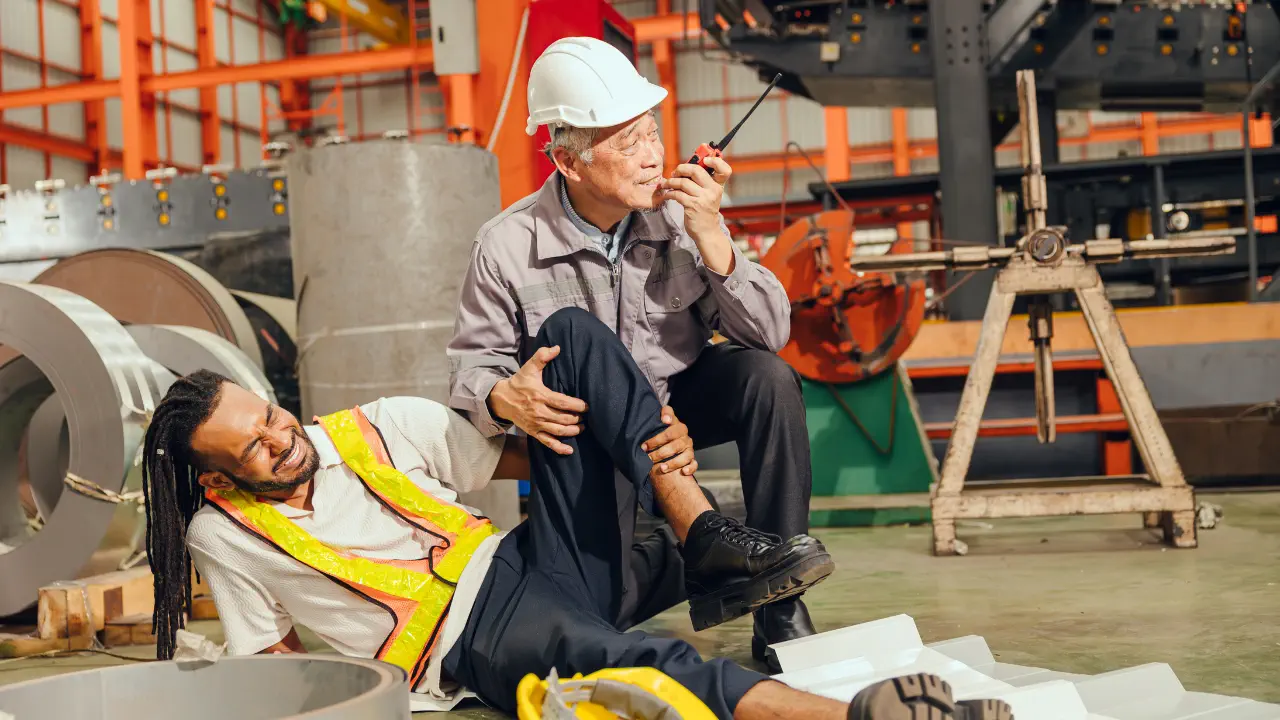
Enables one-tap distress signals, verified acknowledgements, and guided response playbooks so supervisors can confirm, coordinate, and close the loop fast.
Centralizes live muster/evacuation views, device health, and alert streams with timeline replay and sensor-video correlation to speed root-cause and CAPA.
Plugs into CMMS/EAM, HRIS, LMS, ERP, and messaging (email/SMS/Teams/Slack) so events, work orders, and training/compliance data flow automatically across systems.
PETRAN abstracts devices and protocols so you can combine best‑of‑breed wearables, tags, gateways, and fixed sensors without lock‑in.
Passive/active RFID for access control, tool/asset tracking, and permit validation at gates and zones.
10–30 cm accuracy for man‑down locating, muster, and equipment/worker separation.
Wearables, beacons, and gas detectors streaming vitals, motion, and proximity with long battery life.
Rugged wearables and area sensors with multi‑kilometer range for remote sites.
Integrated IMUs, thermal sensors, and BLE/UWB tags for fall, fatigue, and heat‑stress insights.
On‑prem vision analytics for PPE compliance, restricted zone breaches, and vehicle‑pedestrian proximity.
Always‑connected SOS and breadcrumb trails for crews beyond cellular coverage.
Identify tasks, zones, hazards, and workflows.
Select RTLS mix, network, and rules; align with PTW.
Deploy to a representative area; capture leading indicators.
Connect HRIS/LMS/CMMS; define identities and roles.
Roll to sites with templates and QA.
Role‑based training and quick‑reference guides.
Weekly reviews on alerts, nuisance reduction, and ROI.
Evidence packs, compliance dashboards, and continuous improvement.

UWB/BLE/GPS/LoRaWAN with seamless indoor/outdoor handoff.

Mesh, LTE‑M/5G, satellite fallbacks for remote work.

At the edge for sub‑second alerts.

And supervisor escalation.

Binding permits, check‑ins, and procedures to location.

Time‑in‑zone, lone‑worker windows, lockouts.

RBAC, anonymization options, encryption at rest/in transit.

Operation to survive outages without data loss.
Workplace Safety software is a digital platform that uses tools like Real Time Employee Tracking and RTLS to help you identify hazards, record incidents, and track corrective actions in one place. By standardizing inspections and giving managers live visibility into people and plant conditions, it reduces near misses and recordable incidents across the shop floor and field operations.
Workplace Safety management software centralizes all safety documentation—risk assessments, SOPs, training records, and incident logs—so audits are faster and cleaner. Combined with Employee Monitoring data and RTLS-based location insights (who was where and when), it supports investigations and demonstrates that safe work practices and compliance checks actually happened in real time.
Paper and Excel don't scale when you have multiple plants, shifts, and contractors. Modern Workplace Safety platforms with worker monitoring software and Real Time Employee Tracking ensure consistent inspections, prevent data loss, and generate live dashboards. You can instantly see unsafe acts, unsafe conditions, and high-risk zones instead of waiting for someone to compile spreadsheets.
Yes. With configurable inspections, real-time incident reporting, and RTLS-driven visibility into where employees and contractors are working, safety teams can intervene earlier. Employee Monitoring and tracking of worker movement patterns highlight overcrowded or high-risk areas, helping reduce LTIs and near misses.
For multi-site operations, HSE managers need consistent data. Workplace Safety platforms with built-in Employee Monitoring and Real Time Employee Tracking offer a single source of truth across all plants. You can compare sites, benchmark performance, and monitor how workers are distributed across zones in real time to manage risk better.
SMBs can start small—with core Workplace Safety modules like incident reporting, inspections, and basic worker monitoring software features—and add advanced RTLS and analytics later. Cloud-based deployment keeps costs low and removes the need for a big IT team.
Employees can log incidents, near misses, and unsafe conditions from a mobile app with photos and videos. Real Time Employee Tracking and RTLS data automatically show who was present in the area and for how long. This speeds up root cause analysis and makes incident investigations more accurate and transparent.
Yes. Workplace Safety platforms often integrate with HR, payroll, and ERP systems, as well as existing Employee Monitoring tools. This allows automatic syncing of employee data, departments, shifts, and permissions, while RTLS/Real Time Employee Tracking adds the location dimension for deeper safety analytics.
When reporting unsafe conditions is as easy as snapping a photo on a phone—and workers can see that management uses Real Time Employee Tracking and worker monitoring software to protect them, not just "watch" them—trust grows. Quick responses, transparent follow-up, and data-backed decisions show that safety is a priority, which encourages employees to speak up.
Yes. You can store training matrices, assign mandatory courses, and track expiries. Linking this with Employee Monitoring and RTLS ensures that only trained and certified workers enter restricted zones or operate specific machines, enhancing compliance and Workplace Safety in critical areas.
Digital risk assessments (JSA, JHA, HIRA, etc.) can be linked with Real Time Employee Tracking to check if control measures are followed in the field. For example, you can verify that only authorized workers are present in high-risk zones or that people don't stay too long in hazardous areas, thanks to RTLS-based zone monitoring.
Most modern Workplace Safety platforms offer mobile apps where field teams can perform inspections, log near misses, and access procedures. Combined with RTLS and Real Time Employee Tracking, the app also gives supervisors a live map of who is onsite, who is at risk, and who might need assistance in an emergency.
Yes. Dashboards can show TRIR, LTIR, incident trends, and corrective action status, plus Employee Monitoring insights such as exposure time in hazardous zones, crowding in specific areas, and heat maps powered by RTLS data. This gives management a real-time, data-driven view of Workplace Safety performance.
Reputable Workplace Safety providers secure both safety records and Real Time Employee Tracking data with strong encryption, role-based access, and audit logs. This ensures that sensitive Employee Monitoring information is used only for legitimate safety and compliance purposes and is accessible only to authorized users.
Many organizations start with a pilot site in a few weeks—configuring checklists, onboarding users, and enabling basic worker monitoring software and RTLS zones. Once the pilot is validated, they roll out Real Time Employee Tracking and broader Workplace Safety workflows across other locations in phases.
You can digitize PPE checks, machine guarding, forklift operations, fire safety, housekeeping, electrical panels, and more. Using RTLS and Real Time Employee Tracking, supervisors can also verify that safety rounds are actually being done on time and across all required zones, not just logged after the fact.
Yes. Contractors and their workers can be onboarded with their own profiles, documents, and training records. Employee Monitoring and Real Time Employee Tracking ensure that contractors follow access rules, stay in authorized zones, and comply with your Workplace Safety standards, just like internal employees.
Workplace Safety platforms align with ISO 45001 by providing structured processes for hazard identification, risk assessment, and incident investigation. RTLS and worker monitoring software supply objective evidence of presence in zones and adherence to procedures, strengthening your documentation during certification and surveillance audits.
Yes. You can customize fields, workflows, risk matrices, notifications, and user roles, and decide how to apply Employee Monitoring and Real Time Employee Tracking in line with your safety policies and privacy guidelines. This ensures the system fits your organization's culture and regulatory environment.
ROI comes from fewer incidents, lower LTI rates, reduced regulatory penalties, and less manual admin. Adding RTLS and worker monitoring software capabilities often delivers an additional layer of value—by optimizing staffing in high-risk areas, reducing search time during emergencies, and providing precise incident evidence that shortens investigations and downtime.
Look for a Workplace Safety platform that natively supports Real Time Employee Tracking, RTLS, and Employee Monitoring aligned to your risks (heavy machinery, logistics, construction, etc.). Ask for a live pilot in one of your sites, with your zones and workflows configured, so you can see how real-time worker visibility actually improves safety and response times.
Identify your challenge, and we're here to help