
Sustainable Asset Management Using Predictive Maintenance and Lifecycle Analytics
Abstract
Industrial organizations face growing pressure to improve operational sustainability, extending asset life, reducing waste and emissions, and aligning with circular economy goals, while maintaining safety, reliability, and profitability. Traditional asset management and maintenance practices often treat sustainability as a separate reporting exercise, disconnected from day-to-day decisions about repairs, replacements, and upgrades. In contrast, modern predictive maintenance and lifecycle analytics can embed sustainability directly into asset strategy, enabling measurable progress on asset lifecycle optimization and carbon footprint reduction.
This paper proposes a conceptual and architectural framework for sustainable asset management using predictive maintenance and lifecycle analytics. We first define sustainable asset management in the context of asset performance management (APM), real-time asset monitoring, and circular economy principles. We then analyze how AI-driven predictive maintenance extends equipment lifetime, reduces material and energy waste, and supports green operations, drawing on industry research linking predictive maintenance to lower energy use, reduced waste, and extended asset lifespan.
We next present a lifecycle analytics stack that combines IoT sensor data, failure and maintenance histories, and environmental factors with digital-twin-for-sustainability models to support decisions across design, operation, and end-of-life. We show how this stack feeds sustainability dashboards and carbon footprint management tools, aligning asset-level decisions, such as repair versus replace or upgrade versus derate, with corporate net-zero and circular economy strategies. Finally, we discuss integration with circular economy practices, including repair, refurbishment, remanufacturing, and reuse, and outline open challenges in data quality, cross-facility benchmarking, embodied carbon accounting, and emerging environmental dimensions such as biodiversity monitoring around critical infrastructure. We argue that the combination of predictive maintenance, lifecycle analytics, and digital twins offers a practical path from reactive maintenance toward sustainable operations that are both economically and environmentally resilient.
Introduction
Sustainable development goals, net-zero commitments, and tightening environmental regulations are reshaping how organizations think about industrial assets. The operative question is no longer simply how to keep equipment running, but how to run assets in ways that minimize environmental impact across their entire lifecycle.
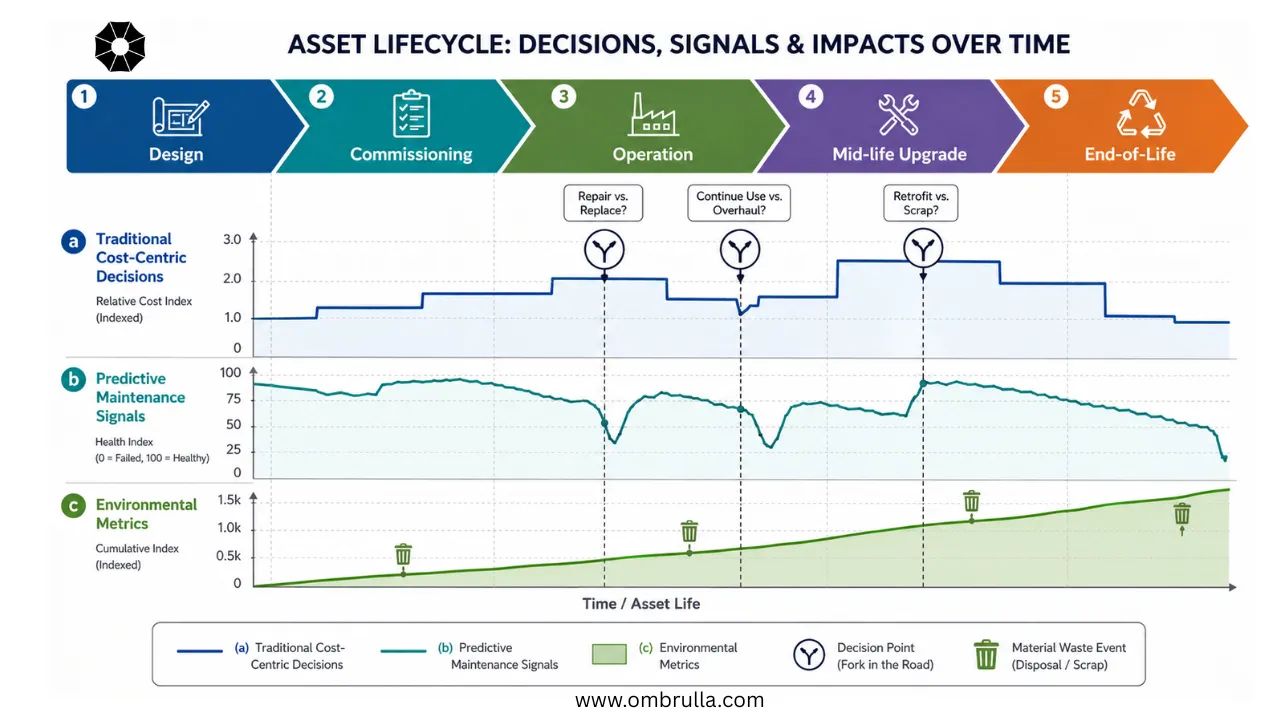
Predictive maintenance has emerged as a core capability of modern asset performance management platforms, using IoT data and analytics to anticipate failures and optimize maintenance interventions. Industry reports and applied studies indicate that predictive maintenance can reduce unplanned downtime, lower maintenance costs, and extend equipment lifespan, while also reducing energy use, material waste, and associated emissions. In parallel, asset lifecycle management and lifecycle assessment frameworks emphasize decisions spanning design through decommissioning: acquisition, operation, maintenance, mid-life upgrade, and end-of-life strategy, including reuse, remanufacturing, and recycling. When enriched with high-frequency IoT data and digital twins, lifecycle analytics can quantify not only cost and risk but also environmental impact over time.
This paper examines how predictive maintenance and lifecycle analytics can be combined into a coherent approach to sustainable asset management, with explicit ties to circular economy principles and green operations strategy. The remainder of the paper is organized as follows. Section 2 reviews related work. Section 3 establishes conceptual foundations, defining sustainable asset management and situating it relative to circular economy principles. Section 4 analyzes the specific mechanisms through which predictive maintenance enables sustainability outcomes. Section 5 presents a lifecycle analytics stack for asset lifecycle optimization. Section 6 discusses digital twins for sustainability. Section 7 connects predictive maintenance to circular economy practice. Section 8 proposes a sustainability KPI and dashboard framework. Section 9 extends the discussion to external environmental context, including biodiversity monitoring. Section 10 outlines open challenges and research directions, and Section 11 concludes.
Related Work
This paper draws on three streams of prior work: predictive maintenance and asset performance management, lifecycle assessment and circular economy research, and digital twins for decarbonization.
The predictive maintenance literature has historically emphasized reliability and cost outcomes, including reduced unplanned downtime and lower maintenance spend, with environmental impact treated as a secondary or incidental benefit rather than a primary design objective. A smaller but growing body of applied research and industry case studies has begun to quantify the environmental impact of predictive maintenance directly, reporting reductions in energy intensity and material waste associated with specific equipment classes when condition-based interventions replace reactive or purely time-based maintenance.
Separately, lifecycle assessment (LCA) methodologies and the ISO 55000 asset management standard provide structured frameworks for evaluating assets across acquisition, operation, and disposal, and circular economy research has formalized the R-strategy hierarchy, comprising reduce, repair, reuse, remanufacture, and recycle, as a basis for extending material and component value. This literature has traditionally been applied at a slower cadence, using periodic audits and static assessments, rather than being continuously informed by operational sensor data.
A third stream of work addresses digital twins, virtual representations of physical assets synchronized with operational data, and their emerging application to decarbonization and lifecycle optimization in energy, industrial, and built-environment contexts. This literature has largely developed in parallel with the predictive maintenance literature, with limited cross-pollination between twin-based optimization and circular economy decision-making specifically.
This paper differs from each of these individual streams by proposing an integrated framework in which predictive maintenance signals, lifecycle analytics, and digital twin simulation jointly inform circular economy decisions, rather than treating reliability, cost, and environmental impact as separately optimized objectives. We further propose a consolidated KPI and dashboard structure (Section 8) intended to make these trade-offs visible and actionable for both maintenance and sustainability teams.
Conceptual Foundations
Sustainable Asset Management and Operational Sustainability
Sustainable asset management is the systematic planning, acquisition, operation, maintenance, and disposal of assets to maximize value while minimizing environmental and social impact over the asset lifecycle. Within this definition, operational sustainability refers specifically to day-to-day and year-to-year decisions about how assets are operated and maintained, encompassing three goals: minimizing energy, water, and material consumption per unit of output; reducing direct (Scope 1) and indirect (Scope 2) emissions through efficiency improvements and cleaner inputs; and minimizing unplanned outages that provoke emergency repairs, expedited logistics, and scrapped product.
Asset performance management (APM) functions as the digital backbone for this vision, providing real-time health indicators, risk scores, and decision support to optimize asset performance and strategy. Major APM vendors now explicitly position their platforms as vehicles for sustainability and decarbonization across the asset lifecycle, reflecting a broader market shift from treating environmental reporting as a separate exercise toward embedding it in operational decision-making.
Lifecycle Analytics and Circular Economy Principles
Lifecycle analytics combines technical and financial perspectives, including reliability, risk, and cost, with environmental metrics such as embodied carbon, operating emissions, and end-of-life waste. Conceptually, this approach aligns with ISO 55000 asset management principles and established lifecycle assessment (LCA) methodologies, extending them with continuously updated operational data rather than periodic static assessment.
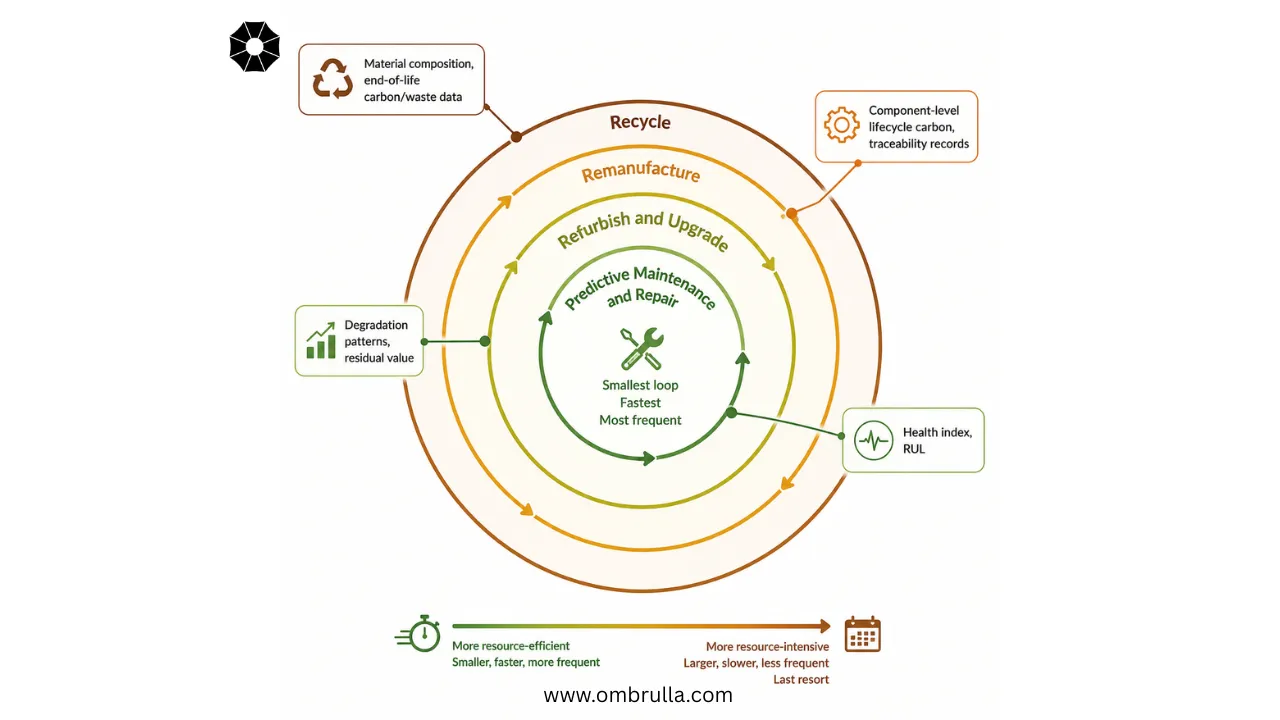
Circular economy principles applied to industrial assets emphasize the R-strategy hierarchy, comprising reduce, repair, reuse, remanufacture, and recycle; extending asset and component service life; and designing for modularity, maintainability, and recoverability. When predictive maintenance reveals remaining useful life and degradation patterns, and lifecycle analytics quantifies the associated environmental and economic trade-offs, organizations can make circular economy decisions in a more systematic, data-driven way rather than relying on fixed replacement schedules or ad hoc judgment.
Predictive Maintenance as an Enabler of Sustainability
Mechanisms for Environmental Impact Reduction
Literature on the environmental impact of predictive maintenance identifies five recurring mechanisms by which it supports sustainability outcomes. Extending asset lifespan occurs because early detection of wear and anomalies allows corrective action before damage becomes irreversible, delaying replacement and avoiding the embodied carbon associated with manufacturing a new asset. Reducing material waste occurs because avoiding catastrophic failure prevents collateral damage and scrapped materials, such as broken shafts, damaged housings, or contaminated product. Improving energy efficiency occurs because predictive maintenance can detect conditions such as misalignment, imbalance, fouling, and lubrication issues that cause elevated energy consumption; correcting these issues often yields measurable carbon footprint reduction. Optimizing maintenance logistics occurs because better planning reduces emergency trips, rush shipping, and inefficient mobilization, shrinking the footprint of the maintenance process itself. Avoiding environmentally hazardous incidents occurs because early detection of leaks, overheating, or abnormal vibration can prevent spills, fires, or toxic releases, aligning reliability improvement directly with environmental risk reduction.
Case studies from industrial suppliers and maintenance service providers report double-digit reductions in energy use for certain equipment classes following predictive maintenance adoption, alongside simultaneous increases in uptime and asset life, suggesting that reliability and sustainability outcomes are frequently complementary rather than competing.From Reliability-Only to Sustainable Maintenance Strategies
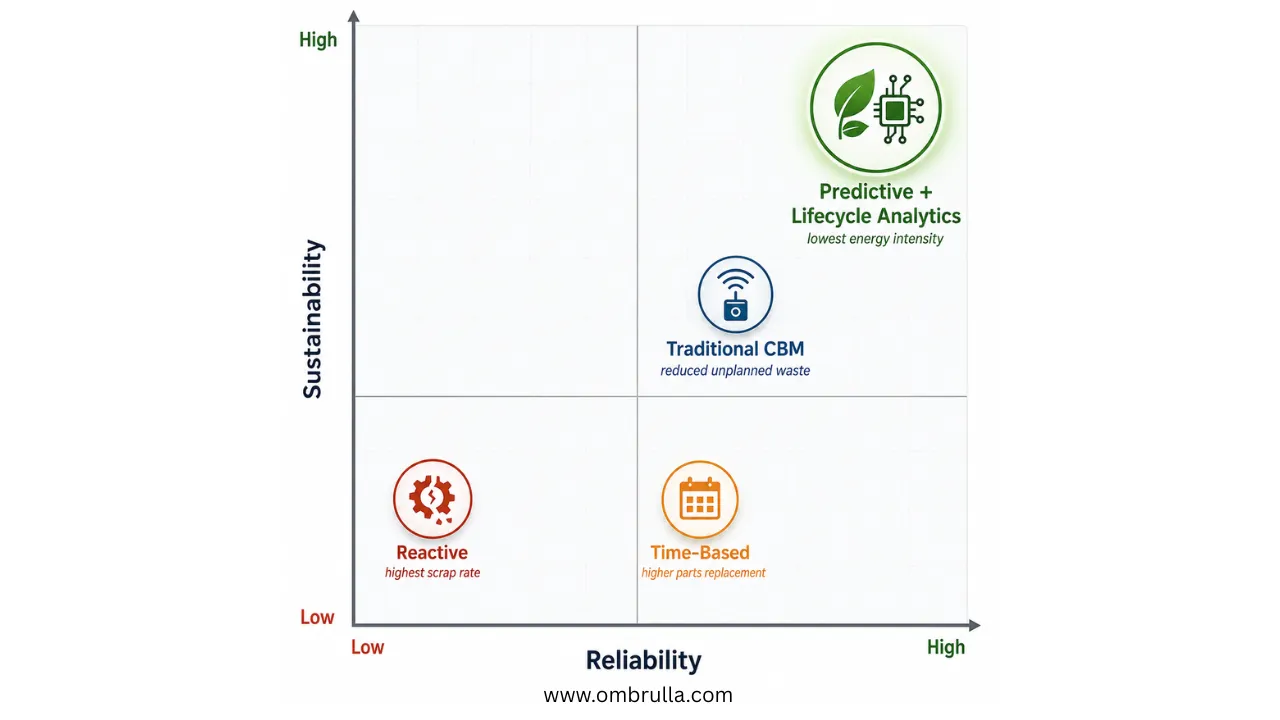
Maintenance strategies can be positioned along two axes: reliability and sustainability. Traditional reactive maintenance performs poorly on both axes, responding only after failure has already occurred. Time-based preventive maintenance improves reliability somewhat but often performs maintenance regardless of actual asset condition, wasting materials and labor on unnecessary interventions. Traditional condition-based maintenance (CBM) improves reliability further but typically optimizes for failure avoidance alone, without explicitly accounting for environmental impact. Predictive maintenance, when combined with environmental metrics, enables a fourth category, sustainable maintenance, in which interventions are timed to jointly avoid failures, minimize lifecycle cost, and minimize lifecycle environmental impact.
| Strategy | Reliability / Sustainability Profile | Typical Practice | Representative Environmental Outcome |
|---|---|---|---|
| Reactive (run-to-failure) | Low reliability / Low sustainability | Repair only after failure occurs | Highest scrap rate; emergency logistics footprint; risk of collateral damage |
| Time-based preventive | Medium reliability / Low sustainability | Fixed-interval servicing regardless of condition | Unnecessary parts replacement; moderate material waste |
| Traditional condition-based (CBM) | High reliability / Medium sustainability | Threshold-triggered maintenance from sensor data | Reduced unplanned failures; energy/efficiency impact not explicitly optimized |
| Predictive + lifecycle analytics | High reliability / High sustainability | RUL-informed, multi-objective repair/replace/retrofit decisions | Lower energy intensity, reduced scrap rate, extended asset life |
Lifecycle Analytics and Asset Lifecycle Optimization
Asset Lifecycle Management and APM
Asset lifecycle management (ALM) frameworks describe phases spanning planning and design through operation and decommissioning, with an emphasis on total cost of ownership and value realization. Modern APM platforms connect operational data with ALM processes in three ways: by providing real-time asset monitoring of condition and performance; by supporting risk-based decision-making for repair, replacement, or upgrade; and by feeding insights back into design and procurement, for example identifying which asset variants prove more reliable and efficient over their operating life.
Lifecycle Analytics Stack
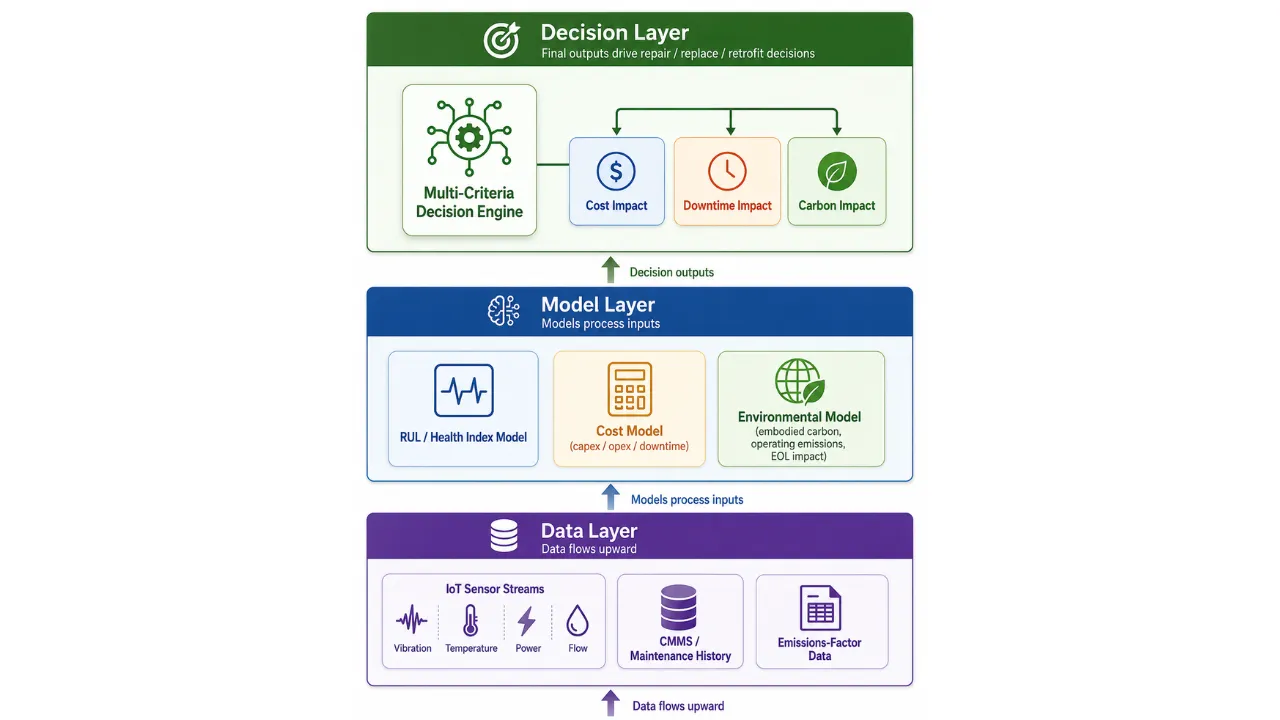
A lifecycle analytics stack supporting asset lifecycle optimization typically comprises three layers. The data layer includes IoT sensor streams covering vibration, temperature, power, and flow; maintenance and failure histories; and environmental data such as ambient conditions and grid emissions factors. The model layer includes health-index and Remaining Useful Life (RUL) models drawn from predictive maintenance; cost models covering capital expenditure, operating expenditure, maintenance cost, and downtime cost; and environmental models covering embodied carbon, operating emissions, and end-of-life impact. The decision layer includes multi-criteria decision frameworks for repair, replace, or retrofit choices, and scenario-analysis dashboards that compare options such as extending asset life against early replacement with high-efficiency equipment.
This stack supports sustainable operations decisions of practical significance, such as whether to keep an older motor running with predictive maintenance and targeted efficiency upgrades, or to replace it with a new high-efficiency model; the correct answer depends on embodied carbon, expected remaining life, and usage profile, and can differ substantially across otherwise similar assets.
Digital Twin for Sustainability
Digital Twins Across the Asset Lifecycle
Digital twins are virtual representations of assets or systems synchronized with operational data over the lifecycle. Recent research highlights their potential for decarbonization and lifecycle optimization in energy, industrial, and built-environment contexts. In sustainable asset management specifically, a digital twin for sustainability can simulate how operational changes, such as load, setpoints, or maintenance intervals, affect energy use, emissions, and remaining life; evaluate design alternatives before deployment, including materials, configurations, and control strategies; and support continuous commissioning and optimization over the asset's operating life rather than a one-time design-stage assessment.
Coupling Predictive Maintenance and Sustainability Twins
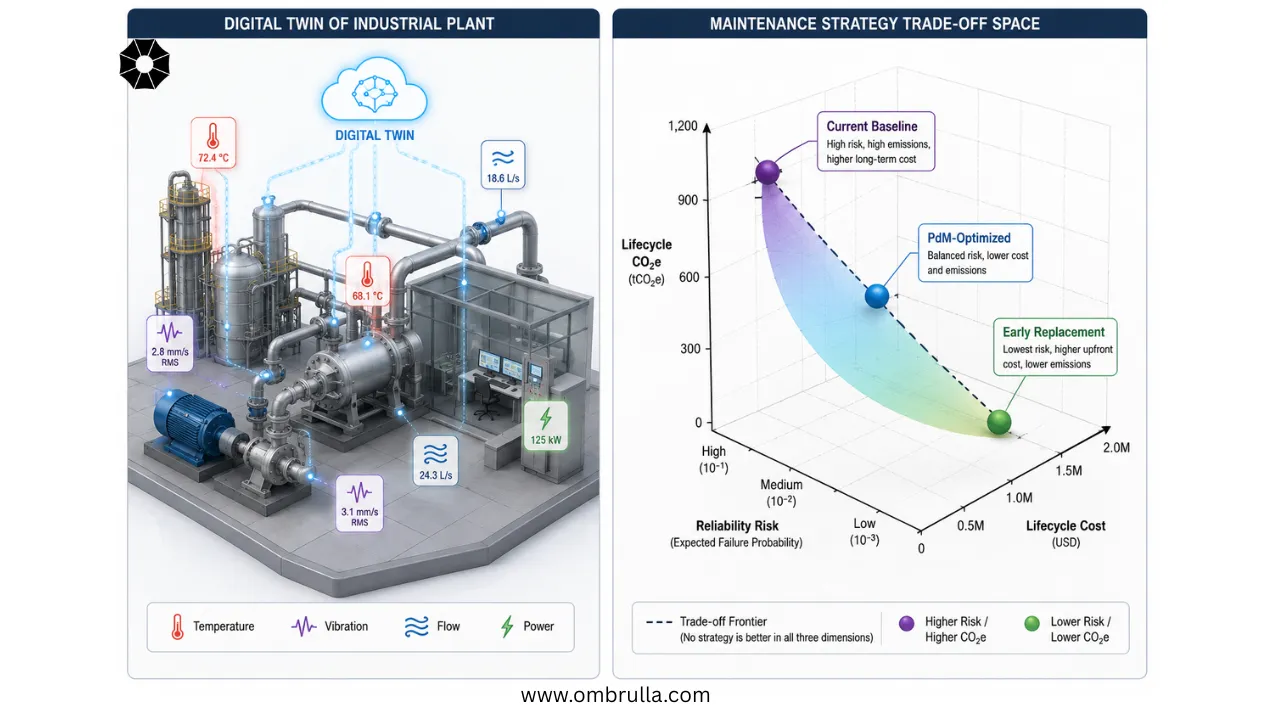
When predictive maintenance models are embedded within the digital twin, it becomes possible to analyze trade-offs between reliability, cost, and environmental performance directly. Aggressive run-to-failure strategies may minimize short-term capital expenditure but increase energy use and scrap generation. Conversely, overly conservative replacement schedules reduce operational risk but may cause premature scrapping of still-serviceable assets and higher embodied carbon than necessary. Digital twins can help optimize these tensions across an asset fleet, coordinating maintenance schedules with production plans and corporate decarbonization trajectories simultaneously, rather than treating each objective in isolation.
Integrating Circular Economy Principles
Extending the Use Phase
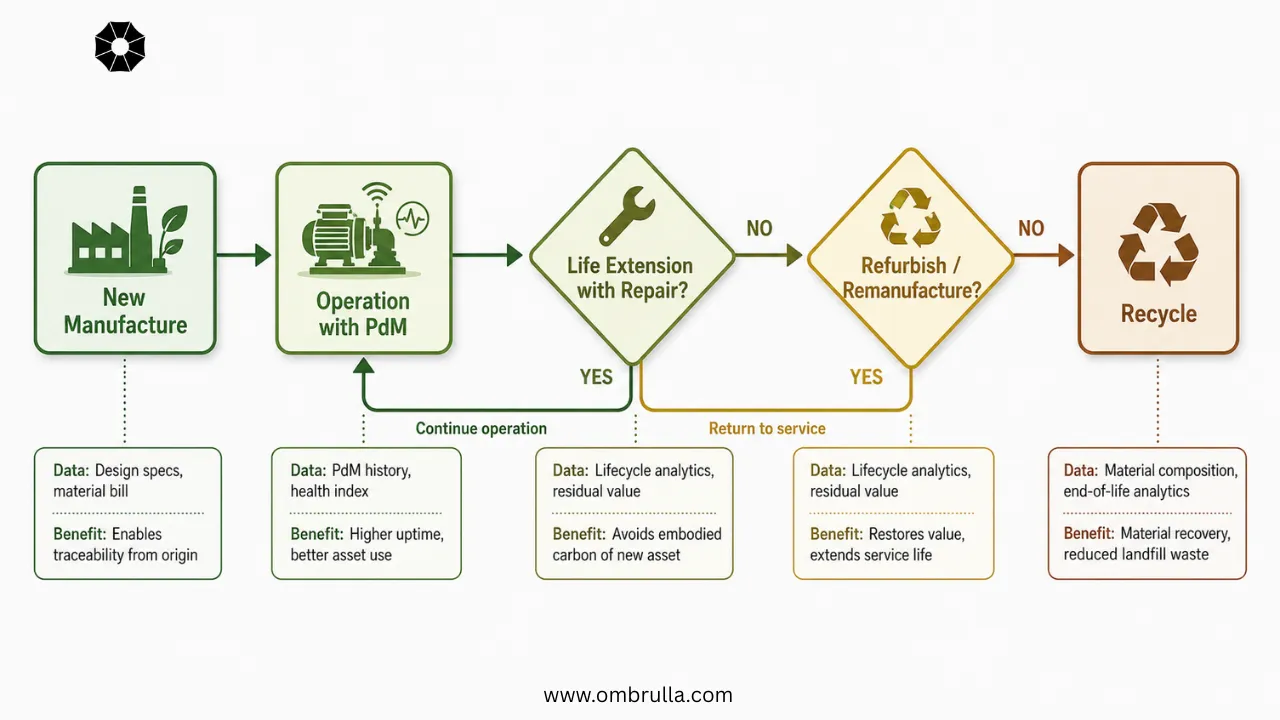
Predictive maintenance is inherently aligned with circular economy R-strategies centered on reuse and life extension. By continuously monitoring degradation and remaining life, organizations can confidently extend asset use where risk is demonstrably low, rather than defaulting to conservative fixed-interval replacement. Predictive maintenance also makes mid-life refurbishment more targeted, allowing replacement of only the specific components that have degraded rather than entire assemblies, which reduces both material consumption and cost.
Informing Remanufacturing and Reuse
Lifecycle analytics and predictive maintenance histories can directly inform remanufacturing decisions in two ways. Assets with detailed health records and component-level traceability are more attractive to remanufacturing markets, since buyers and remanufacturers can assess actual condition rather than relying on age alone. Digital records also support warranty decisions and quality assurance for remanufactured products, reducing the information asymmetry that often limits remanufacturing markets. Manufacturers and service providers can leverage these datasets to design green operations models, including service contracts, refurbished-component offerings, and take-back schemes grounded in empirical lifecycle performance rather than generic assumptions.
Sustainability KPIs and Dashboards for Asset Management
KPIs Linking Reliability and Environment
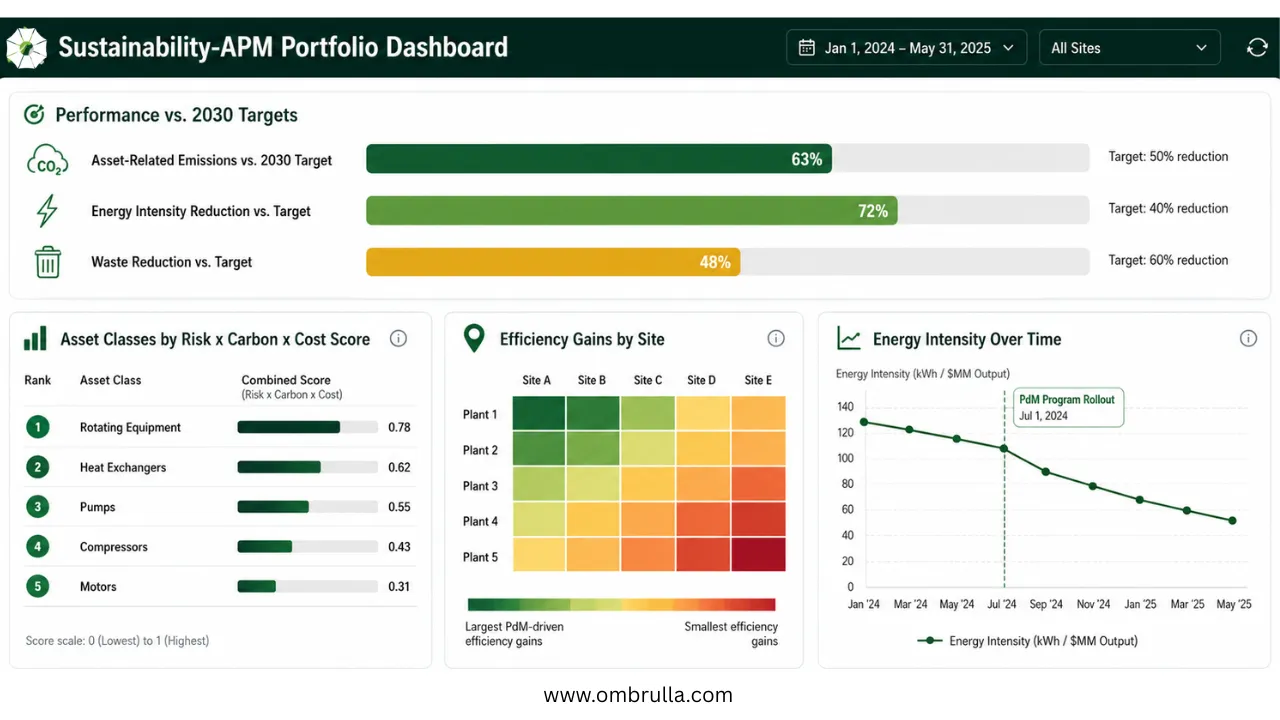
Sustainable asset management dashboards should combine three categories of key performance indicator. Reliability KPIs include mean time between failures (MTBF), failure rate, and downtime. Cost KPIs include maintenance cost per asset and total lifecycle cost. Environmental KPIs include energy use and energy intensity, expressed for example as kilowatt-hours per ton or per cubic meter of output; water use intensity; carbon footprint management metrics, including Scope 1 and Scope 2 emissions and CO2e per ton of output; and waste volumes together with recycling rates. The central design goal for such a dashboard is to make visible how changes in predictive maintenance strategy and lifecycle decisions influence these KPIs over time, rather than reporting reliability, cost, and environmental metrics in separate, disconnected systems.
Fleet- and Portfolio-Level Views
At higher levels of aggregation, spanning site, fleet, and enterprise, dashboards can highlight three additional perspectives: assets with disproportionate environmental impact relative to their number or capacity; quick-win opportunities where modest maintenance or retrofit actions yield large carbon footprint reduction; and progress against stated targets, such as a 40 percent reduction in asset-related emissions by 2030.
| KPI Category | Representative Metrics | Primary Data Source | Typical Reporting Level |
|---|---|---|---|
| Reliability | MTBF, failure rate, unplanned downtime hours | CMMS, IoT condition sensors | Asset, fleet |
| Cost | Maintenance cost per asset, total lifecycle cost | ERP/CMMS financial records, cost models | Asset, site, enterprise |
| Environmental - energy/water | Energy intensity (kWh/ton, kWh/m³), water use intensity | Utility meters, IoT sensors, environmental models | Asset, site |
| Environmental - carbon | Scope 1/2 emissions, CO2e/ton, embodied carbon | Grid emissions factors, environmental models, supplier data | Site, enterprise |
| Environmental - circularity | Waste volume, recycling rate, component reuse rate | Maintenance records, end-of-life tracking | Asset class, enterprise |
Environmental Context and Biodiversity Monitoring
While most of the preceding discussion focuses on internal asset impacts, sustainable asset management also encompasses external environmental context. Pipelines and transmission lines, for example, may affect surrounding habitats; biodiversity monitoring can be integrated into asset risk models so that, for instance, routine maintenance is scheduled to avoid nesting periods or sensitive habitat windows. Tailings dams, waste facilities, and cooling-water intakes similarly carry external ecological footprints that are increasingly measurable through dedicated environmental sensors rather than periodic manual survey alone.
Future digital-twin-for-sustainability implementations may embed such external data directly, providing a fuller picture of sustainability performance that extends beyond simple carbon metrics, linking asset operations to ecological indicators and nature-related financial risk in a manner consistent with emerging disclosure frameworks in this area.
Challenges and Research Directions
Despite its promise, sustainable asset management using predictive maintenance and lifecycle analytics faces five open challenges:
- -Data Quality and Interoperability: Inconsistent tagging, missing histories, and siloed systems hinder lifecycle analytics. Standards for asset taxonomies, failure modes, and sustainability metrics remain immature relative to financial or safety reporting standards.
- -Embodied Carbon and Scope 3 Data: Reliable embodied-carbon data for assets and components is frequently lacking, making full lifecycle carbon accounting difficult. Integrating supplier-provided footprints and global reference databases remains an open and largely unsolved task.
- -Multi-Objective Optimization: Balancing reliability, cost, and environmental objectives simultaneously is both computationally and organizationally challenging. Decision-makers need transparent trade-off views rather than opaque, single-number optimization outputs.
- -Change Management and Skills: Maintenance and asset teams must develop new competence in sustainability analytics and digital tools. Sustainability teams must conversely build sufficient understanding of predictive maintenance and APM concepts to engage productively.
- -Evaluation and Benchmarking: Few standardized benchmarks exist to quantify how much predictive maintenance contributes to sustainability beyond anecdotal case studies. Rigorous comparative studies and shared, anonymized datasets would meaningfully advance the field.
| Dimension | Representative Current-State Gap | Representative Target State |
|---|---|---|
| Data | No embodied-carbon data available for many pump and motor classes | Component-level embodied carbon and operating-emissions data integrated into asset records |
| Models | RUL and cost models exist independently; no joint optimization | Combined reliability-cost-carbon models supporting joint scenario analysis |
| Decisions | No multi-objective decision tools; repair/replace judged on cost alone | Multi-criteria decision dashboards exposing cost, downtime, and carbon trade-offs |
| People | Limited training on sustainability metrics for maintenance teams | Cross-trained maintenance and sustainability teams with shared KPI literacy |
| Governance | Sustainability reporting disconnected from maintenance planning cycles | Sustainability KPIs embedded directly in APM governance and planning processes |
Conclusion
Predictive maintenance and lifecycle analytics are often justified primarily on reliability and cost grounds, but their potential contribution to sustainability is equally significant. By extending asset life, reducing waste, optimizing energy and resource use, and preventing environmentally harmful failures, predictive maintenance becomes a core tool for operational sustainability and carbon footprint reduction rather than a narrowly technical maintenance function.
When combined with asset performance management, real-time asset monitoring, and digital-twin-for-sustainability capability, predictive maintenance provides a data-rich foundation for asset lifecycle optimization and circular economy strategy, spanning repair and refurbishment through to remanufacturing and recycling. This integrated approach allows organizations to move beyond siloed, project-based sustainability initiatives toward sustainable operations in which asset decisions are consistently aligned with both environmental and business goals.
For practitioners, a practical roadmap follows four steps: embedding sustainability metrics, including energy, emissions, and waste, into existing predictive maintenance and APM projects rather than treating them as separate workstreams; building lifecycle analytics capability that combines cost, risk, and environmental indicators for key asset classes; piloting digital-twin-for-sustainability models on high-impact assets or plants to explore trade-offs and test circular strategies before wider rollout; and refining governance, data standards, and skill development to sustain these capabilities across the enterprise over time. Pursued well, sustainable asset management using predictive maintenance and lifecycle analytics can shift maintenance and reliability from a cost center into a strategic driver of decarbonization, resource efficiency, and long-term organizational resilience.
References
- Oxmaint. "How Does Predictive Maintenance Contribute to Sustainability?" 2024.
- Fluke Reliability. "Predictive Maintenance: The Sustainability Opportunity." eBook, 2025.[fluke.com]
- International Journal for Multidisciplinary Research (IJFMR). "Environmental Impact of Predictive Maintenance." 2024.
- AssetWatch. "Building a More Sustainable Operation with Predictive Maintenance." 2024.
- Hogonext. "How to Contribute to a Circular Economy through Predictive Maintenance." 2024.[hogonext.com]
- ManWinWin. "Top Strategies for Sustainable Maintenance." 2025.[manwinwin.com]
- GE Vernova. "Asset Lifecycle Management: A Comprehensive Guide." 2025.[gevernova.com]
- Brightly Software. "Asset Lifecycle Management (ALM)." Product overview, 2025.[brightlysoftware.com]
- Oxmaint. "Asset Management Best Practices for Equipment Lifecycle Performance." 2025.[oxmaint.com]
- IBM. "Maximo Sustainability in Asset Management." Product documentation, 2025.[ibm.com/maximo]
- IBM. "Asset Lifecycle Management Best Practices." 2025.[ibm.com]
- SAP. "SAP Asset Performance Management." Product documentation, 2025.[sap.com]
- Limble CMMS. "Maximizing Lifetime Value with Asset Performance Management." 2025.[limblecmms.com]
- SciePublish. "Asset Management Excellence: A Roadmap for Integrating Lean Six Sigma and Digital Tools." 2025.
- Balagopal, P. A. "Digital Twins in Mechanical Engineering and Decarbonization." International Journal of Innovative Science and Research Technology (IJISRT), 2025.
- "Digital Twin-Driven Sustainable Energy Life Cycles: Technical Review and Future Research Directions." Sustainable Energy Systems, 2025.
- Institute for Sustainable Infrastructure (ISI). "Advancing Infrastructure Sustainability Through Digital Twins." 2025.[sustainableinfrastructure.org]
- "Digital Twin's Effort for the Decarbonization Process in the Built Environment." In Sustainable Built Environments, Springer, 2024.[springer.com]
- NVIDIA. "Sustainable Manufacturing and Design: How Digital Twins Are Driving Industrial Decarbonization." 2024.[nvidia.com]
- Accenture. "Intelligent Asset Management Services." Service overview, 2025.[accenture.com]