
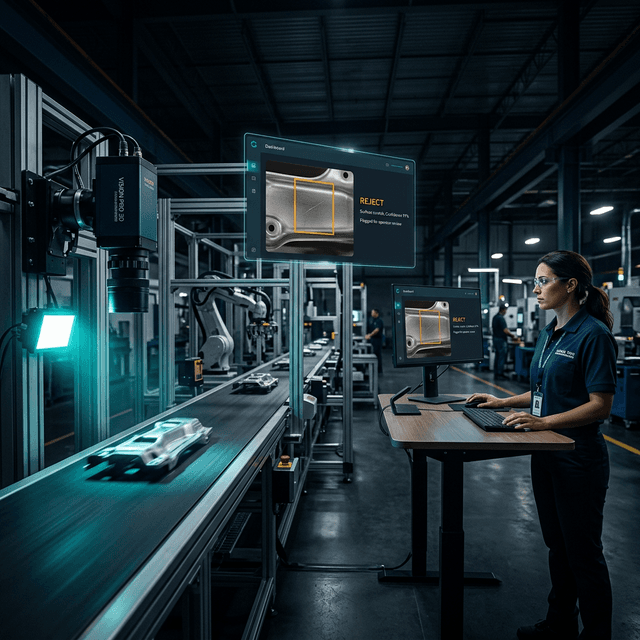

The 2026 Manufacturing AI Landscape: What Has Changed and Why It Matters
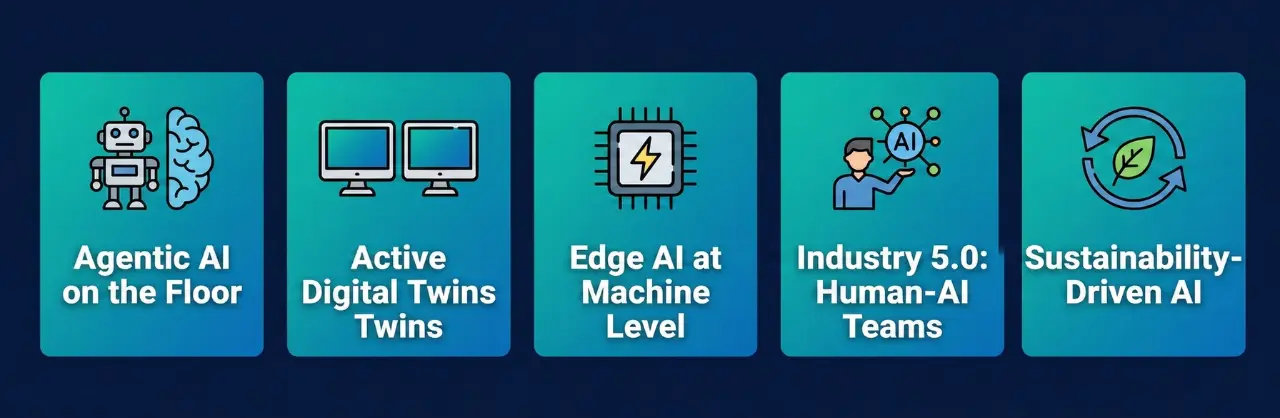
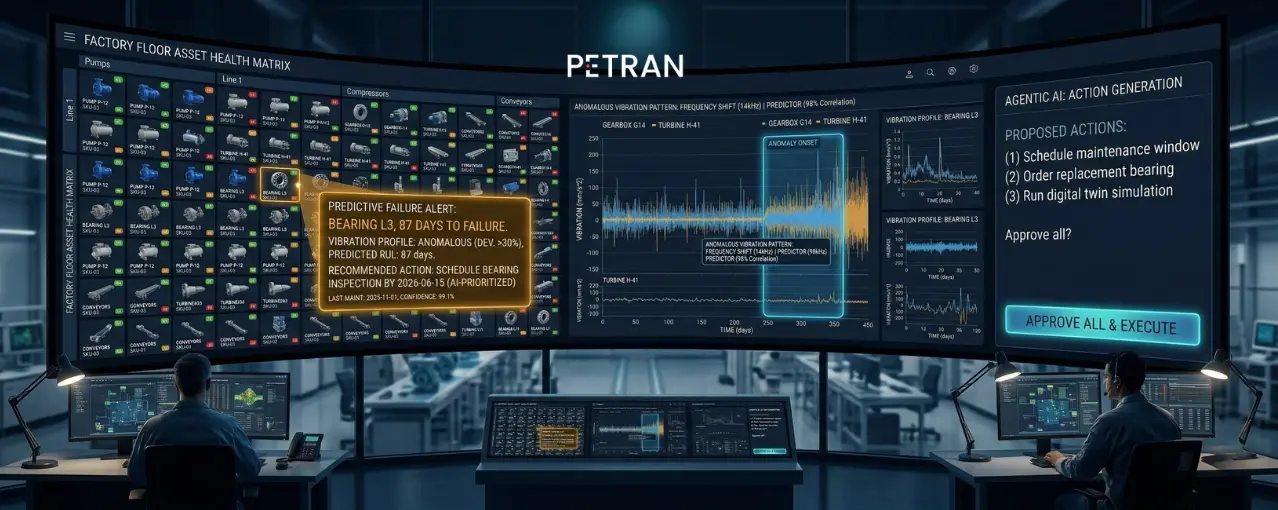
- - Agentic AI has moved from lab to lineIn 2026, leading manufacturing AI platforms do not just recommend actions they take them. Petran's AI predictive maintenance software agentic AI, for example, detects a developing compressor failure, proposes opening relief valves, schedules the maintenance team, and initiates a digital twin simulation, waiting only for operator confirmation before executing.
- - Tritva Vision and the democratisation of custom model trainingThe historically expensive barrier of training custom AI inspection models requiring data scientists, GPU infrastructure, and months of development is collapsing. Tritva Vision's intuitive annotation and training interface means quality engineers, not AI researchers, can define and train defect detection models with industrial IoT real-time monitoring platform specific to their products and processes.
- - Siemens and NVIDIA's Industrial AI OS redefines the enterprise baselineThe CES 2026 announcement of the Siemens-NVIDIA Industrial AI Operating System signals that the enterprise manufacturing AI category is consolidating toward unified platforms rather than best-of-breed assemblies.
- - The AI skills gap remains the #1 implementation riskThe Revalize Smart Manufacturing 2026 report surveying 500 manufacturing leaders identifies the skills gap as the primary barrier to AI deployment. Solutions that require internal data science teams to operate are disadvantaged relative to those with intuitive interfaces and manufacturing-native configurations.
- - Sustainability is now an AI selection criterionESG reporting requirements in the EU and UK, and investor pressure globally, mean that manufacturing AI platforms are now evaluated on their contribution to energy efficiency, emissions reduction with AI and IoT operational sustainability platform, and sustainable operations.
#1 TRITVA by Ombrulla
Category: AI Visual Inspection | Computer Vision Quality Control | Real-Time Defect Detection | Edge AI Inspection
Best For: Manufacturing, automotive, oil & gas, infrastructure, and utilities operations requiring production-grade, real-time AI defect detection that integrates with drones, conveyor cameras, cobots, and mobile devices
What Is Tritva?
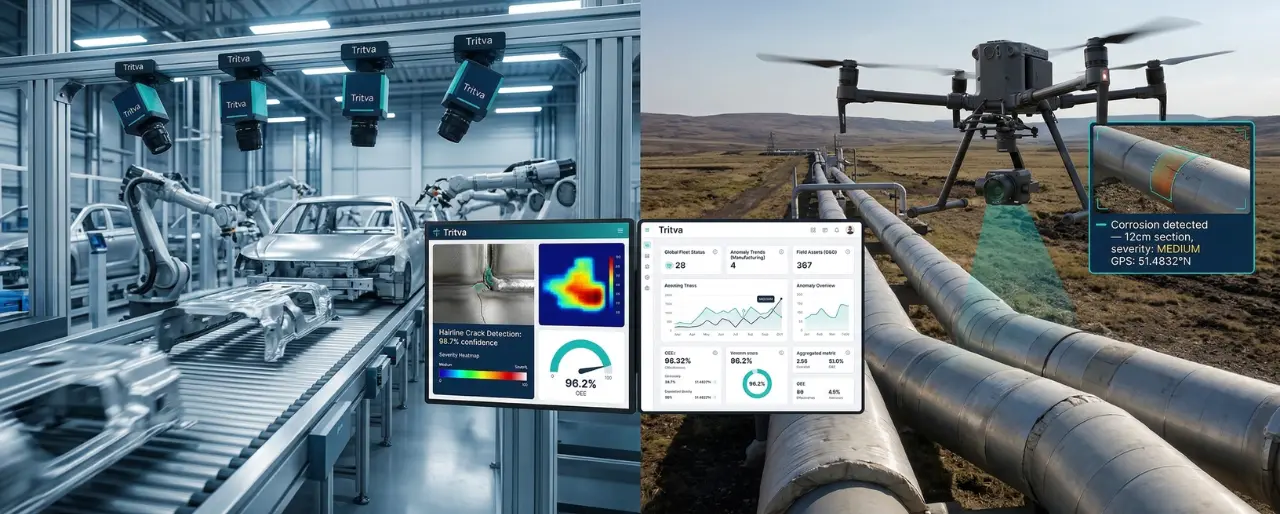
Tritva is Ombrulla's TRITVA AI visual inspection for manufacturing purpose-built AI Visual Inspection platform. Where generic computer vision tools require months of configuration for manufacturing contexts, Tritva ships with manufacturing-specific AI models, pre-integrated industrial camera and drone support, and compliance documentation built in. It uses advanced computer vision to automatically inspect products and assets from images or video, instantly flagging defects in real time and generating audit-ready reports without slowing the production line.
Tritva's Core Platform Modules:
Tritva Vision, Inspection Intelligence Layer
Intuitive interface for image/video annotation, defect labelling, and AI model training. Create custom inspection models tailored to your specific assets, defect taxonomy, and industry requirements. Continuously retrain and update models for improved accuracy as production data accumulates.
Key Capabilities in 2026
- - Real-time defect detection at full production line speed (500–1,200+ units/min) with sub-second decisions, no slowdown, no sampling gaps
- - Universal input support: production line cameras, drones, rovers, cobots, and mobile devices, inspect any asset through any capture method in a single platform
- - Custom AI model training via Tritva Vision: annotate, label, and train defect-specific models using your own production imagery, no off-the-shelf model compromise
- - Continuous model retraining: models improve automatically as more production data is captured, accuracy increases over the deployment lifetime
- - Edge-first architecture: AI inference runs at the station with sub-10ms latency, no cloud dependency for production-critical real-time rejection decisions
- - Automated CMMS/MES integration: defect detection automatically creates work orders, updates quality records, and triggers maintenance tickets without manual intervention
- - Audit-ready compliance documentation: every inspection event logged with timestamped images, defect classification, confidence score, and disposition, meeting ISO 9001, IATF 16949, API, OSHA, and FDA documentation requirements
- - Multi-asset inspection: same platform handles in-line product inspection, AI infrastructure inspection for industrial assets-captured infrastructure inspection, rover-based confined space inspection, and mobile device field inspection
- - Defect pattern intelligence: aggregate defect data surfaces recurring patterns linked to equipment conditions, shift timings, and process parameters, enabling root-cause identification
- - Cloud, edge, or hybrid deployment: flexible architecture adapts to your data sovereignty, latency, and connectivity requirements
Where Tritva Is Deployed:
- - Manufacturing & Automotive:In-line surface defect detection, weld inspection, paint quality, assembly verification, PCB inspection, at full conveyor speed
- - Oil & Gas:Pipeline corrosion detection, storage tank structural inspection, offshore platform monitoring, flare stack observation, via drone, rover, and fixed cameras
- - Infrastructure:Bridge crack detection, tunnel lining inspection, road surface analysis, structural delamination, drone-captured with AI classification
- - Utilities & Energy:Transformer inspection, wind turbine blade assessment, solar panel defect detection, power line anomaly identification
- - Mobile Field Inspection:Inspection teams use AI-enabled smartphones with predefined checklists, standardised field inspection with automatic defect flagging and audit trail
Why Manufacturers Choose Tritva Over Generic AI Platforms:
Tritva is built from the ground up for production environments, not adapted from general enterprise AI. This means the defect taxonomy, model architecture, hardware integration protocols, and compliance documentation are designed for manufacturing from day one. Teams do not spend the first six months configuring a general-purpose platform for industrial use; they spend those months accumulating production data that makes Tritva progressively more accurate. The Tritva Vision training interface also means quality engineers, not data scientists, can define, annotate, and retrain inspection models, reducing dependency on AI specialists and compressing the timeline from new defect identification to deployed detection capability from months to weeks.
Proven Impact
- - 45% reduction in welding defects on automotive assembly lines within 6 months of deployment
- - 70% reduction in pipeline inspection costs for oil & gas operators deploying Tritva-powered drone inspection
- - 50% faster inspection cycle for infrastructure operators, bridges, tunnels, and industrial structures
- - 30–50% shift from reactive to predictive work, enabled by Tritva defect pattern data feeding maintenance decisions
- - 20–35% cut in emergency field call-outs through AI-prioritised defect alerts
- - Inspection teams report elimination of inter-inspector agreement disputes, one AI standard replaces subjective human variance
- - Audit preparation time reduced from weeks to days through automated, structured inspection records
Deployment Model : Edge, on-premises, or cloud. Compatible with existing industrial cameras, drones, rovers, cobots, and mobile devices. Modular, deploy the inspection use cases you need now; add additional asset types and locations as deployment scales.
#2 PETRAN by Ombrulla AI-Driven Asset Performance Management & Predictive Maintenance
Predict Failures. Orchestrate Action. Protect Uptime.
Category: Predictive Maintenance | Asset Performance Management | IIoT | Agentic AI | Digital Twin
Best For: Industrial operations in manufacturing, oil & gas, automotive, energy, and infrastructure requiring AI-powered asset health monitoring, failure prediction 30–90 days ahead, and agentic AI-driven maintenance orchestration at enterprise scale
What Is Petran?
Petran is Ombrulla's PETRAN predictive maintenance and APM software AI-driven Asset Performance Management (APM) platform. It combines IoT sensor data ingestion, machine learning failure prediction, agentic AI-driven maintenance orchestration, and operational intelligence dashboards in a single unified system. Petran does not just predict failures, it triggers the right action at the right time, auto-generating maintenance work orders, scheduling crews, and logging every decision for compliance audit. Critically, Petran integrates directly with Tritva: visual inspection defect data from Tritva feeds Petran's predictive models, linking quality anomalies to specific equipment conditions for closed-loop asset intelligence.
Key Capabilities in 2026
- - IoT sensor integration: real-time ingestion of vibration, temperature, pressure, acoustic, flow, and corrosion sensor data from across the asset fleet, live dashboards show asset health the moment issues begin
- - AI failure prediction: ML models trained on equipment-specific sensor history identify anomalies and predict failure probability 30–90 days ahead, providing actionable maintenance lead time instead of reactive response
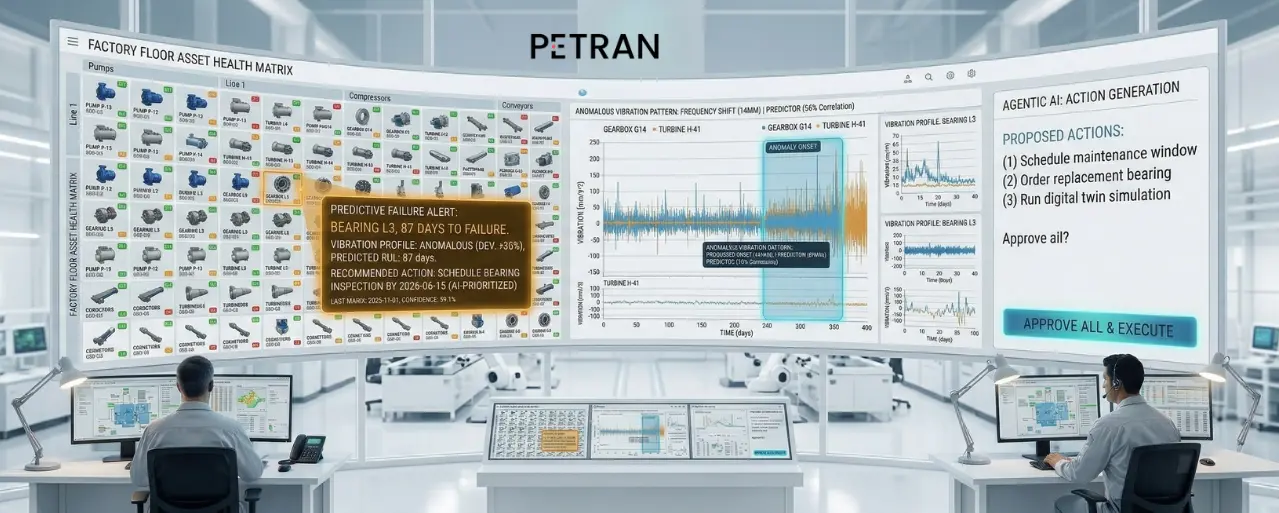
- - Agentic AI maintenance orchestration: when Petran detects a developing failure, it autonomously proposes corrective actions, opening relief valves, dispatching maintenance teams, running digital twin simulations, operators execute with one click; every decision is logged for compliance
- - Risk-based maintenance scheduling: Petran prioritises maintenance resource allocation by asset criticality and failure probability, eliminating both over-maintenance of healthy assets and under-maintenance of at-risk ones
- - Tritva integration, quality-linked maintenance triggers: defect patterns detected by Tritva visual inspection automatically feed Petran predictive models, linking production quality anomalies to specific machine conditions and triggering maintenance before defects escalate to failures
- - Digital twin simulation: test process and maintenance changes in a virtual replica before physical execution, quantify the impact on performance, downtime, and cost with confidence before committing
- - Energy optimisation: AI tracks energy consumption by asset and shift, identifies inefficient operating patterns, and recommends schedule and parameter adjustments to reduce energy waste
- - Regulatory compliance logging: AI logs and audits every maintenance activity, flags overdue inspections and environmental risk thresholds in real time, and generates regulatory reporting-ready documentation
- - Remote and hazardous operations: IoT sensors and AI monitoring replace human presence in confined spaces, offshore platforms, and chemically hazardous environments, predictive intelligence without risk exposure
- - Multi-site enterprise dashboard: centralised visibility into asset health, OEE, maintenance status, and energy performance across all facilities in a single unified view
The Tritva + Petran Closed Loop, What Makes It Different:
Most manufacturers run quality inspection and asset maintenance as separate systems, quality defects are recorded in the QMS; maintenance is scheduled in the CMMS; and the connection between a spike in surface defects and a degrading machine bearing is discovered weeks later, after rework costs have accumulated. Petran + Tritva closes that loop. When Tritva detects a cluster of scratch defects appearing on components from line 3, that pattern feeds Petran's predictive model for the line 3 press. Petran identifies the correlation with vibration data from the press bearing, schedules a bearing inspection during the next planned maintenance window, and prevents the unplanned breakdown that would otherwise have cost days of production. This closed-loop quality-to-maintenance intelligence is the highest-value operational advantage in the combined Ombrulla platform.
Where Petran Is Deployed:
- - Manufacturing:Motor vibration analysis, press and stamping equipment health, conveyor system predictive maintenance, compressor and pump failure prediction
- - Oil & Gas:Pipeline corrosion and pressure monitoring, offshore rig equipment health, storage tank integrity, flare stack thermal anomaly detection, IoT sensors + agentic AI for remote autonomous response
- - Automotive:High-speed precision press and robot maintenance optimisation, paint booth equipment health, assembly line uptime protection
- - Energy & Utilities:Transformer health monitoring, wind turbine performance optimisation, generator predictive maintenance, substation equipment integrity
- - Infrastructure:Bridge and tunnel structural health monitoring, HVAC and building system optimisation, heavy equipment fleet maintenance
Proven Impact
- - 30–50% reduction in unplanned maintenance costs through AI failure prediction and proactive intervention
- - 20–35% improvement in maintenance schedule efficiency, right resource, right asset, right time
- - 30–40% shift from reactive to predictive maintenance within 12 months of deployment
- - Offshore operator case: Petran APM identified micro-corrosion on flare stack 4 months before failure, maintenance dispatched early, preventing $3M+ in estimated downtime costs
- - OEE improvement of 15–25% through reduced unplanned downtime and optimised asset utilisation
- - Energy cost reduction of 10–20% through AI-driven energy optimisation across assets and shifts
- - Compliance audit time reduced by 60%+ through automated maintenance logging and regulatory reporting
Deployment Model : Cloud, edge, or hybrid. Integrates with existing CMMS, MES, SCADA, and ERP systems. IoT sensor hardware is available as part of the Ombrulla stack or integrates with existing sensor infrastructure.
The Tritva + Petran Advantage: Closed-Loop Quality and Maintenance Intelligence
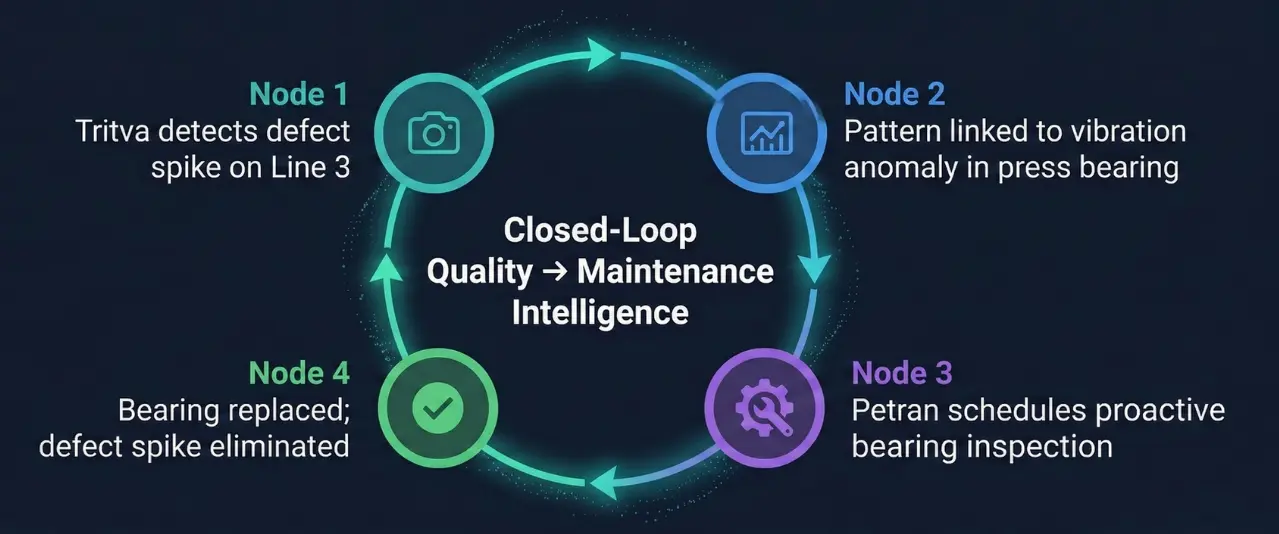
The most expensive quality and maintenance failures in manufacturing share a common characteristic: they were visible in data before they became crises. A defect spike that started three weeks before a production line shutdown. A vibration anomaly that preceded a catastrophic bearing failure by two months.
The reason these signals are missed is structural: without quality-to-maintenance intelligence, quality inspection data lives in the QMS, maintenance sensor data lives in the CMMS, and energy data lives in building management systems. The patterns that span these domains are invisible unless someone manually correlates them.
Tritva and Petran are built to close this loop automatically. When Tritva detects a defect pattern a cluster of surface scratches appearing on components from a specific production station that pattern feeds directly into Petran's predictive models. Petran correlates the defect onset with sensor data: vibration levels, temperature, acoustic signatures. It identifies the equipment condition, quantifies the failure probability, and schedules the intervention before the equipment fails.
- - Typical deployment sequenceTritva is deployed first for quality inspection fastest time-to-value. Within 60–90 days, quality data volume is sufficient to begin Petran integration. By month 6, the closed-loop system is generating proactive maintenance interventions.
- - ROI compoundingThe combined ROI of Tritva + Petran consistently exceeds the sum of their individual ROI projections because the closed loop prevents both quality escapes and the equipment failures that cause them.
#3 Siemens & NVIDIA Industrial AI Operating System
Active Digital Twins + Production Intelligence at Enterprise Scale
Category: Industrial AI Platform | digital twin simulation and optimization | Production Simulation | Agentic Manufacturing AI
Best For: Large manufacturers and OEMs seeking a unified industrial AI OS that integrates digital twin simulation, real-time production AI, and physical automation; best for organisations with dedicated OT/IT integration teams
Key Capabilities in 2026
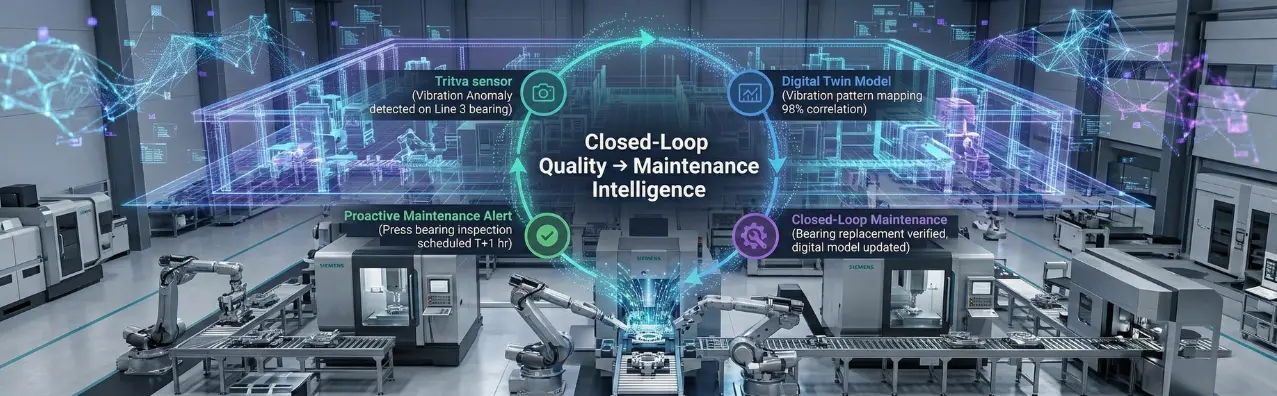
- - Industrial AI OS (announced CES 2026): embeds AI across the full manufacturing lifecycle, design, production, service, as a unified operating system rather than a collection of point tools
- - Active Digital Twins: NVIDIA Omniverse + Siemens Xcelerator deliver real-time AI-driven production intelligence, changes tested in digital twin before physical implementation
- - Siemens Generative AI embedded in predictive maintenance and process optimisation tools
- - NVIDIA Isaac: autonomous robot training via photorealistic simulation, deploy robots trained in digital twin to physical line
- - Industrial edge AI via NVIDIA Jetson, sub-10ms inference at machine level
- - Multi-system integration: PLM, ERP, MES, and OT in a unified data model
Why Manufacturers Choose It:
The most ambitious attempt in 2026 to create a single industrial AI foundation for large manufacturers. Early adopters including PepsiCo report 20% throughput improvements. Best suited to enterprises with dedicated IT/OT integration capability and the budget for a comprehensive platform commitment.
Proven Impact
- - 20% throughput improvement at early adopter sites
- - Reduced physical changeover risk via digital twin validation
- - Faster new product introduction timelines
#4 Microsoft Azure AI for Manufacturing
Enterprise Cloud AI Platform with Manufacturing Intelligence and Ecosystem Depth
Category: Cloud AI Platform | IIoT | Digital Twin | Generative AI | Supply Chain AI
Best For: Manufacturers of all sizes building on Microsoft ecosystem (Azure, Dynamics 365, Teams, Power Platform); ideal for organisations wanting modular, pay-as-you-go AI without large upfront platform commitment
Key Capabilities in 2026
- - Azure AI Foundry (2026): customised industrial LLMs for maintenance documentation, quality analysis, and process engineering, Copilot for manufacturing operations
- - Azure Digital Twins: real-time factory floor models connected to live IoT sensor data
- - Azure Machine Learning: managed ML for predictive maintenance, quality forecasting, and demand planning models
- - Microsoft Fabric for Manufacturing: unified analytics across production, supply chain, and ERP data
- - Azure IoT Hub + Event Hubs: real-time sensor data from thousands of IIoT devices across facilities
- - Copilot for Dynamics 365 Supply Chain: AI supply chain disruption prediction and alternative sourcing
Why Manufacturers Choose It:
Azure AI's strength is breadth and ecosystem depth. Manufacturers already using Microsoft products extend AI capabilities across production, quality, maintenance, and supply chain without new vendor relationships. Pay-as-you-go pricing enables low-risk entry. Strong for organisations wanting cloud-first, modular AI expansion.
Proven Impact
- - 15–25% reduction in unplanned downtime via predictive maintenance
- - 30–40% supply chain visibility improvement
- - 60%+ reduction in quality report generation time with Copilot assistance
#5 IBM Maximo Application Suite
Category: Enterprise Asset Management | Predictive Maintenance | AI Inspection | Reliability Engineering
Best For: Asset-intensive manufacturers, oil & gas, chemicals, power generation, heavy industry, utilities, requiring enterprise-scale EAM with embedded AI for failure prediction, inspection management, and compliance
Key Capabilities in 2026
- - Maximo Predict: AI models analysing sensor data, operational history, and environmental conditions to predict equipment failure probability with intervention timing
- - Maximo Visual Inspection: AI image-based inspection for assets, mobile, fixed camera, or drone capture
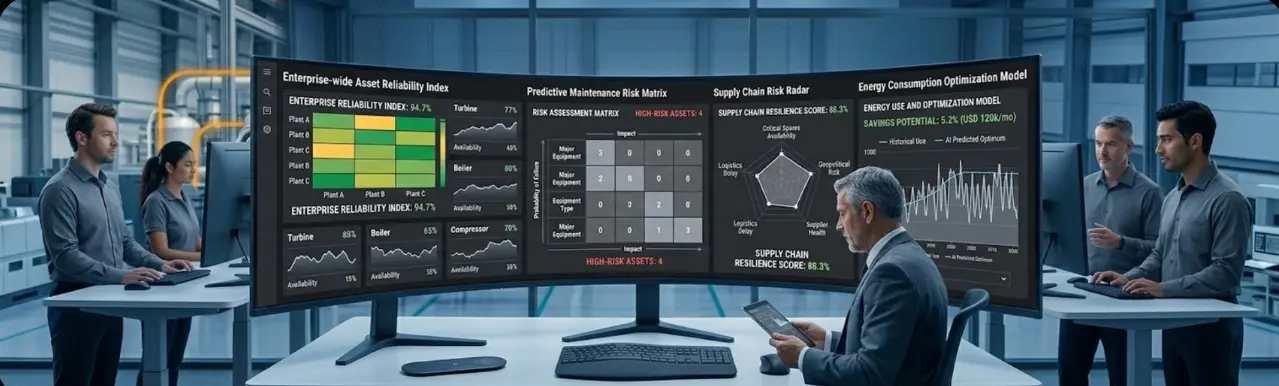
- - Maximo Health: fleet-wide asset health scoring to prioritise maintenance resource allocation by risk
- - Watson NLP: natural language work order generation, maintenance documentation, and asset history search
- - IBM + SAP joint GenAI solutions (2024): Maximo data surfaces in SAP workflows for integrated operations
- - Reliability-Centred Maintenance (RCM): AI-assisted failure mode analysis and maintenance strategy optimisation
Why Manufacturers Choose It:
Maximo is the deepest EAM platform available at enterprise scale. For asset-intensive manufacturers where maintenance programme design and asset performance and lifecycle management are primary concerns, Maximo provides capabilities that purpose-built point solutions cannot match. The 2026 Maximo Application Suite SaaS consolidation has simplified the previously complex multi-product portfolio.
Proven Impact
- - 30–50% reduction in unplanned maintenance costs
- - 20–35% improvement in maintenance schedule efficiency
- - 40% faster work order completion via AI-assisted technician guidance
#6 AWS Industrial AI (SageMaker + Lookout + Rekognition + IoT Greengrass)
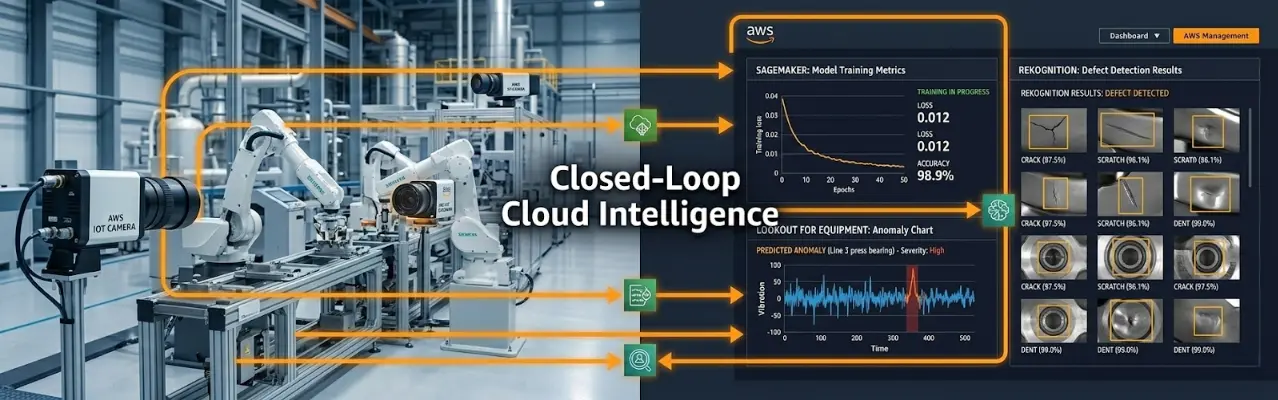
Category: Cloud ML Platform | Computer Vision QC | IIoT | Predictive Maintenance | Edge AI
Best For: Manufacturers with capable in-house or SI-partner data science teams who want flexibility to build custom AI applications on proven managed cloud infrastructure; operations already on AWS
Key Capabilities in 2026
- - Amazon SageMaker: end-to-end managed ML for custom predictive maintenance, quality forecasting, and defect detection models
- - Amazon Lookout for Equipment: pre-trained ML that learns normal machine behaviour and detects anomalies, no ML expertise needed
- - Amazon Rekognition Custom Labels: custom computer vision for defect detection without deep CV expertise
- - AWS IoT Greengrass: edge AI deployment, run models locally at machine level, no cloud dependency for real-time decisions
- - Amazon Monitron: end-to-end predictive maintenance including wireless vibration + temperature sensors and anomaly detection
- - AWS Supply Chain: AI-powered supply chain risk visibility, demand sensing, and inventory optimisation
Why Manufacturers Choose It:
AWS provides the most flexible toolkit approach, modular managed services assembled into precise custom solutions. Best for operations with internal engineering capability who want to build bespoke AI rather than buy pre-packaged applications. Pay-as-you-go economics suit manufacturers starting with a focused use case and expanding.
Proven Impact
- - 50%+ reduction in quality defect escape rates using Rekognition
- - 35% reduction in maintenance costs using Lookout for Equipment within 12 months
- - 40% average reduction in unplanned downtime using Monitron
#7 Google Cloud Manufacturing Data Engine
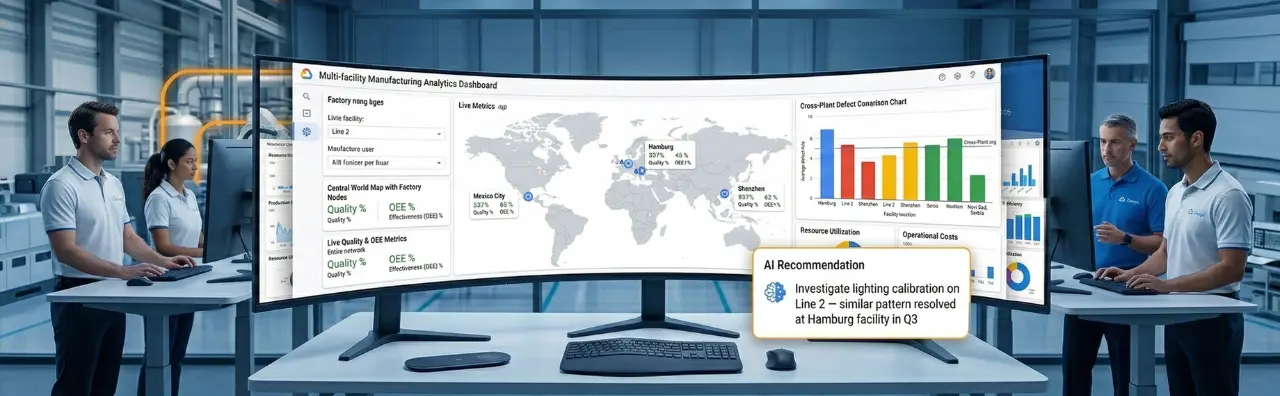
Category: Manufacturing Analytics Platform | Multi-site OEE | Quality AI | Vertex AI | Gemini for Mfg
Best For: Large manufacturers operating multiple facilities who need unified production and quality data across all sites with cross-plant benchmarking, AI analytics, and Gemini-powered operational intelligence
Key Capabilities in 2026
- - Manufacturing Data Engine: unified platform ingesting and normalising production, quality, and energy data across all facilities in a single queryable model
- - Vertex AI: managed ML platform for custom quality prediction, defect classification, and process optimisation models
- - Google Vision AI + AutoML Vision: custom defect classification models without deep ML expertise
- - Looker Manufacturing Analytics: pre-built OEE, quality performance, and production reporting dashboards
- - Google AI Essentials (Gemini): natural language interface for production data queries and quality report generation
- - BigQuery: scalable data warehouse for multi-year production, quality, and sensor data across all facilities
Why Manufacturers Choose It:
Google Cloud manufacturing analytics's differentiation is multi-site scale intelligence, aggregating and analysing data across manufacturing networks to identify cross-plant performance gaps and propagate improvements from best-performing sites to others. The 2026 Gemini integration makes production data accessible to non-technical manufacturing staff through natural language queries.
Proven Impact
- - 30–45% improvement in cross-site quality consistency
- - 25% energy cost reduction via AI-optimised scheduling
- - 2–3x faster quality issue escalation and resolution using unified analytics
#8 C3 AI Suite
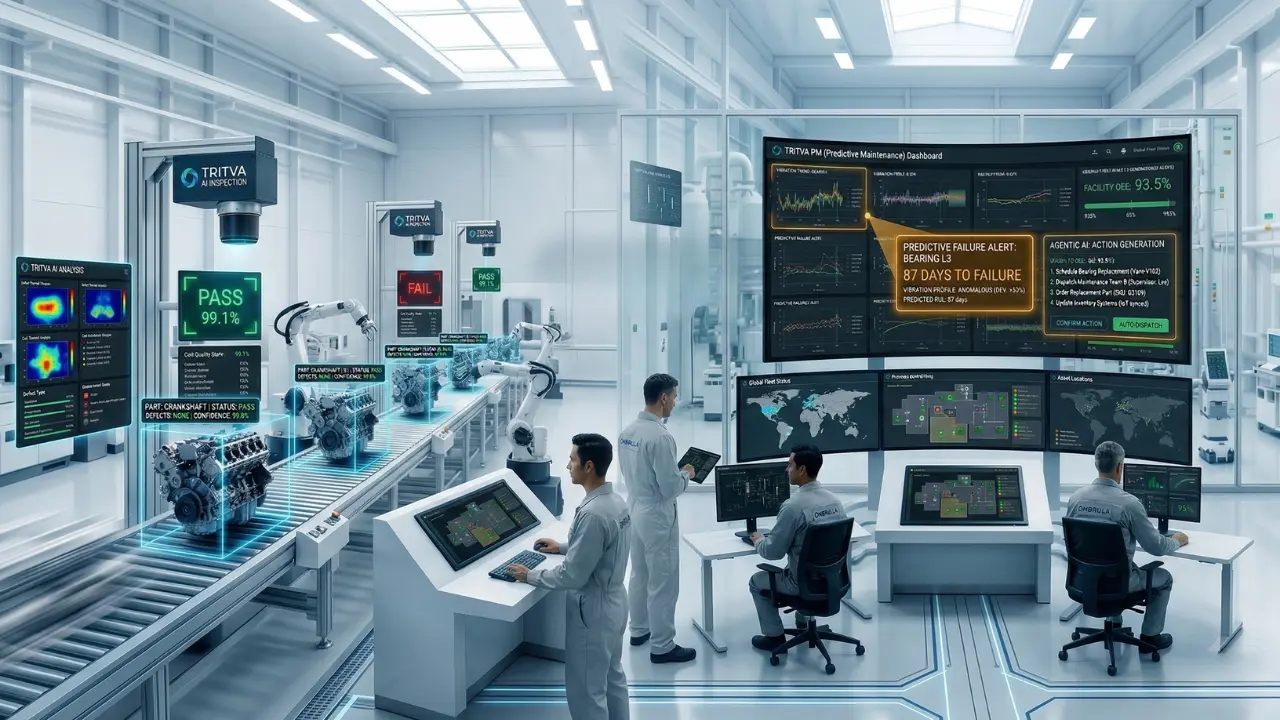
Category: Enterprise AI Platform | Pre-built Industry Applications | Predictive Maintenance | Supply Chain AI
Best For: Large enterprises with premium budgets seeking pre-configured, industry-specific AI applications deployable in weeks rather than months; organisations wanting validated manufacturing AI without building from scratch
Key Capabilities in 2026
- - C3 AI Predictive Maintenance: pre-built ML models for equipment failure prediction, deployable without building models from scratch
- - C3 AI Quality: defect prediction and quality control applications pre-integrated with manufacturing data models
- - C3 AI Supply Chain: demand forecasting, supplier risk scoring, and inventory optimisation
- - C3 AI Energy Management: ML-driven energy consumption optimisation across facilities
- - C3 Generative AI: enterprise GenAI for manufacturing, natural language production data queries, maintenance procedure generation, quality analysis
- - Pre-built manufacturing data models: industry-standard data schemas reducing data engineering before AI deployment
Why Manufacturers Choose It:
C3 AI's value is acceleration, pre-built applications proven in production deployments save the 12–18 months of model development that custom builds require. Best for large enterprises with the budget for premium enterprise licensing and the scale to justify a comprehensive platform. Smaller manufacturers typically find better value in focused solutions.
Proven Impact
- - 25–40% reduction in maintenance costs
- - 20–35% reduction in unplanned downtime
- - 15–20% improvement in demand forecast accuracy
- - 10–20% energy cost reduction
#9 PTC ThingWorx + Vuforia + Kepware
IIoT Connectivity, Augmented Reality, and Digital Thread for Complex Manufacturing
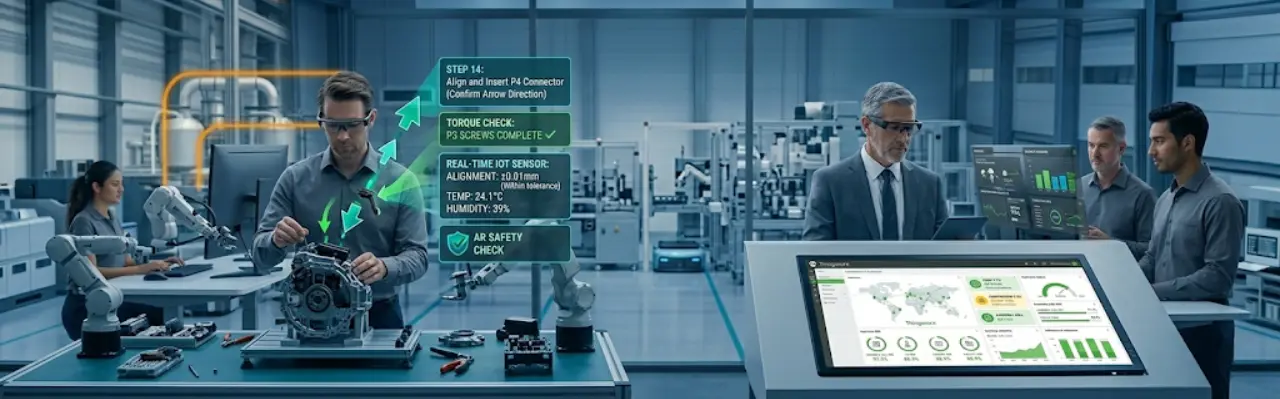
Category: industrial IoT connectivity and monitoring Platform | Augmented Reality | Digital Thread | Legacy OT Connectivity | Remote Expert Assistance
Best For: Discrete manufacturers with complex assembly operations and legacy equipment who need IoT connectivity, AR-guided operator assistance, and a digital thread connecting design through production to service
Key Capabilities in 2026
- - ThingWorx IIoT: connects legacy machines, including equipment never designed for digital connectivity, via Kepware's 150+ industrial protocol library
- - Vuforia AR: AI-guided work instructions on tablets or smart glasses, assembly guidance, quality inspection overlays, remote expert video assistance
- - ThingWorx Analytics: embedded ML for anomaly detection, quality prediction, and OEE optimisation from connected machine data
- - PTC Digital Thread: connects PLM design data through manufacturing execution to field service, closed-loop product improvement
- - Windchill PLM integration: quality and production feedback loops back into product design
- - ThingWorx Navigate: role-based production data views for operators, engineers, and managers
Why Manufacturers Choose It:
PTC's unique strength is getting AI insights to operators at the point of work, Vuforia AR delivers intelligence to hands-on-the-line workers, not just analysts behind dashboards. ThingWorx's legacy connectivity makes it the best option for manufacturers with older equipment they cannot replace but need to digitise.
Proven Impact
- - 30–50% reduction in assembly errors via AR-guided work instructions
- - 25–35% OEE improvement
- - 40–60% reduction in on-site expert travel via remote AR assistance
#10 Rockwell Automation FactoryTalk AI
OT-Native AI for Process Control, Edge Intelligence, and Production Optimisation
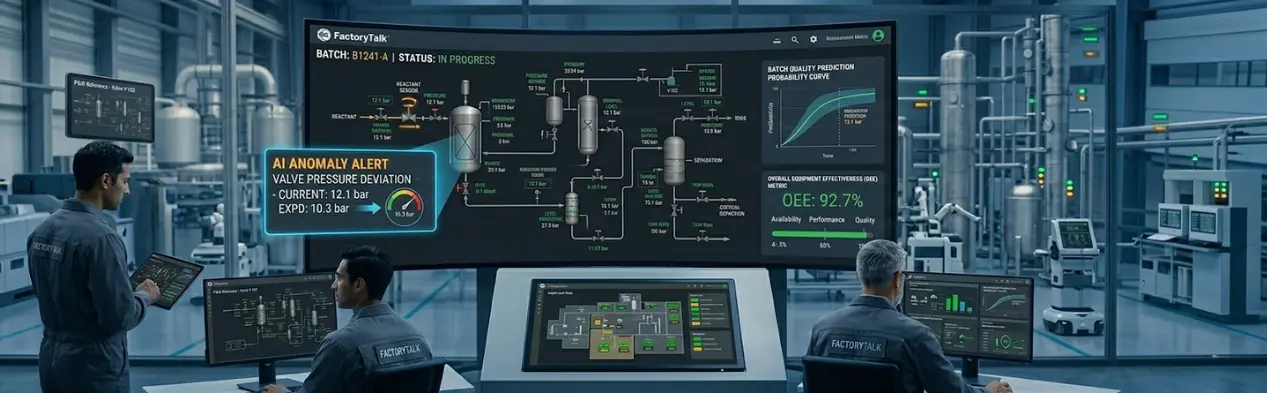
Category: OT-Native AI | Process Control | Edge AI | Batch Optimisation | MES
Best For: Process manufacturers (chemicals, pharmaceuticals, food & beverage, oil & gas refining) and discrete manufacturers using Allen-Bradley control systems who want AI embedded natively in operational technology
Key Capabilities in 2026
- - FactoryTalk Analytics AI: ML embedded in production intelligence platform, anomaly detection, quality prediction, yield optimisation from process historian data
- - NVIDIA integration: AI-powered robotic process optimisation for assembly and process automation
- - FactoryTalk Edge: ML model deployment on Allen-Bradley PLCs and Rockwell edge gateways, zero cloud dependency
- - FactoryTalk Optix: cloud-connected HMI with embedded analytics, operators see AI insights on process control interface
- - Batch Analytics: AI identifies process parameters associated with best quality outcomes for recipe optimisation
- - Plex Smart Manufacturing Platform: cloud-native ERP + MES + AI analytics (via Rockwell acquisition)
Why Manufacturers Choose It:
Rockwell's operational technology native AI AI is the preferred option for process manufacturers where the control loop is the quality mechanism. AI embedded in the PLC/SCADA layer detects process deviations in real time, within the correction window, rather than flagging them in a separate analytics platform after the fact. Particularly valuable for Allen-Bradley installed base operations.
Proven Impact
- - 15–25% yield improvement in batch manufacturing
- - 20–30% energy reduction per production unit
- - 30–40% quality out-of-spec rate reduction in pharmaceutical batch deployments