

Ombrulla logo
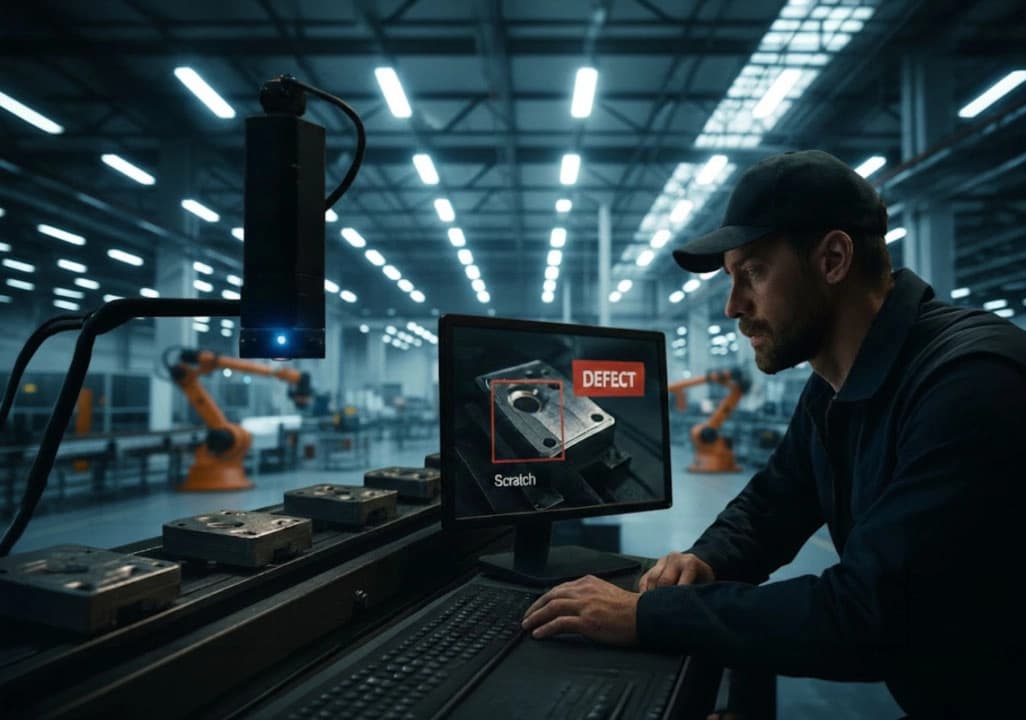
Image shows How AI Visual Inspection works in Manufacturing: The Complete Implementation Guide for 2026

How AI Visual Inspection works in Manufacturing: The Complete Implementation Guide for 2026

Zara Elizabeth - Business Development Associate - Ombrulla

Zara Elizabeth

Business Development Associate

A complete guide on how AI visual inspection works in real manufacturing environments, what it costs, and how to deploy it successfully in 2026.

Introduction

What is AI Visual Inspection in Manufacturing?

Key technologies

How this differs from traditional AOI

Manufacturing advantages

  • - Speed: Inspects at line speed, typically processing images in under 100 milliseconds.
  • - Consistency: Applies identical criteria to every part, every shift.
  • - Data insights: Creates trackable data points showing where defects cluster, which suppliers drift, and which settings correlate with quality issues.

Manufacturing Specific Defect Types AI Defect Detection can detect

Image shows Specific types of AI Defect Detection in Manufacturing
Specific types of AI Defect Detection in Manufacturing

  • - Surface defects: Scratches, dents, corrosion, pits, orange peel, dust contamination. Detection accuracy depends on lighting and camera resolution.
  • - Assembly defects: Missing fasteners, incorrect placement, wrong parts, harness routing errors. Compare against reference images of correct assembly.
  • - Cosmetic defects: Color variations, uneven coating, finish inconsistencies, print quality. The subject depends on brand standards and customer expectations.
  • - Material defects: Cracks, porosity, inclusions, voids. Often needs special lighting like backlighting or thermal imaging.

Why manufacturing is unique

AI Visual Inspection ROI Calculator

  • - Start with the “money leak” (Baseline COPQ): Output volume, defect rate, current catch rate, scrap/rework cost per defect, warranty/return cost per escape, and inspection labour cost.
  • - Turn AI into a measurable delta: Higher pre shipment detection, fewer escapes, optional defect rate reduction from faster root cause feedback, and labor redeployment/avoidance.
  • - Don’t ignore realism knobs: False reject handling cost, ramp up to steady state, and ongoing model upkeep (MLOps/retraining).
  • - Convert to executive KPIs: Annual net benefit (after opex), payback in months, NPV at your hurdle rate, IRR, and simple ROI then stress test with conservative/base/aggressive scenarios.

Implementing AI Visual Inspection: Step by Step

Pre deployment assessment

Camera positioning and lighting

Integration with production lines

Operator training

Pilot testing

Real examples

Building Training Datasets

  • - Data collection strategies: Collect during production (realistic but slow to build defect examples), stage defect samples (faster but risk missing variation), or use a hybrid approach start with staged samples, then collect real production data in shadow mode.
  • - Handling limited defect samples: Defects are rare in well run operations. Handle this through data augmentation (rotate, flip, adjust existing defect images), transfer learning (start with pre trained models), or anomaly detection (train on good parts, flag deviations).
  • - Labeling best practices: Consistency beats speed. Establish clear criteria for severity levels and borderline cases. Use the same labelers throughout when possible.
  • - Continuous learning: You can work on reinforced learning Track edge cases, retrain periodically with new examples, monitor performance trends. Tritva tracks model performance across all points, making it easier to spot when models need attention.

Industry Specific Applications

  • - Automobile Manufacturing: High volume production with tight tolerances where quality directly impacts safety and warranty costs. Paint surface defects (scratches, runs, orange peel), Weld bead quality (porosity, undercut, discontinuities), Assembly verification (missing clips/fasteners, misalignment). Ensures consistent, high speed QC across body, paint, and assembly lines.
  • - Textile Manufacturing: Large area materials and visual variability make manual inspection slow, inconsistent, and expensive at scale. Fabric defects (holes, tears, stains, slubs), Pattern and seam alignment issues, Shade variation and roll grading/classification. Automates fabric inspection to improve grading accuracy and reduce customer rejections.
  • - Solar Panel Manufacturing: Small defects can cause significant efficiency loss and long term reliability issues in the field. Cell microcracks and broken fingers, Busbar/soldering defects and misalignment, Lamination bubbles, backsheet defects, edge chipping. Detects hidden and visible defects early to protect module efficiency and reliability.
  • - Pharma & Healthcare: Regulated environments demand zero defect packaging, patient safety, and full batch traceability. Vial/ampoule defects (cracks, chips, particulates), Fill level and cap/stopper verification, Label, batch code, and serialisation validation. Delivers compliant inspection with complete traceability across every batch and site.
  • - Electronics Manufacturing: Miniaturized components and dense assemblies require inspection at component level precision. Solder joint inspection (bridging, voids, insufficient solder), Component placement/orientation (missing, wrong, polarity), Connector/pin integrity and AOI based defect classification. Prevents escapes by catching PCB and assembly defects early and consistently.

Implementation Roadmap

Image indicates a roadmap to implement AI Visual Inspection
Implementation of AI Visual Inspection Roadmap
  • - Phase 1: Use case selection (2-4 weeks): Identify biggest quality impact point, assess feasibility, and document the baseline.
  • - Phase 2: Data collection and pilot (4-8 weeks): Install cameras, capture images, label data, train initial model.
  • - Phase 3: Model validation (4-6 weeks): Deploy in shadow mode, compare decisions, tune thresholds.
  • - Phase 4: Production deployment (2-4 weeks): Switch to active mode with operator verification, monitor closely.
  • - Phase 5: Scale and optimize (ongoing): Expand to other points/plants, continuous improvement through retraining.

Measuring Success

  • - Executive outcomes (monthly/quarterly): Customer PPM / escaped defects (overall + CTQ), COPQ ($ scrap+rework+warranty/returns+containment), FPY/RTY, scrap & rework cost, delivery impact (holds/backlog), payback/NPV/IRR vs plan.
  • - Operational health (weekly): Inspection coverage (% units inspected), takt time compliance (p95/p99 decision latency vs cycle time), uptime & MTTR, disposition flow (recheck queue size/aging), override rate (human overrides), false reject operational burden (hours/$ created).
  • - Inspection performance (weekly/biweekly): Detection effectiveness (defect capture pre shipment), CTQ miss rate (false accepts per million), false reject rate (good units flagged) and cost, precision/recall by defect class (CTQ weighted), drift indicators (confidence/data distribution shifts) + time to retrain/change control.

Choosing the Right Solution

  • - Edge vs. Cloud (Architecture): Hybrid is most common: edge inference for speed + cloud for reporting/updates - Edge = faster, resilient; Cloud = centralized analytics and updates.
  • - Integration Capabilities: Must integrate with PLCs, MES, SCADA, ERP/QMS and trigger actions - Integration quality often decides scale success more than the model.
  • - Customization vs. Off-the-Shelf: Off-the-shelf for standard, repeatable use cases; custom when conditions vary - Custom-built approaches (e.g., Ombrulla’s approach) tend to perform better when conditions vary or defects are subtle.
  • - Vendor Evaluation: Choose vendors with manufacturing track record in your industry - Look for proven deployments not just demos.
  • - POC Best Practices: Run a POC using real parts, real conditions, real variation - Short POCs often miss variation and overestimate ROI.
  • - Total Cost of Ownership (TCO): Cost model should include capex + opex and ongoing AI ops - Tritva can reduce costs by consolidating multiple inspection points on one platform (confirm with a line-level cost breakdown).

Conclusion

Take the Next Step

Ready to see how AI visual inspection can transform your manufacturing process?
Schedule consultation