

Ombrulla Logo
Drone + AI Infrastructure Inspection: 2026 Adoption Outlook for Industrial Leaders

Drone + AI Infrastructure Inspection: 2026 Adoption Outlook for Industrial Leaders

Zara Elizabeth - Business Development Associate - Ombrulla

Zara Elizabeth

Business Development Associate

Aug 14, 2026

In 2026, drone-assisted AI inspection has crossed from pilot phase into mainstream industrial deployment. Learn key adoption trends, ROI metrics, industry applications, and implementation strategies.
The Inspection Problem

The Inspection Problem That Won't Wait

Somewhere in your facility right now, there is aging infrastructure that nobody has looked at closely enough - not because your team is negligent, but because getting a human inspector to every weld seam, flare stack, or bridge deck is physically, economically, and sometimes legally impractical.

It is a problem that every VP of Operations, HSE Director, and Plant Manager in oil and gas, manufacturing, construction, and chemicals quietly lives with. You schedule inspections. You work around regulatory compliance calendars. You try to balance access risk with asset uptime. And somewhere in that process, things slip - cracks go unmeasured, corrosion advances undetected, and near-misses accumulate until they become incidents.

This is not a technology gap. It is an information gap - and in 2026, drone + AI inspection technology is closing it faster than most senior leaders realise.

This article gives you an honest, grounded look at where the market stands, which industries are gaining the most, what the adoption barriers still are, and how to evaluate whether your organisation is ready to make this shift - or is already falling behind.

What Exactly Is Drone + AI Infrastructure Inspection?
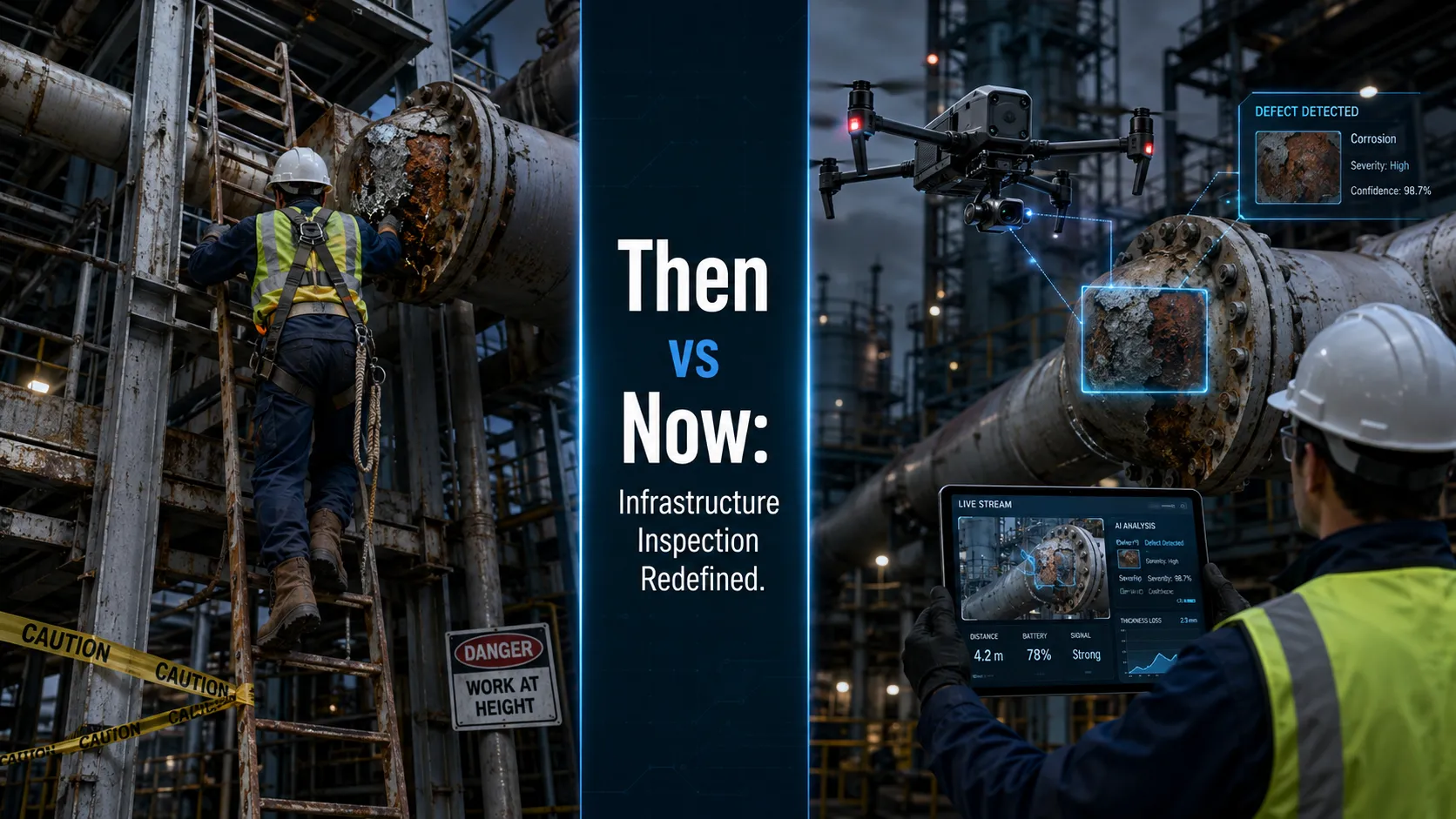
What Exactly Is Drone + AI Infrastructure Inspection
Then vs Now: Infrastructure Inspection Redefined

The Core Definition

Drone + AI infrastructure inspection - also referred to as autonomous aerial inspection, AI-assisted UAV inspection, or intelligent drone NDT (Non-Destructive Testing) - combines three converging technologies:

  • -
    Unmanned Aerial Vehicles (UAVs):Industrial-grade drones capable of navigating confined, elevated, or hazardous environments without direct human entry.
  • -
    Computer Vision and Machine Learning:AI models trained to identify defects, anomalies, corrosion, cracks, structural deformation, and heat signatures from visual, thermal, and LiDAR sensor data.
  • -
    Edge Computing and Cloud Analytics:Real-time processing onboard or near-device, with full analytical reporting available in cloud dashboards within hours - not weeks.

What Can It Inspect?

Modern drone + AI systems are not limited to photography. Depending on sensor configuration, they inspect:

Asset CategorySensor UsedWhat AI Detects
Pipelines & VesselsThermal + RGBCorrosion, leaks, insulation loss, delamination
Flare StacksThermal + Gas SensorHot spots, flame irregularities, metal fatigue
Storage TanksLiDAR + RGBWall thinning, weld defects, settlement
Structural SteelRGB + UltrasonicCracks, spalling, bolt looseness, weld failure
Cooling TowersThermal + RGBFouling, scaling, mechanical anomalies
Construction SitesLiDAR + RGBProgress monitoring, safety compliance, earthwork volume
High-Rise BuildingsRGB + ThermalFacade cracks, water ingress, HVAC issues
Chemical Plant AssetsGas + ThermalVOC leaks, pipe stress, tank integrity

Why "Drone Alone" Is Not the Answer

It is important to make a distinction that vendors do not always make clearly: drones without AI are flying cameras. They capture data, but data without analysis is just storage cost.

The transformation happens at the AI layer - where trained models can scan thousands of images per mission, flag anomalies with severity scoring, cross-reference findings against historical asset data, and deliver inspection reports that prioritise intervention before failure occurs.

Without that intelligence layer, organisations end up with raw footage that still requires human review at every frame - replacing one bottleneck with another, more expensive one.

The 2026 Market Reality - Where Are We Now?
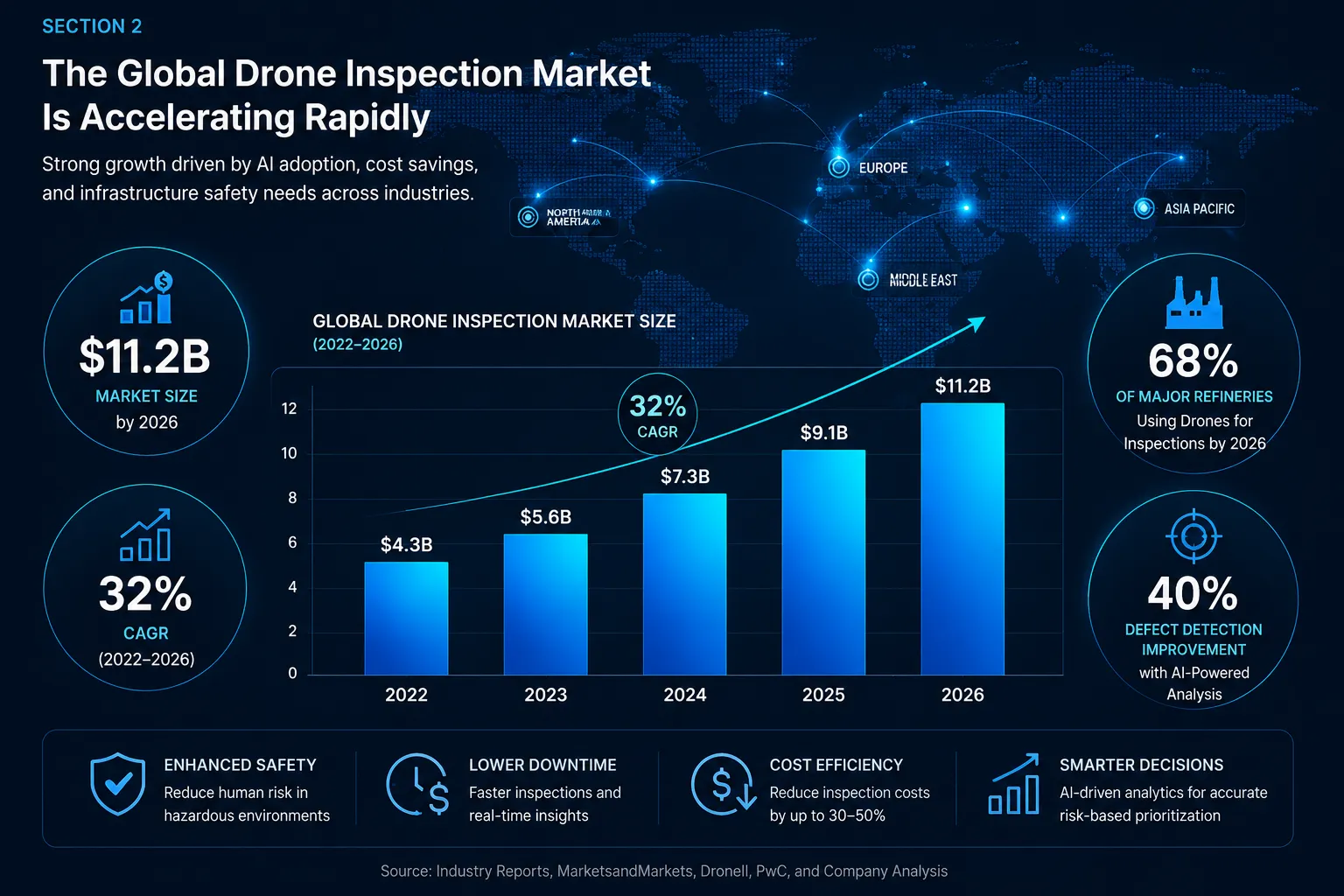
Infographic showing global drone inspection market growth from 2022 to 2026, highlighting AI-powered infrastructure inspection trends, market size, CAGR, refinery adoption, and defect detection improvements across industrial sectors.
Global Drone Inspection Market Growth

The Market Has Moved Beyond the Pilot Stage

For years, drone inspection occupied a familiar innovation gap: compelling in demonstrations, successful in pilots, yet difficult to scale across complex industrial environments. That changed around 2024.

A convergence of regulatory progress, AI vision maturity, longer flight endurance, improved sensor performance, and enterprise software integration transformed drone inspection from an experimental capability into a deployable industrial system.

Today, the market is entering a new phase-one defined not by proof of concept, but by enterprise-wide adoption, automation, and measurable operational impact.

$11.2B

Global Drone Inspection Market Size in 2026

Source: MarketsandMarkets and Grand View Research estimates

32% CAGR

Projected growth through 2030

Source: Grand View Research - Inspection & Maintenance Drone Market

68%

Major Refineries Using Drones

Major refineries and chemical complexes globally now use drones for inspection as of Q1 2026.

40%

Defect Detection Improvement

Higher defect-detection performance when AI computer vision complements manual inspection.

The implication is clear: drone inspection is no longer an emerging technology initiative. It is becoming core industrial infrastructure.

Sector-by-Sector Adoption in 2026

IndustryAdoption StagePrimary DriverKey Use Cases in 2026
Oil & GasMainstreamSafety & ComplianceTank farms, pipeline corridors, flare inspection, offshore platforms
ManufacturingEarly MajorityDowntime ReductionStructural steel, conveyor systems, roof inspection, press areas
ConstructionEarly MajorityProgress MonitoringSite surveying, safety audits, earthwork measurement, facade inspection
ChemicalEarly AdopterRegulatory PressureStorage tanks, pressure vessels, vent stacks, confined zone mapping

What's Driving the Acceleration in 2026?

The 2026 inflection point is not explained by a single factor. It is the result of several converging forces:

  • -
    Regulatory normalisation:Aviation authorities across the US, EU, UK, and GCC have finalised BVLOS (Beyond Visual Line of Sight) frameworks, enabling longer autonomous mission flights without a pilot in direct visual range. This has unlocked large-site inspections that were previously impractical.
  • -
    AI model maturity:Computer vision models trained on industrial defect datasets have now reached commercial-grade reliability - routinely outperforming human visual inspectors on repetitive image classification tasks.
  • -
    Insurance pressure:Underwriters are beginning to offer premium discounts to facilities that operate structured drone inspection programmes, recognising the risk-reduction value. In some energy sector cases, inspection data is now required for policy renewals.
  • -
    Workforce pressure:Skilled industrial inspectors are a shrinking demographic. Drone + AI doesn't replace the expertise, but it dramatically reduces the volume of high-risk physical access required, making the existing workforce more productive and safer.
  • -
    Cost curve improvement:The per-mission cost of drone inspection has dropped significantly as hardware matures and software scales. Enterprise drone programmes are now reporting total inspection cost reductions of 30–60% versus traditional scaffolded access methods.

Industry Deep Dive - Real-World Applications

Oil & Gas: Safety-Critical and Cost-Sensitive

AI-powered drone inspection of an oil refinery using a thermal camera to detect pipeline insulation failure, helping improve predictive maintenance, infrastructure safety, and asset reliability.
AI-Powered Drone Thermal Inspection of Oil & Gas Refinery

No sector has embraced aerial inspection technology more aggressively than oil and gas. The reasons are structural: facilities are vast, operating continuously, populated with hazardous media, and regulated heavily by bodies including OSHA, HSE, API, and the European PED framework.

  • -
    Upstream Operations:Offshore platforms and onshore drilling pads are using drones for flare tip inspection - once a task requiring weeks of scaffolding, crane hire, and shutdown coordination. A drone mission takes hours, the platform keeps running, and the AI delivers anomaly-flagged thermal imagery and structural analysis within the same working day.
  • -
    Midstream & Pipeline:Thousands of kilometres of pipeline corridor that previously relied on annual ground-level visual surveys or manned helicopters are now patrolled by fixed-wing drones on programmatic schedules. AI models process imagery for soil displacement, third-party activity encroachment, corrosion under insulation (CUI), and cathodic protection failure indicators.
  • -
    Downstream Refining:Refinery tank farms, heat exchangers, and process columns represent some of the highest inspection value density for drone + AI systems. A single drone mission covering an entire tank farm - with AI-generated wall thickness estimates, seal integrity reports, and drainage channel analysis - produces more actionable data than a month of manual inspection rounds.

Manufacturing: Downtime Is the Enemy

Manufacturing plants operate on tight production schedules where unplanned downtime is the most expensive event that can occur. Traditional inspection approaches require production interruptions - shutting down a press line or conveyor system to allow physical access. This is a cost many plant managers absorb because they see no alternative.

Drone + AI inspection changes the equation by enabling non-intrusive inspection during operations. A drone can survey a running conveyor system, identify a developing bearing fault through thermal imaging, and flag it for scheduled maintenance before it becomes an emergency shutdown.

  • -
    REAL-WORLD EXAMPLE: European Automotive ManufacturerA European automotive components manufacturer deployed an AI-powered drone inspection programme for their press shop roof structures and overhead cranes in 2025. Previously inspected manually every 18 months, the programme now runs quarterly autonomous missions. In the first deployment cycle, the AI identified early-stage fatigue cracking in three crane girders - defects estimated to be 6–12 months from failure. The deferred incident cost? Conservatively €2.3M in production loss and repairs. The drone programme annual cost? Under €180,000.

Construction: Progress, Safety, and Compliance
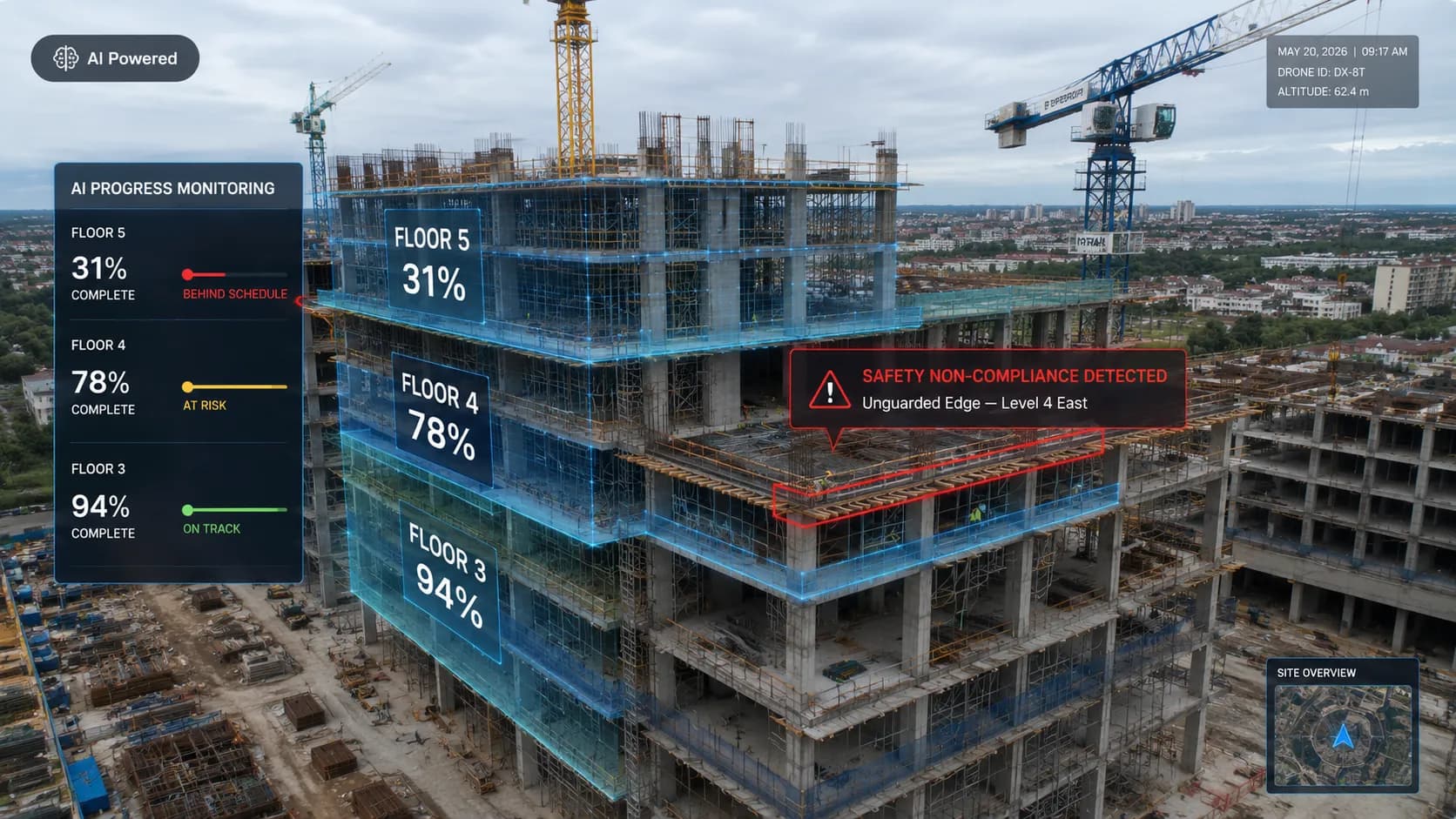
AI-powered drone monitoring a high-rise construction site with real-time progress tracking, floor completion analysis, and automated safety compliance alerts.
AI-Powered Drone Progress and Safety Monitoring on Construction Site

Construction drone applications in 2026 fall into three distinct categories that deliver compounding value when deployed together:

  • -
    Volumetric and progress monitoring:LiDAR-equipped drones generate precise 3D site models that measure earthwork volumes, track structure progress against BIM models, and quantify material stockpiles - replacing manual surveys that previously took days per week.
  • -
    Safety compliance monitoring:AI models trained on construction safety standards identify PPE non-compliance, unguarded edges, improper scaffold configurations, and proximity violations - providing HSE teams with evidence-based safety intelligence rather than anecdotal observation.
  • -
    Facade and structural inspection:As structures approach completion, drones survey concrete facades, glazing installations, and waterproofing systems for cracks, voids, and defects that would otherwise require expensive rope access at handover stage.

Chemical Industry: Regulatory Complexity Meets AI Precision

Chemical facility inspection carries a level of complexity that exceeds most other industrial environments - corrosive media, flammable atmospheres, high-pressure processes, and multilayered regulatory oversight from bodies including REACH, COSHH, EPA, and local environmental permits.

Drone inspection in this context requires ATEX-rated equipment (explosion-proof certified) and AI models specifically trained to recognise the unique failure modes of chemical storage, containment, and processing assets. In 2026, both are commercially available and being actively deployed at major chemical complexes across Western Europe and the Gulf Cooperation Council.

The specific areas delivering highest value in chemical plant inspection include pressure vessel external condition assessment, bund wall integrity monitoring, vent stack condition, and ground-level inspection of secondary containment systems - all tasks that previously required specialised access permits and significant shutdown coordination.

The AI Layer - What Intelligence Actually Looks Like

Beyond the Buzzword: What AI Actually Does in Inspection

The word "AI" is overused in industrial technology marketing to the point of becoming noise. For senior leaders evaluating inspection technology, the more useful question is: what specific function does the AI perform, and how does it improve on what we do today?

In mature drone inspection platforms in 2026, the AI layer performs several distinct and independently valuable functions:

  • -
    1. Automated Defect Detection and ClassificationComputer vision models - typically convolutional neural networks trained on millions of industrial defect images - scan every frame of captured footage and flag candidate anomalies. Unlike human reviewers who experience attention fatigue, AI models maintain consistent detection performance across the 10,000th image as they do across the 10th. In 2026, best-in-class systems classify defect type (corrosion, crack, deformation, contamination), estimate severity, and assign a risk score - all within minutes of flight completion.
  • -
    2. Trend Analysis and Predictive Maintenance IntegrationWhen inspection data is compared across multiple missions over time, AI models can identify the rate of deterioration - not just the current state. This is where drone inspection transcends its periodic nature and begins to function as a predictive maintenance signal, feeding directly into CMMS (Computerised Maintenance Management Systems) and enterprise asset management platforms.
  • -
    3. Anomaly Correlation Across AssetsEnterprise AI platforms analyse findings across multiple assets simultaneously, identifying patterns that human analysts would not detect across disparate datasets - for example, recognising that a specific weld type is failing at an accelerated rate across a class of vessels, suggesting a systematic issue rather than isolated incidents.
  • -
    4. Regulatory Report GenerationAI-generated inspection reports structured to meet specific regulatory standards (API 653 for storage tanks, ASME for pressure vessels, EN 1090 for structural steel) reduce the compliance documentation burden significantly - a practical benefit that matters enormously to compliance teams with growing audit obligations.

The Human in the Loop: Why AI Does Not Replace the Inspector

A critical misunderstanding that slows adoption is the belief that AI drone inspection removes the need for qualified inspectors. It does not - and the best platforms are designed specifically to amplify inspector expertise rather than circumvent it.

The model that works in practice in 2026 is this: drones handle data capture across the full asset footprint; AI handles first-pass analysis, anomaly flagging, and report structuring; qualified inspection engineers review AI-flagged findings, apply professional judgement, and make fitness-for-service determinations. The result is that an inspection engineer who previously spent 60% of their time on access logistics and image review can redirect that capacity toward analysis, client advisory, and complex fault assessment.

📊 EFFICIENCY IMPACT
Independent analysis by the Society for Non-Destructive Testing (ASNT) estimates that AI-assisted drone inspection reduces total inspection man-hours by 35–55% on complex industrial assets while simultaneously increasing the proportion of the asset surface area inspected per mission by 200–400%.

Barriers to Adoption - What's Still Holding Organisations Back?
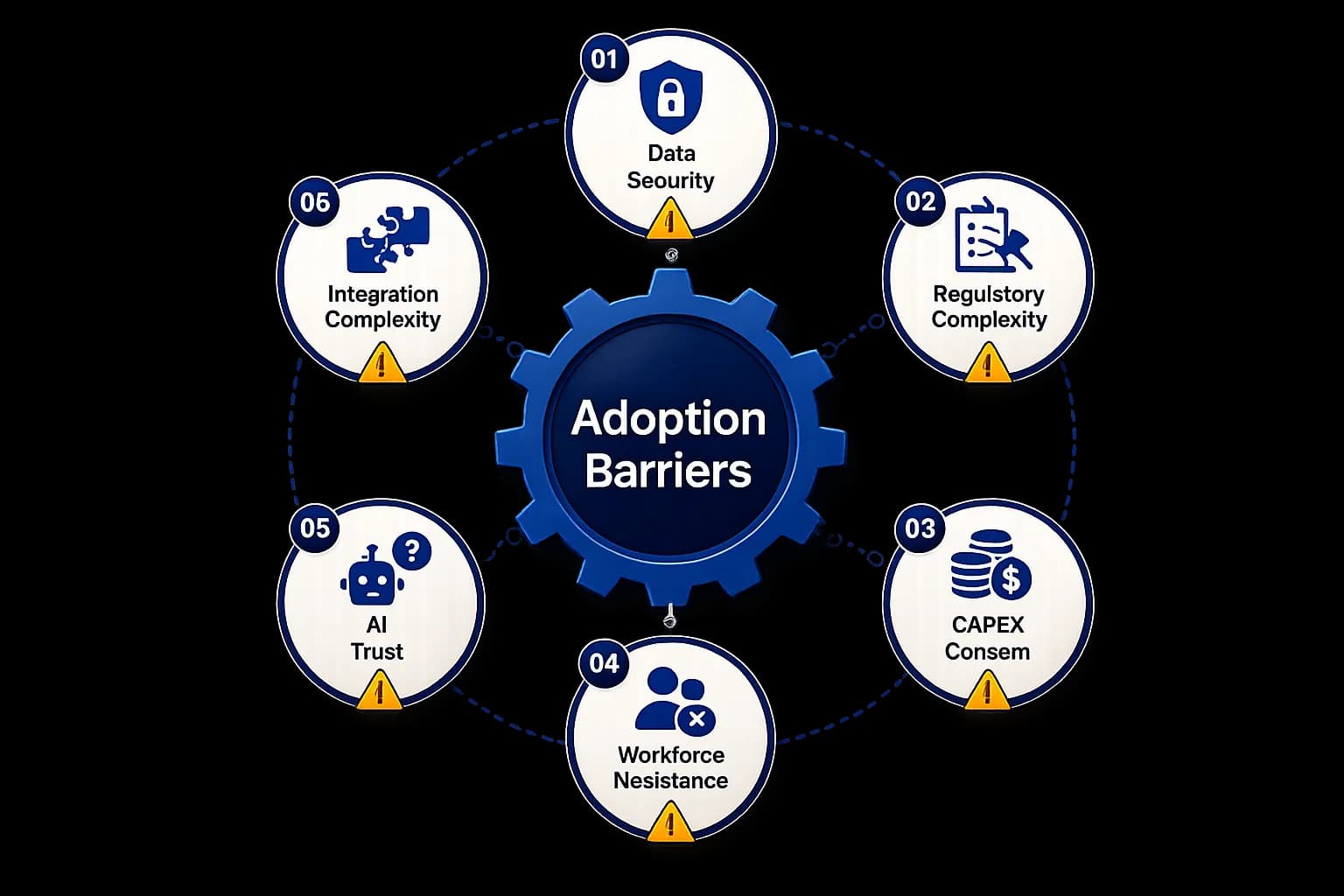
AI-powered drone inspection adoption
Key Barriers Holding Organisations Back in Drone + AI Adoption

Acknowledging barriers is not pessimism - it is operational realism. For every organisation that has successfully deployed drone + AI inspection at scale, there are others that have stalled. Understanding why helps leaders navigate those obstacles faster.

  • -
    Barrier 1: Data Security and Sovereignty ConcernsIndustrial inspection data is not just commercially sensitive - in some cases it is strategically sensitive. Facility layouts, asset configurations, capacity data, and integrity status represent information that organisations legitimately do not want processed through opaque third-party cloud environments. In 2026, leading platforms offer on-premise and private cloud deployment options that keep data within defined sovereignty boundaries.
  • -
    Barrier 2: Regulatory and Airspace ComplexityFlying drones within active industrial facilities requires navigating multiple regulatory layers simultaneously: aviation authority approval, site-specific HSE risk assessment, potentially ATEX zone compliance, and insurance validation. The practical solution in 2026 is to engage technology providers who manage regulatory compliance as part of their service offering.
  • -
    Barrier 3: Integration With Existing Maintenance SystemsDrone inspection data that lives in a separate platform delivers a fraction of its potential value. The transformative step is integration with CMMS, EAM, digital twin, and predictive maintenance platforms - allowing AI-flagged findings to automatically generate work orders, update asset registers, and feed into risk-based inspection (RBI) planning.
  • -
    Barrier 4: Internal Resistance and Workforce ConcernsChange management in industrial organisations is neither trivial nor quick. Inspection workforce communities may perceive drone + AI technology as a workforce displacement threat rather than a capability enhancement. Successful organisations involve inspection professionals in technology evaluation and invest in upskilling.
  • -
    Barrier 5: Trust in AI RecommendationsQualified inspection engineers are accountable for the findings they sign off. Explainable AI (XAI) capabilities - where the platform communicates why a particular anomaly was flagged, with what confidence level, and based on what comparable training examples - are becoming a standard requirement in enterprise procurement.

The ROI Calculation - Making the Business Case

Building a Compelling Internal Business Case

For senior management in capital-intensive industries, technology investment decisions are ROI conversations. Here is how the value proposition for drone + AI inspection structures across a typical large facility:

Value CategoryTypical Impact RangeExample Scenario
Inspection Cost Reduction30–60%Replace 4 scaffolded access campaigns (£280K) with 8 drone missions (£95K)
Downtime Prevention£500K–£5M/incidentEarly crack detection on process column avoids unplanned 72hr shutdown
Safety Incident AvoidanceImmeasurable + regulatoryInspector RIDDOR incident eliminated by removing need for physical height access
Regulatory ComplianceAudit cost −30%AI-structured reports reduce audit preparation from 6 weeks to 10 days
Insurance Premium Reduction5–15%Demonstrated inspection programme reduces risk profile for underwriters
Asset Life Extension10–20% lifecycleEarly intervention on corrosion extends vessel life by 4–6 years vs. replacement

Typical Payback Timelines

Based on independently reported case studies across the oil and gas, manufacturing, and chemical sectors:

  • -
    High-value, high-complexity assets (refineries, chemical plants, offshore):Typical ROI positive within 12–18 months of programme establishment.
  • -
    Mid-scale manufacturing:Typically ROI-positive within 18–24 months.
  • -
    Construction and infrastructure:Often ROI-positive within a single project cycle where traditional access costs are displaced.

The Cost of Inaction

The business case for drone + AI inspection is not just about programme ROI. There is an equally compelling case built around the cost of not adopting - and this is the calculation that moves more quickly than many leaders expect.

In competitive industrial sectors, the organisation that can complete a full tank farm inspection in 3 days versus 6 weeks - and produce AI-prioritised maintenance schedules that keep assets running 12% longer - carries a structural efficiency advantage. This translates into bid competitiveness, insurance differentials, regulatory relationship quality, and ultimately share price for publicly listed businesses.

What to Look for When Evaluating Solutions

The 2026 Buyer's Evaluation Framework for Drone + AI Inspection

Not all drone inspection platforms are equal, and the gap between a well-engineered enterprise solution and a cobbled-together system becomes apparent only when you are relying on the data to make multi-million pound maintenance decisions.

Here are the key evaluation dimensions that industrial procurement teams should examine:

  • -
    AI Model Provenance and Training Data:Where was the model trained? On what datasets? Has it been validated against your specific asset types? A model trained primarily on construction imagery will not perform reliably on refinery process equipment. Ask for sector-specific validation data.
  • -
    Regulatory Report Compatibility:Can the platform produce inspection reports that meet the specific standards applicable to your assets - API 510/570/653, ASME, EN 13480, PSSR, etc.? This is a compliance necessity.
  • -
    System Integration Capability:Does the platform have pre-built connectors to your existing CMMS, EAM, or digital twin environment? What is the data export format - open standard or proprietary?
  • -
    Deployment Flexibility:Is cloud deployment the only option, or can the system run on-premise or in a private cloud environment? For sensitive facilities, this is often a procurement gate.
  • -
    Airspace and Regulatory Support:Does the provider manage aviation authority compliance and site-specific operational authorisation? Or does this burden fall entirely on your organisation?
  • -
    Explainability and Audit Trail:Can the AI explain its findings? Is there a full audit trail of model version, detection parameters, and human review decisions for each inspection finding?
  • -
    Scalability Pricing Model:Does cost scale sensibly as you expand from one site to five to fifty? Per-mission, per-asset, or enterprise licence models have significantly different economics at scale.

Red Flags to Watch For

  • -
    Unvalidated Models:Platforms that cannot demonstrate sector-specific AI training and validation.
  • -
    Integration Afterthought:Vendors who treat integration as an afterthought or extra-cost project.
  • -
    Hardware Lock-in:Solutions that require proprietary drone hardware exclusively - locking your procurement to a single supply chain.
  • -
    Black Box AI:AI platforms with no explainability layer or confidence scoring.
  • -
    No Regulatory Backing:Providers who cannot supply regulatory compliance documentation for your specific jurisdiction.

How Ombrulla Approaches Drone + AI Inspection
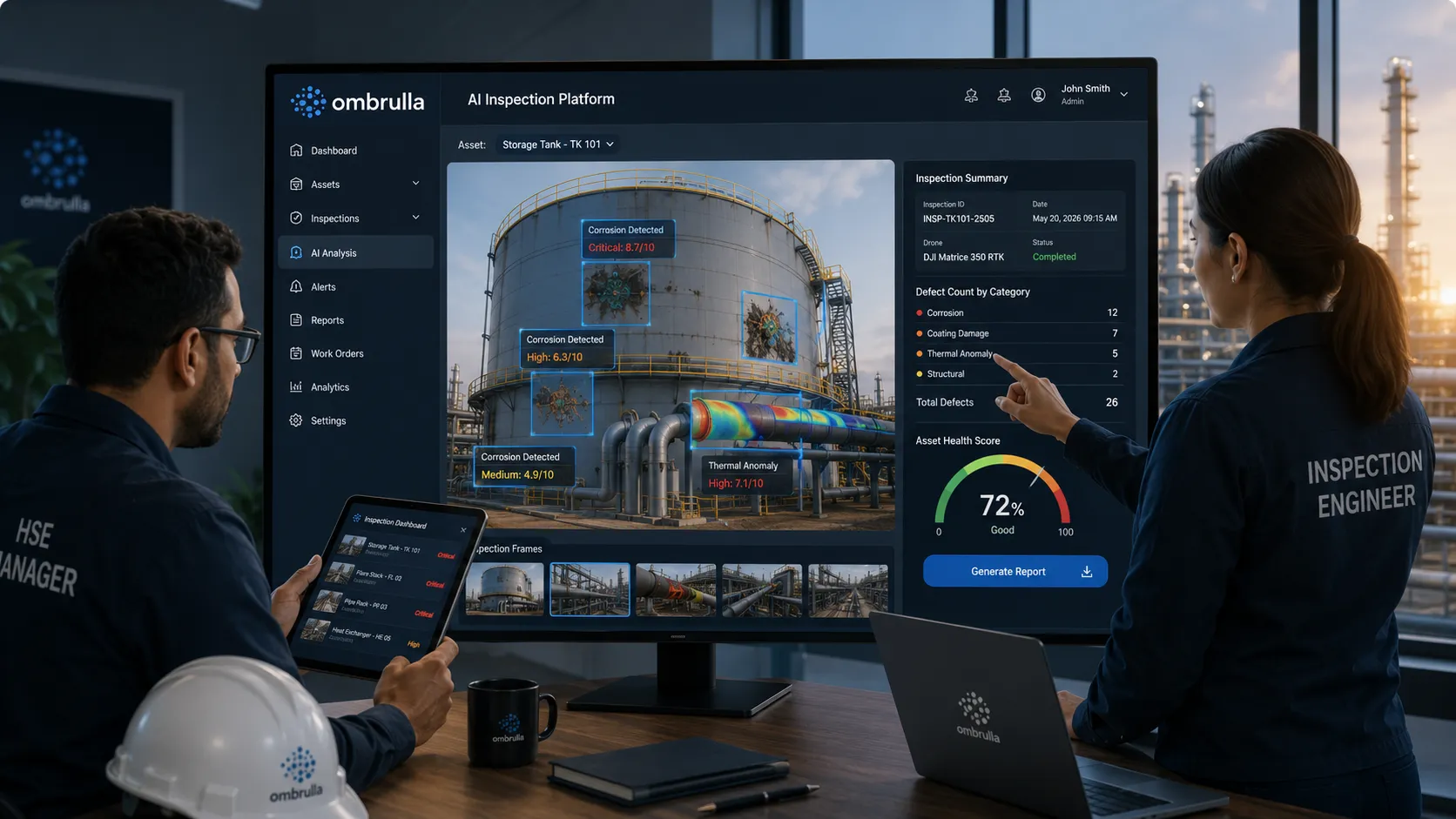
Ombrulla AI inspection platform dashboard displaying industrial asset analysis with AI-powered defect detection, thermal inspection, asset health monitoring, and automated inspection reporting.
Ombrulla AI Inspection Platform Dashboard

Ombrulla is an AI-first inspection intelligence platform designed specifically for industrial asset owners and inspection service providers who need more than drone footage - they need defensible, actionable intelligence.

Built for the complexity of oil and gas, chemical, manufacturing, and construction environments, Ombrulla's platform addresses the most common failure points that prevent drone inspection programmes from scaling:

  • -
    Industry-Specific AI Models:Trained and validated against industrial defect datasets across multiple asset classes - not generic computer vision adapted to an industrial context, but purpose-built models for real industrial environments.
  • -
    Regulatory-Ready Reporting:Automated report generation structured for API, ASME, EN, and PSSR compliance requirements - reducing compliance documentation burden while maintaining engineering standards.
  • -
    Open Integration Architecture:Pre-built connectors and open APIs that allow Ombrulla's findings to feed directly into SAP PM, IBM Maximo, and equivalent enterprise asset management platforms.
  • -
    Deployment Flexibility:Cloud, private cloud, and on-premise deployment options ensuring data sovereignty for sensitive infrastructure environments.
  • -
    Hardware Agnostic:Compatible with leading industrial drone platforms across DJI Enterprise, Parrot, Skydio, and Percepto ecosystems.

For senior leaders evaluating whether a drone + AI inspection programme is the right fit for your organisation, Ombrulla offers structured discovery sessions - working conversations with domain specialists who understand your regulatory environment, asset complexity, and operational constraints.

Preparing Your Organisation for Adoption

Successfully deploying a drone + AI inspection programme is as much an organisational change initiative as it is a technology procurement. Here is a practical readiness framework:

Phase 1 - Foundation (Months 1–3)

  • -
    Asset Inventory:Conduct an asset inventory and prioritise inspection candidates by risk, access difficulty, and current inspection cost.
  • -
    Workflow Integration:Map existing CMMS, EAM, and maintenance workflow systems that inspection data will need to connect with.
  • -
    Regulatory Compliance:Identify regulatory and airspace approval requirements for your specific sites.
  • -
    Steering Group:Engage an inspection steering group including HSE, maintenance, engineering, and compliance stakeholders.

Phase 2 - Pilot (Months 3–6)

  • -
    Asset Selection:Select a high-value, representative asset class for a structured pilot programme.
  • -
    Success Metrics:Define clear success metrics before the pilot begins: detection rate, report turnaround, integration performance, engineer satisfaction.
  • -
    Parallel Inspection:Run parallel inspection - traditional and drone + AI - on a subset of assets to validate comparative performance.
  • -
    Cost Measurement:Measure actual cost against baseline; quantify avoided access costs and time savings.

Phase 3 - Scale (Months 6–18)

  • -
    Enterprise Expansion:Expand programme across asset classes and sites based on pilot ROI evidence.
  • -
    Internal Capability:Invest in internal drone programme management capability - do not remain entirely dependent on third-party service delivery.
  • -
    Predictive Integration:Integrate inspection findings into predictive maintenance scheduling and risk-based inspection planning.
  • -
    Model Feedback Loop:Establish an ongoing AI model improvement loop with your technology partner - feeding back confirmed findings to improve detection accuracy over time.

Looking Ahead - 2027 and Beyond

The Next Frontier: Continuous Autonomous Inspection

The 2026 model - periodic drone missions generating AI reports - is already being superseded in the most advanced deployments. The emerging model is continuous autonomous inspection, where:

  • -
    Autonomous Dock Systems:Permanently stationed drones conduct daily or weekly missions without human intervention, building a continuous data stream of asset condition.
  • -
    Living Digital Twins:Digital twins receive real-time inspection data, maintaining a living model of asset condition that evolves with every mission.
  • -
    Dynamic Risk Scoring:AI-driven risk scoring dynamically updates maintenance priority queues based on deterioration rate, operating conditions, and consequence of failure modelling.
  • -
    Predictive Intervention:Predictive intervention replaces scheduled maintenance as the primary maintenance trigger - moving from time-based to condition-based to prediction-based maintenance cycles.

Technology Trends to Watch

  • -
    Swarm inspection:Multiple coordinated drones inspecting large assets simultaneously, reducing mission time for extensive asset footprints.
  • -
    Multi-modal AI fusion:Combining visual, thermal, acoustic, and gas detection data in a single AI analysis layer for richer defect characterisation.
  • -
    Digital thread integration:Inspection findings linked directly to original design data, material specifications, and construction records - enabling life-cycle-aware asset management.
  • -
    Quantum sensing on drones:Emerging research into quantum magnetometers and gravimeters that could detect subsurface defects and pipeline contents - inspection capabilities currently impossible with conventional sensor arrays.

The organisations building programme infrastructure and institutional knowledge now will be positioned to adopt these advanced capabilities as they mature - without the disruption of starting from scratch.

Ready to Move From Pilot to Programme?

Whether you're exploring options, building a business case, or ready to scope a pilot programme, Ombrulla's team of industrial AI and inspection specialists can help you move forward with clarity.

Request a complimentary Infrastructure Inspection AI Assessment

Download the Drone + AI Inspection ROI Calculator

Book a 30-Minute Discovery Call With an Industry Specialist

Get Started with Ombrulla

Frequently Asked Questions

What is drone AI infrastructure inspection?

Drone AI infrastructure inspection combines unmanned aerial vehicles (UAVs) equipped with sensor arrays and AI-powered computer vision software to autonomously inspect industrial assets - including pipelines, tanks, structural steel, and process equipment. The AI analyses captured data to detect defects, anomalies, and deterioration patterns, producing actionable inspection reports without requiring physical human access to hazardous or difficult-to-reach areas.

How accurate is AI defect detection compared to traditional manual inspection?

In controlled comparative studies, AI-assisted drone inspection has demonstrated defect detection rates 30–50% higher than manual visual inspection for consistent, repetitive inspection tasks. However, accuracy is highly dependent on AI model training quality, sensor resolution, flight parameters, and the specific defect type. AI excels at detecting corrosion, surface cracking, and thermal anomalies at scale; complex fitness-for-service determinations still require qualified inspection engineer judgement.

What industries benefit most from drone + AI inspection in 2026?

Oil and gas (upstream, midstream, and downstream), chemical processing, large-scale manufacturing, and construction are the primary beneficiaries in 2026. These sectors share the characteristics that generate the highest ROI from drone inspection: large, complex asset footprints; high physical access risk and cost; significant consequence of undetected defects; and strong regulatory inspection obligations.

Is drone inspection legally compliant with industry standards like API and ASME?

Drone + AI inspection can be structured to support compliance with API 510, 570, 653, ASME BPVC, EN 13480, and equivalent standards, but several conditions must be met. The inspection must be designed and approved by a qualified inspection engineer; AI findings must be reviewed and signed off by a competent person; and the report must document the methodology, equipment calibration, and scope coverage. In 2026, leading platforms are designed specifically to meet these requirements. Drone inspection is typically used to supplement, rather than entirely replace, direct contact NDT methods for fitness-for-service critical determinations.

How long does a drone inspection mission take versus traditional methods?

For a typical midsize industrial asset (a storage tank farm of 8–10 tanks), a drone inspection mission takes 4–8 hours of flight time with AI report delivery within 24–48 hours. The equivalent scaffolded manual inspection would typically require 4–8 weeks of access planning, equipment mobilisation, and inspection execution. The time compression - not just cost reduction - is often the primary operational benefit cited by early adopters.

What are the main risks or limitations of drone + AI inspection?

Key limitations include: weather dependency (high winds, rain, and extreme temperatures can prevent or degrade drone missions); ATEX zone restrictions that require certified explosion-proof equipment for some chemical environments; AI detection performance that declines for defect types underrepresented in training data; inability to replicate contact NDT methods (ultrasonic thickness measurement, magnetic particle inspection) for direct material testing; and the need for qualified engineer review to translate AI findings into engineering decisions.

What should I look for when choosing a drone + AI inspection platform?

Evaluate platforms across six dimensions: AI model quality and sector-specific training validation; regulatory report compatibility with the standards applicable to your assets; integration capability with your existing CMMS and EAM platforms; data security and deployment flexibility (cloud, private cloud, on-premise); regulatory and airspace compliance support; and the commercial scalability of the pricing model as your programme expands across sites and asset classes.

How does Ombrulla differ from other drone inspection platforms?

Ombrulla is purpose-built for industrial inspection - not a general-purpose computer vision platform adapted for industrial use. Its AI models are trained specifically on oil and gas, chemical, manufacturing, and construction asset defect datasets. The platform provides regulatory-structured report outputs, open API integration with enterprise asset management systems, and flexible deployment including on-premise options for data-sensitive environments. Ombrulla also offers hardware-agnostic operation, supporting multiple commercial drone platforms rather than tying customers to proprietary hardware.