

Ombrulla - home
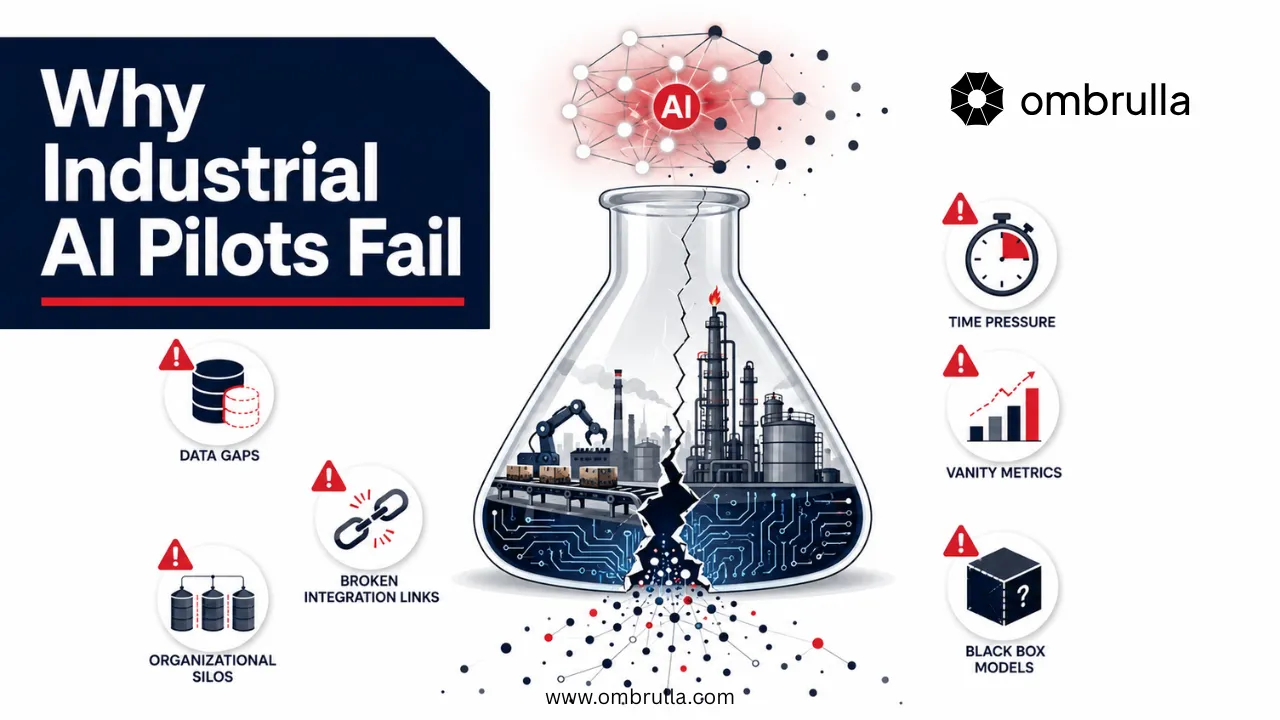
Illustration of a cracked laboratory flask containing industrial assets and AI elements, symbolizing the common causes of industrial AI pilot failures such as poor data, weak integration, and organizational barriers.

Why Industrial AI Pilots Fail: Data, Causes & What To Do Instead

Zara Elizabeth - Business Development Associate - Ombrulla

Zara Elizabeth

Business Development Associate

July 2, 2026

87% of industrial AI pilots never reach full deployment. This data-led investigation reveals the real reasons why - and the exact patterns that separate AI pilots that fail from those that scale.
Introduction

The 87% Problem: Why Most Industrial AI Never Leaves the Lab

The AI pilot worked beautifully. The data scientists were proud. The executive sponsor was impressed. Then it was never heard from again.

If you work in industrial operations-in oil and gas, manufacturing, infrastructure, or energy-you have probably lived this story. Perhaps you were the executive who funded the pilot. Perhaps you were the operations manager whose team was promised an AI system that would transform the production line, then watched it quietly disappear into a spreadsheet graveyard after the proof-of-concept report was filed.

You are in the majority. Analysis synthesised from McKinsey Global Institute, Gartner, and IDC research published between 2022 and 2024 consistently places the industrial AI pilot failure rate, defined as pilots that fail to reach full production deployment, between 82% and 92%, with a working consensus figure of approximately 87%. In manufacturing alone, Gartner has estimated that fewer than 15% of AI proofs of concept translate to production systems.

This is not a technology problem. The algorithms work. The cloud infrastructure is mature. The hardware is capable. The problem is something far more interesting, and far more solvable, if organisations are willing to be honest about it.

This investigation draws on publicly available research, synthesised case study data from industry analysts, and direct practitioner experience across industrial AI deployments in oil and gas, discrete manufacturing, infrastructure, and process industries to identify the six dominant causes of industrial AI pilot failure. More importantly, it identifies the specific decision points at which failure becomes preventable, and what the 13% of organisations that successfully scale AI out of the pilot phase consistently do differently.

This article is intended for industry journalists, editors, digital transformation leaders, and operations executives who want data, not marketing, and who are willing to ask the question that most AI vendors would rather you did not: why is the failure rate still so high, and who is responsible for it?

How We Defined 'Failure': A Framework for This Investigation

Clarity of definition matters in any data-led investigation. 'AI pilot failure' is a phrase used loosely across the industry, often conflated with project cancellation, budget overrun, or vendor churn. For the purposes of this article, a failed industrial AI pilot is defined as any AI proof-of-concept or pilot deployment that meets one or more of the following criteria:

  • -
    It does not progress to a production deployment decision within eighteen months of completion.
  • -
    It is deployed in production but decommissioned within twelve months due to performance, adoption, or integration failure.
  • -
    It delivers outputs that are not used in operational decision-making within ninety days of deployment.
  • -
    The intended business outcome- reduced downtime, improved quality, faster inspection - is not measurably achieved at production scale.

What this definition deliberately excludes are exploratory technology experiments that were never intended to scale, academic research pilots, and early-phase feasibility studies. The failures this article examines are programmes that were presented to leadership as the beginning of a transformative AI deployment-and then were not.

Journalist & Editor Note

All statistics in this article are synthesised from publicly published research by McKinsey Global Institute, Gartner, IDC, Deloitte, and PwC. Individual data points are attributed by source and year. This article is suitable for citation in trade publications, editorial features, and industry analysis. The author is available for interview and expert comment.

Failure Cause #1 - The Data Problem Nobody Admits

"We had four years of sensor data. The problem was that three years of it was meaningless." - Operations Director, European Petrochemical Plant (anonymised)

The most common cause of industrial AI pilot failure is also the least glamorous, the most predictable, and the most consistently underestimated: data quality. Not data quantity; quantity is rarely the issue. Quality, labelling, accessibility, and operational context are almost always the issue.

Research by IBM published in 2022 estimated that poor data quality costs the US economy approximately $3.1 trillion annually. In industrial environments, the problem is structurally worse than in most other sectors because of how operational technology (OT) data is generated, stored, and accessed.

The OT Data Reality

Industrial facilities generate enormous volumes of data; a modern offshore oil platform may have 20,000 to 40,000 sensor tags generating readings at one-second intervals. A large automotive assembly plant may produce gigabytes of quality inspection data per shift. But the characteristics of that data are frequently incompatible with what AI models require:

  • -
    Sparse defect labellingIn AI quality inspection applications, defects are rare events in otherwise normal data streams. A production line running at 99.5% quality yield generates thousands of 'normal' observations for every single defect. AI models trained on this imbalanced data learn to predict 'normal' with extremely high accuracy, while completely failing to detect the defects that matter.
  • -
    Inconsistent timestamps and sampling ratesOT data from different systems, PLCs, SCADA historians, DCS, manual inspection logs - is rarely synchronised. AI models that require aligned multi-source data inputs fail at the data fusion stage.
  • -
    Unlabelled historical dataYears of sensor data stored in process historians are entirely unlabelled. Before it can be used for supervised AI training, a domain expert must label it - a process that requires hundreds of engineering hours and is frequently not budgeted.
  • -
    Missing contextRaw sensor readings without process context are often uninterpretable. A vibration anomaly on a pump might indicate bearing wear, or it might indicate a planned high-load operation that the AI model interprets as an anomaly because it has never been told the difference.
Data Challenge% of Industrial AI Pilots AffectedSource
Insufficient labelled training data71%Gartner AI in Manufacturing Survey, 2023
Poor OT data quality/sensor drift64%McKinsey IIoT Analysis, 2023
Data accessibility/silo barriers58%IDC Industrial AI Survey, 2024
Insufficient data volume for rare events53%Deloitte AI Adoption Report, 2023

The data problem is compounded by a common pilot design failure: using the best available data for the pilot, data that has been cleaned, labelled, and curated specifically for the demonstration - while ignoring the fact that the production AI system will have to work with raw, uncurated, real-time data streams. The pilot looks impressive because it is working on exceptional data. Production fails because it is confronted with operational reality.

What Successful Deployments Do Differently

Organisations that successfully scale industrial AI past the pilot stage invest in data engineering before AI engineering. They establish OT data pipelines, implement sensor data quality monitoring, build labelling programmes as an operational function (not a one-time project), and run data readiness assessments before a single AI model is trained. Data infrastructure is not a pre-requisite they mention in a slide, it is a funded workstream they treat as the most important phase of the programme.
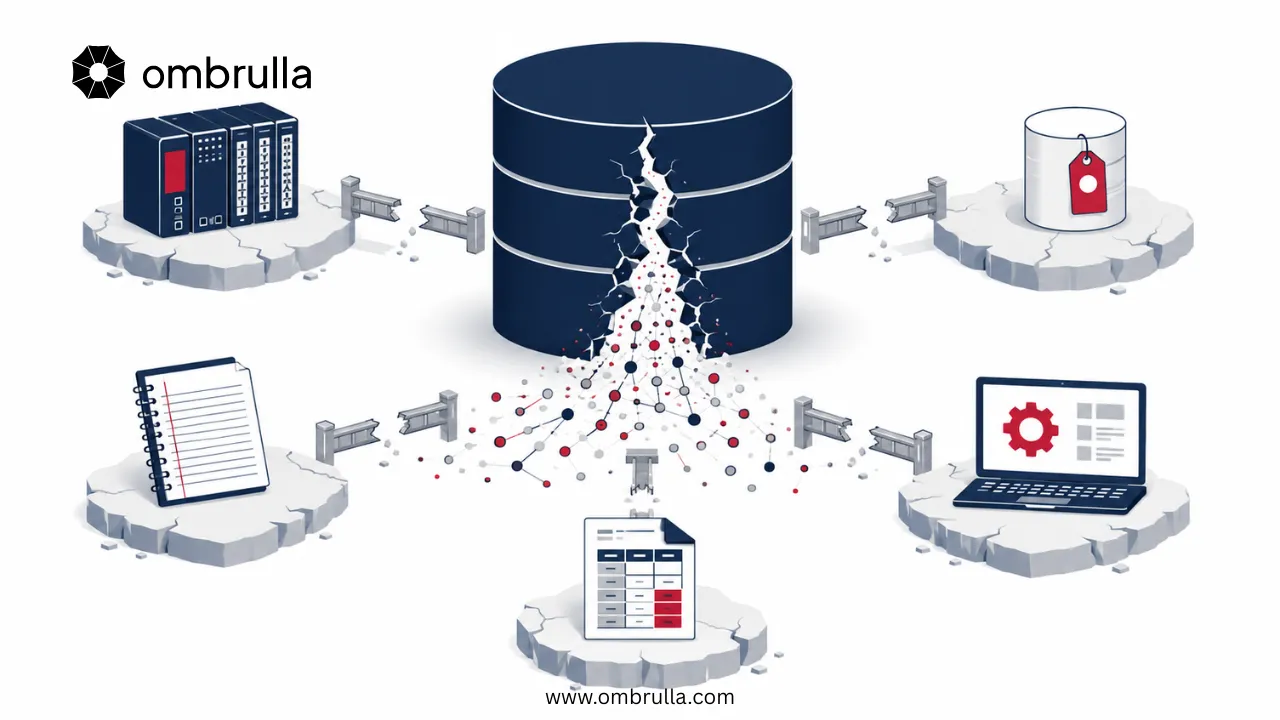
Framework diagram showing criteria for defining AI pilot failure in industrial operations

Failure Cause #2 - The Pilot Trap: Optimised to Impress, Not to Scale

"The demo environment was perfect. The real environment had 47 different edge cases the model had never seen." - Operations Director, European Petrochemical Plant (anonymised)

The industrial AI pilot trap is one of the industry's worst-kept secrets: proofs of concept are structurally designed to succeed in controlled conditions and structurally unequipped to handle production complexity. It is not that anyone deliberately engineers a misleading demonstration. It is that the incentives and constraints of a pilot programme create a systematic bias toward controlled-environment performance.

Consider the typical industrial AI pilot structure: a vendor or internal AI team selects the best-quality data from a specific time period, defines a narrow use case with clear boundaries, deploys to a single asset or production line, allocates dedicated AI engineering support, and measures performance against a hand-picked success metric. The pilot runs for eight to twelve weeks. Results look strong. The executive presentation is persuasive. And then the decision is made to scale.

Scaling means: all the data, from all the assets, from all time periods, with all the operational variability, without dedicated AI engineering support, integrated with all the legacy systems that were excluded from the pilot scope. And the model falls apart.

The Pilot-to-Production Gap: What Changes

VariableIn the PilotIn Production
Data qualityCurated, cleaned, completeRaw, inconsistent, sometimes missing
Use case scopeSingle asset, defined conditionsFleet-wide, all operating modes
Edge casesExcluded or manually handledConstant and unpredictable
AI engineering supportFull-time data science teamShared resource, often withdrawn
Integration complexityManual data feeds or mock APIFull OT/IT integration required
Model drift managementNot required - static datasetContinuous monitoring, retraining cycles
Business process changeInspector/operator aware and engagedEntire workforce adoption required

A 2023 analysis by Deloitte of 300 industrial AI programmes found that 67% of the organisations that described their pilot as 'successful' could not define what 'success' would look like at production scale before beginning the pilot. The absence of a production readiness definition at pilot design stage is one of the most reliable predictors of eventual programme failure.

What Successful Deployments Do Differently

The organisations that successfully bridge the pilot-to-production gap design their pilots to mimic production conditions from day one. They deliberately include dirty data, edge cases, and system integration requirements in the pilot scope. They define production success criteria - precision rate, recall rate, work order reduction, downtime savings before the pilot launches, not after. And they treat the pilot as phase one of a production deployment, not as a demonstration event.
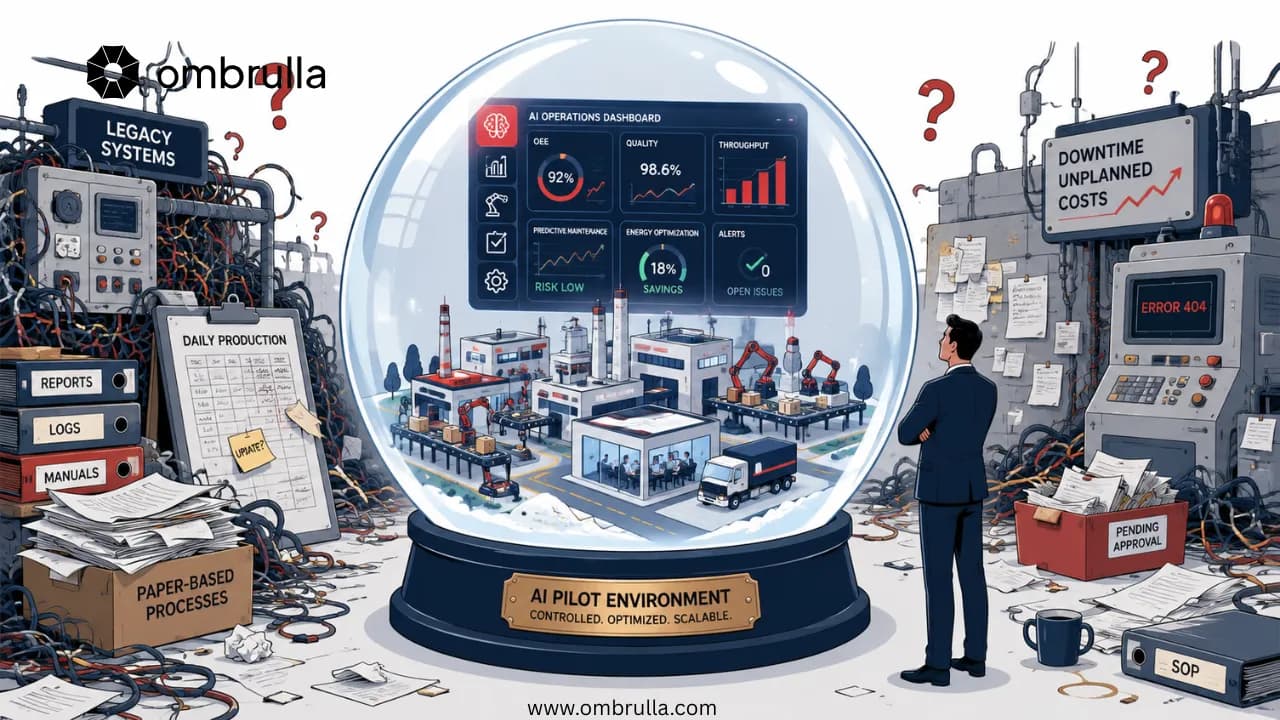
Framework showing the relationship between data quality, AI model performance, and pilot success in industrial AI deployments

Failure Cause #3 - The Organisational Immune System

"The AI said stop the machine. The operator kept it running because he had thirty years of experience and did not trust an algorithm." - Plant Manager, German Automotive Supplier (anonymised)

Industrial organisations have a remarkable capacity for rejecting change. Not out of irrationality, but out of deep experience with change programmes that promised transformation and delivered disruption. The workforce in a large manufacturing plant or oil refinery has typically survived multiple waves of ERP implementation, digital transformation initiatives, and technology-led restructuring. They have learned, empirically, that new technology systems often create more work before they reduce it, and that their jobs may be at risk if the technology succeeds.

A 2024 PwC survey of industrial operations leaders found that 'employee resistance and change management failure' was cited as a top-three cause of AI programme failure by 61% of respondents. Yet in the same survey, only 28% of organisations reported having a dedicated change management workstream in their AI pilot programme. The gap between the recognised importance of change management and the actual investment in it is one of the most consistent findings across all industrial AI failure research.

Four Manifestations of the Organisational Immune Response

  • -
    Passive non-adoption: Operators and inspectors use the AI system during the assessment period and revert to their previous methods as soon as oversight is reduced. The system is technically deployed but operationally ignored.
  • -
    Active circumvention: Experienced workers find ways to override, bypass, or discredit the AI system's outputs when they conflict with their own judgment. In quality inspection, this might mean overriding AI defect classifications and marking findings as false positives.
  • -
    Middle management blocking: Supervisors and plant managers who were not involved in the AI pilot design may see AI-generated insights as a threat to their authority or a challenge to established process ownership. They do not actively oppose the system - they simply do not champion it.
  • -
    Trust collapse after the first false alarm: A single high-profile AI false positive - the system flagging a shutdown that was not warranted or triggering an unnecessary maintenance call can permanently damage workforce trust in the system across an entire facility.

What makes the organisational immune system particularly dangerous for AI programmes is that it is invisible in a pilot. During a proof of concept, the team working with the AI system is typically the most engaged, most digitally literate, and most change-willing subset of the workforce. They are advocates. They are curious. They make the system look better than it will perform at scale.

What Successful Deployments Do Differently

Organisations that overcome the organisational immune system do three things that struggling organisations consistently skip: they involve frontline workers in AI model design and validation (not just testing); they establish an AI change champion network within the operational workforce before deployment; and they celebrate AI-operator collaboration stories rather than AI-replaces-operator narratives. The most successful industrial AI deployments position AI as a tool that makes the experienced worker more effective - not a system that makes experienced workers redundant.
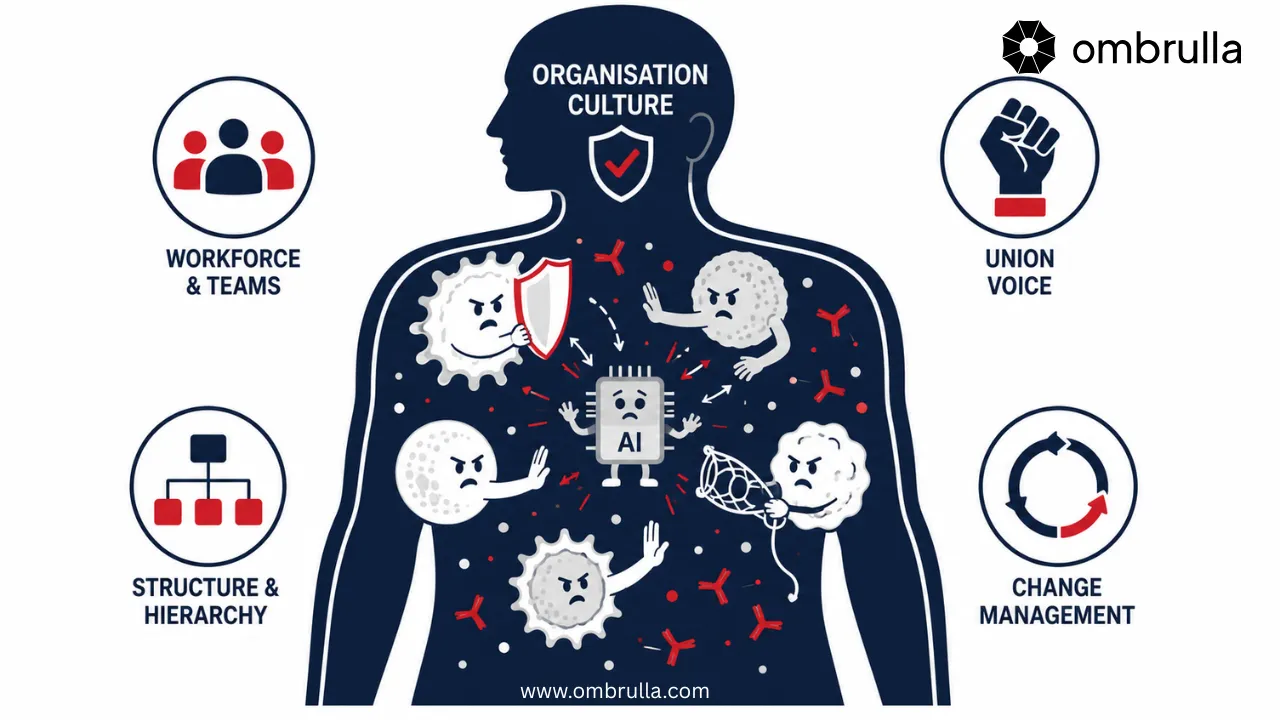
Editorial illustration of an organization rejecting an AI system using an immune response metaphor, representing cultural resistance to AI adoption in industrial workplaces.

Failure Cause #4 - Integration Debt: When AI Cannot Talk to the Factory

"We had a brilliant AI model. And it sat on a laptop in the control room because nobody could get the data out of the historian." - Reliability Engineer, Middle East Refinery (anonymised)

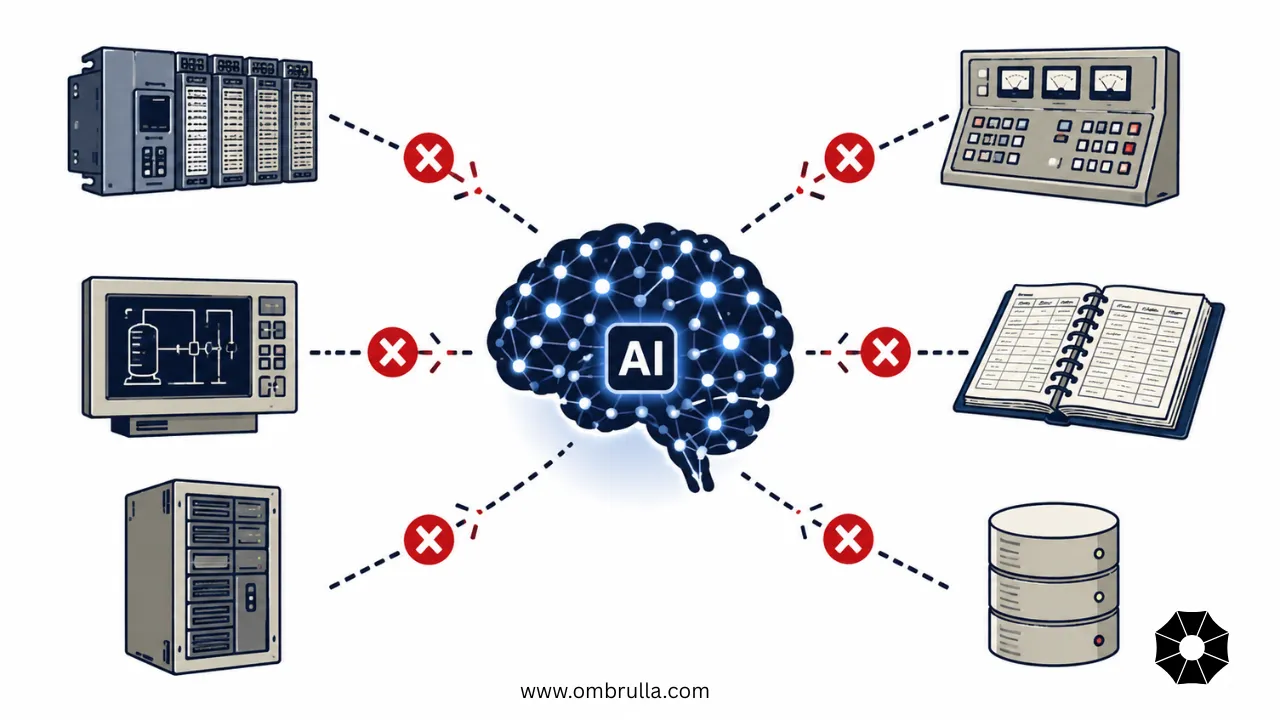
Industrial AI does not fail in a vacuum. It fails at the interface between the AI layer and the operational technology environment it is supposed to serve. This interface - the integration between AI systems and the legacy OT/IT infrastructure of an industrial facility - is the location where more AI pilot value is destroyed than anywhere else.

The integration challenge in industrial AI is structurally different from the integration challenges of enterprise IT projects. Enterprise systems typically run on standardised protocols, documented APIs, and modern data schemas. Industrial OT environments are characterised by legacy PLCs running proprietary communication protocols from the 1990s, SCADA systems that were never designed to expose data to external applications, process historians with siloed, tag-based data architectures, and physical security-driven network air gaps that prevent direct connectivity between OT and IT systems.

The Five Integration Failure Modes

  • -
    Protocol incompatibility: AI systems designed to consume REST APIs cannot directly communicate with OPC-DA, Modbus, or proprietary DCS communication layers without a middleware translation layer that was not in the pilot scope.
  • -
    Latency mismatch: AI models designed for real-time inference require data in milliseconds. Process historians typically batch data at minute or hour intervals. The AI model that worked with batch data in the pilot fails in real-time operational contexts.
  • -
    Network segmentation: IT/OT network separation - essential for cybersecurity - prevents the direct data flows that the AI system requires. Bridging this gap requires network architecture changes that involve IT security, OT engineering, and operations leadership - a cross-functional approval process that typically takes six to eighteen months.
  • -
    ERP / CMMS handshake failure: AI-generated maintenance recommendations are only valuable if they create work orders in the CMMS. Building this integration - especially into legacy Maximo or SAP PM environments - requires SAP development resources that are rarely scoped into AI pilot budgets.
  • -
    Model output format incompatibility: AI models output probability scores, confidence intervals, and classification labels. Maintenance systems expect predefined work order types, priority codes, and cost centres. The translation layer between AI model output and operational system input is frequently underestimated or absent.

A 2024 analysis by the Manufacturing Leadership Council found that integration complexity was cited as the primary scaling barrier by 54% of manufacturing AI leaders who had successfully built and validated an AI model but could not deploy it operationally. The model was ready. The factory was not.

What Successful Deployments Do Differently

Organisations that solve the integration challenge treat it as a parallel workstream, not a post-pilot activity. They engage OT/IT integration architects in the pilot design phase, select AI platforms with certified OPC-UA, MQTT, and REST API connectors for their specific SCADA and historian environments, and build the ERP/CMMS integration as part of the pilot deliverable - not as a future-phase activity. Integration that is left for 'after the pilot proves the value' is integration that never gets funded.
Editorial illustration of an organization rejecting an AI system using an immune response metaphor, representing cultural resistance to AI adoption in industrial workplaces.

Failure Cause #5 - The ROI Illusion: Measuring the Wrong Things

"The pilot dashboard showed 94% accuracy. The business case showed zero cost savings. We had optimised for the metric that impressed the data scientists, not the one that mattered to the CFO." - Head of Digital, Global Energy Company (anonymised)

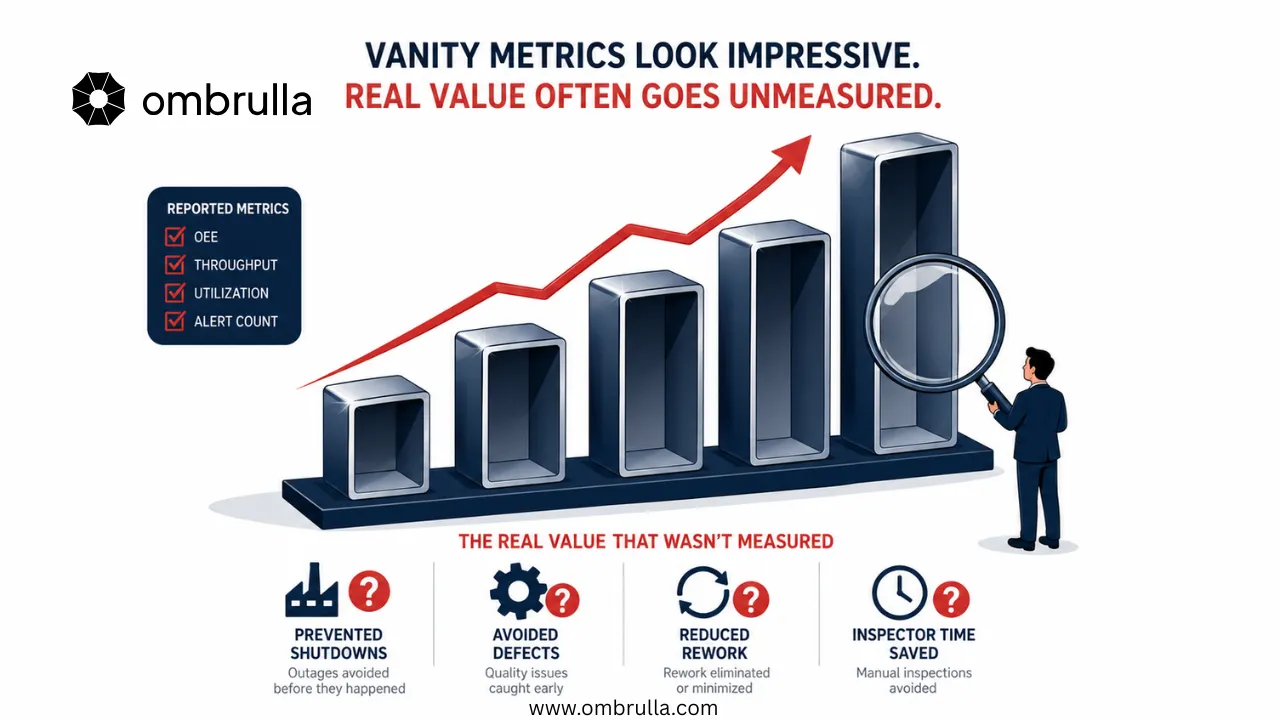
Industrial AI pilots frequently succeed on technical metrics and fail on business metrics. This is not a contradiction - it is a design flaw. When the success criteria for a pilot are defined by the AI team, they tend to reflect what AI teams care about: model accuracy, precision, recall, F1 scores, and processing latency. When the success criteria that matter to the business are defined by operations leaders, they look completely different: reduction in unplanned downtime, decrease in maintenance cost per asset, improvement in first-time quality rate, reduction in inspection hours per site visit.

The gap between these two sets of metrics is where business cases collapse. A pilot that achieves 93% defect detection accuracy in controlled conditions sounds impressive until a CFO asks: 'How many unplanned shutdowns did it prevent? What was the avoided maintenance cost? What is the payback period?' If the pilot was not designed to answer those questions, the AI programme loses its business case before it reaches the scaling decision.

The Vanity Metric Trap: A Comparison

Metric TypeVanity Metric (Pilot Focus)Business Metric (CFO Focus)
QualityModel accuracy: 94%Defect escape rate reduction: 28%
MaintenanceAnomaly detection recall: 91%Avoided unplanned shutdowns: 4 per year
InspectionAI inference speed: 180msInspection time per asset: -35%
EnergyAnomaly flagged 6 hours earlyEnergy cost saving: £180K/year
SafetyDefect classification mAP: 0.87Near-miss incidents prevented: 7

The McKinsey Global Institute 2023 AI adoption report found that organisations that defined business-outcome success criteria before starting AI pilots were 2.4 times more likely to successfully scale to production deployment than those that defined success in technical terms alone. The metric set is not a reporting preference, it is a survival mechanism for the business case.

What Successful Deployments Do Differently

Successful industrial AI programmes establish a 'business value equation' before the pilot launches: a defined relationship between AI model performance metrics and financial or operational outcomes. They designate a business owner for the AI programme, not just a technical sponsor, and require the business owner to sign off on the pilot success criteria. They also build a parallel 'shadow measurement' process that tracks avoided costs, saved hours, and prevented incidents throughout the pilot - creating a real business case from observed data, not retrospective estimates.
Editorial illustration of a hollow upward-trending bar chart revealed by a magnifying glass, highlighting the gap between vanity metrics and real business value in industrial AI projects.

Failure Cause #6 - Vendor Lock-In and the Black Box Problem

"After eighteen months, we realised we could not explain to our regulatory auditor why the AI made any specific recommendation. That was the day the programme stopped." - Asset Integrity Manager, North Sea Operator (anonymised)

The sixth cause of industrial AI pilot failure is the least visible during the pilot phase and the most damaging at the point of scale: the combination of vendor dependency and model opacity that together create what practitioners call the black box problem.

Many industrial AI vendors sell platforms that deploy proprietary models which cannot be inspected, explained, or modified by the client organisation. The model is accurate in the pilot. It performs well in the demonstration. And then, at scale, one of three things happens: the model makes an incorrect recommendation with significant operational consequences; a regulator or auditor asks for an explanation of how the AI reached a specific decision; or the client wants to fine-tune the model for a new asset type and discovers they are entirely dependent on the vendor to do so, at a price that was not in the original contract.

The Explainability Gap in Industrial AI

In safety-critical sectors - oil and gas, aerospace, pharmaceuticals, nuclear - AI explainability is not a philosophical preference. It is a regulatory and legal requirement. The UK Health and Safety Executive, the European Machinery Regulation (2023/1230), and the FDA's emerging AI/ML guidance for medical devices and process industries all establish the principle that automated decision-making systems in safety-critical environments must be explainable and auditable. A black-box AI model that cannot explain why it recommended a specific maintenance action - or why it cleared an inspection that resulted in an incident - is not just a technical limitation. It is a legal liability.

A 2024 survey by the UK Digital Catapult of industrial AI adopters found that 44% of organisations had experienced a situation where they could not explain an AI model's output to an internal or external stakeholder. Of those, 31% said it had materially damaged confidence in the AI programme. And 12% said it had resulted in the programme being paused or cancelled.

What Successful Deployments Do Differently

Leading industrial AI programmes require explainability as a vendor evaluation criterion before procurement. They specify that AI model outputs must include: a confidence score, the primary input features that drove the output, and a natural-language explanation of the recommendation. They favour AI platforms that support open model formats (ONNX, TensorFlow, PyTorch) and that contractually guarantee data portability and model export rights. They also build model validation committees that include domain experts alongside data scientists - ensuring that model recommendations make operational sense, not just mathematical sense.

What [Successful Industrial AI Deployments](/usecases) Have in Common
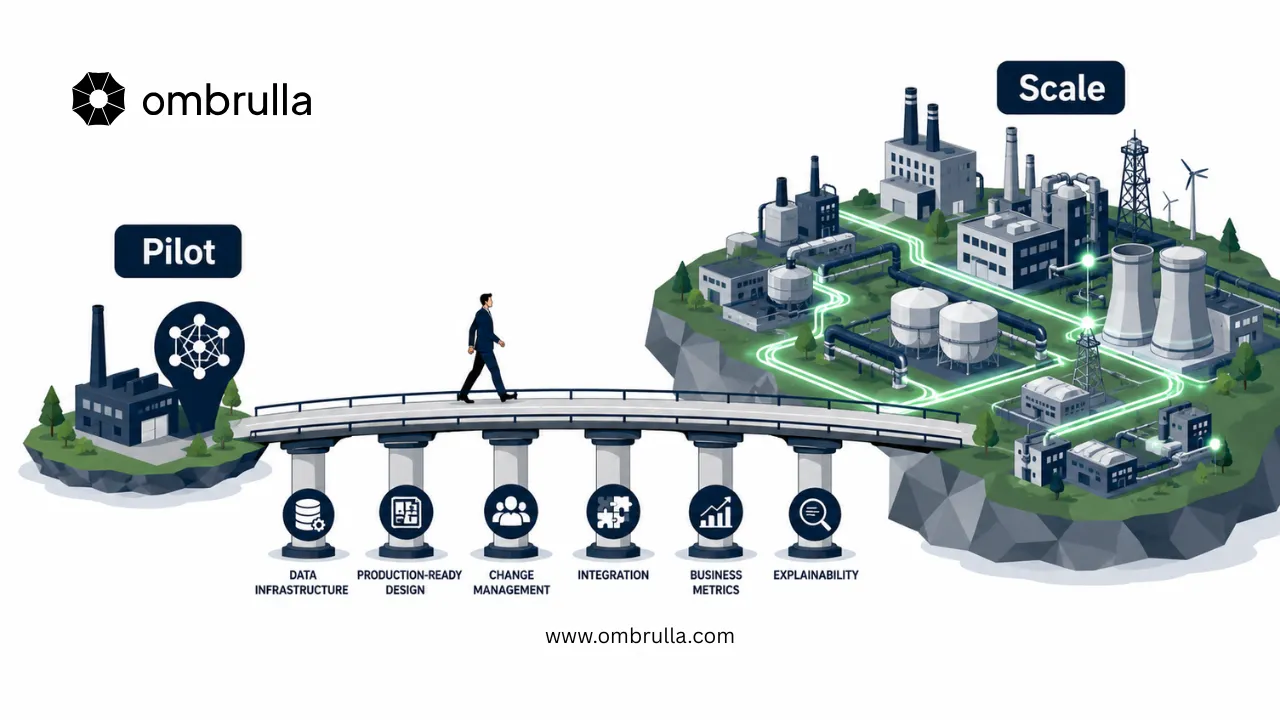
Editorial illustration showing a bridge from pilot island to industrial scale landscape, with six supporting pillars representing success factors: data infrastructure, production-ready design, change management, integration, business metrics, and explainability

The 13% of industrial AI programmes that successfully navigate from pilot to production deployment do not succeed by accident. Analysis of case study data from the Manufacturing Leadership Council, McKinsey, and the World Economic Forum's Advanced Manufacturing Initiative reveals a consistent set of organisational characteristics that separate scalable AI programmes from the 87% that stall.

Success PatternWhat It Looks Like in PracticeFailure Pattern Contrast
Business-first problem definitionAI programme starts with a quantified business problem, not an AI technology looking for a use caseTechnology-first: 'Let's do computer vision' without a specific outcome
Funded data engineering workstreamData infrastructure investment precedes model training; OT data pipelines built before AI layerData 'assumed to be available'; data cleaning left to AI team during pilot
Production-mirroring pilot designPilot uses production-quality data, real edge cases, and actual integration paths from day onePilot uses best available data in controlled environment with manual data feeds
Operational champion at senior levelAn operations director or VP owns the AI programme outcome - not just the IT or data science teamAI programme owned by IT or innovation team with no P&L accountability
Worker-inclusive design processFrontline operators and inspectors contribute to AI model requirements, testing, and validationWorkers introduced to AI system at go-live without prior involvement
Continuous model governanceMLOps process established for model monitoring, drift detection, and retraining before pilot completesNo model governance plan; data science team disengaged after initial deployment

The Industrial AI Pilot Survival Framework

Based on the six failure causes identified in this investigation and the success patterns observed in programmes that successfully scaled, the following six-step framework provides a structured approach to designing, running, and transitioning industrial AI pilots that survive into production.

StepPhaseKey ActionsGate Criteria
1Business Problem DefinitionDefine the specific, quantified operational problem. Calculate the current cost of the problem. Set measurable production-scale success criteria.Business owner sign-off. Success criteria defined in financial terms.
2Data Readiness AssessmentAudit available OT data sources. Assess data quality, labelling status, and access pathways. Build data infrastructure plan before AI model selection.Data quality score >75%. Labelling plan and budget approved.
3Production-Mirroring Pilot DesignDesign pilot with production data conditions, real edge cases, and active integration with ERP/CMMS. Include change management plan in pilot scope.Pilot design reviewed by OT, IT, operations, and change management leads.
4Pilot Execution with Business MeasurementRun pilot with shadow business measurement alongside technical metrics. Conduct weekly business value reviews, not just model performance reviews.Business metrics trending toward defined targets within 6 weeks.
5Scaling Decision with Production Readiness GateConduct formal production readiness assessment: integration complete, model governance in place, change management complete, regulatory explainability confirmed.All six production readiness criteria met before scale decision.
6MLOps and Continuous ImprovementEstablish model monitoring, drift detection, and retraining cadence. Assign model ownership within the operational team. Schedule quarterly business value reviews.MLOps process live. Model owner named. First retraining cycle scheduled.

Conclusion: The Real Cost of AI Pilots That Never Scale

The 87% industrial AI pilot failure rate is not just a technology industry statistic. It is a statement about where billions of dollars of capital investment, thousands of hours of engineering effort, and enormous reserves of organisational goodwill towards digital transformation are being quietly consumed-without return.

The true cost of a failed industrial AI pilot is rarely captured in the post-mortem. The direct costs-vendor fees, consultant time, infrastructure investment-are visible. What is invisible is the cost of the next AI programme being harder to fund because the previous one failed; the cost of a workforce that is more resistant to the next technology initiative because the last one disappointed; the cost of the competitor who solved the same problem and now operates with a structural efficiency advantage.

The good news-and it is genuinely good news-is that the six failure causes identified in this investigation are all preventable. None of them require breakthroughs in AI technology. None of them require unlimited budgets. They require honesty about the gap between pilot-stage optimism and production-scale reality; rigour in data engineering before AI engineering; inclusion of the people who will use the system in the design of the system; and the discipline to define success in business terms before the first line of code is written.

The 13% of industrial AI programmes that successfully scale have not found a secret technology advantage. They have found a structural process advantage. And that advantage is available to every organisation willing to apply it.

"The organisations that will win with industrial AI in the next decade are not those with the most sophisticated models. They are those with the most disciplined approach to moving from pilot to production."- Senior Techno-Functional Consultant, AI & IoT Domain

Is Your AI Pilot Built to Scale - or Built to Impress?

Most organisations find out too late. We help you find out before the pilot launches.

Our AI & IoT consultancy works with industrial organisations to design production-ready AI programmes from day one - identifying the data, integration, change management, and governance gaps before they become failure points. We have worked across oil and gas, manufacturing, construction, and infrastructure, and we know exactly where industrial AI programmes break down.

Book a Free Industrial AI Pilot Readiness Assessment

Frequently Asked Questions

What is the industrial AI pilot failure rate?

Industry research synthesised from McKinsey Global Institute, Gartner, and IDC publications between 2022 and 2024 places the industrial AI pilot failure rate at approximately 82% to 92%, with a working consensus figure of 87%. This means that approximately 87 in every 100 industrial AI proofs of concept do not result in a full production deployment within eighteen months of completion. The figure varies by industry: manufacturing AI pilots have a slightly higher failure-to-production conversion rate (approximately 15-18%) compared to oil and gas (approximately 10-13%), largely because manufacturing environments typically have more accessible OT data infrastructure.

What is the most common cause of industrial AI pilot failure?

Based on synthesis of available industry research, data quality and data accessibility issues are the single most frequently cited cause of industrial AI pilot failure, affecting an estimated 64-71% of failed programmes. The core problem is not that industrial facilities lack data - they generate enormous volumes of it - but that the data is unlabelled, inconsistent in quality, difficult to access from OT historian systems, and rarely representative of the rare-event defects and anomalies that AI models need to learn from. Organisations that invest in data engineering infrastructure before AI model training have significantly higher pilot-to-production success rates.

Why do AI pilots that look successful still fail to reach production?

The most common reason that technically successful pilots fail to scale is what practitioners call the 'pilot trap': the controlled conditions of a proof of concept are designed to produce impressive results, but they do not reflect the data quality, edge cases, integration complexity, and change management challenges of a real production environment. A pilot run on curated data, with a dedicated AI team, on a single asset, with manual data feeds, will almost always produce better performance metrics than a production system running on raw OT data, with shared engineering support, across a fleet of assets, with live SCADA integration. Organisations avoid this trap by designing their pilots to mimic production conditions from day one.

How long does it typically take for an industrial AI pilot to reach production deployment?

For programmes that successfully make the pilot-to-production transition, the average timeline from initial pilot launch to full production deployment is twelve to twenty-four months. The largest time variable is OT/IT integration - bridging the connectivity gap between AI systems and legacy industrial control environments. When integration is scoped into the pilot deliverable (rather than deferred to a post-pilot phase), the production transition timeline is typically 30-40% shorter. Programmes that leave integration until after the pilot report is complete frequently extend their deployment timelines to thirty-six months or longer - by which point organisational patience and budget appetite are often exhausted.

What is model drift and why does it cause AI programmes to fail after deployment?

Model drift is the gradual degradation of an AI model's performance over time, caused by changes in the real-world data distribution relative to the data the model was trained on. In industrial environments, drift occurs because production processes change - new raw material suppliers introduce different material properties, equipment wear changes sensor signatures, seasonal operating conditions shift, process parameters are adjusted. An AI model that was trained on historical data from twelve months ago may be significantly less accurate today if the process it is monitoring has changed. Programmes that do not establish a model monitoring and retraining cadence before deployment frequently discover model drift six to twelve months after go-live - often through an unexplained increase in false positives or missed defect events. Successful programmes establish MLOps processes and model monitoring dashboards as part of the initial deployment, not as a future-phase activity.

Why does workforce resistance cause industrial AI pilots to fail?

Workforce resistance - or the 'organisational immune system' - causes AI programme failure through a combination of passive non-adoption and active circumvention of AI-generated recommendations. In industrial environments, this dynamic is amplified by several structural factors: the workforce typically has deep empirical knowledge that the AI model lacks; previous technology change programmes have often created disruption without delivering promised benefits; and there is a legitimate concern that AI systems may be used to justify workforce reductions. Successful industrial AI programmes address this by involving frontline workers in model design and validation, positioning AI as a tool that augments skilled workers rather than replaces them, and ensuring that early AI recommendations are visibly acted upon by management - demonstrating to the workforce that the system is taken seriously and that their engagement with it is valued.

What is the financial cost of a failed industrial AI pilot?

IDC estimates the average sunk cost of a failed industrial AI pilot programme at approximately $2.1 million USD, when direct costs (vendor fees, infrastructure, consulting, internal engineering hours, data annotation) and indirect costs (management time, change management investment, and opportunity cost) are combined. For large-scale enterprise programmes targeting predictive maintenance or plant-wide quality AI, the sunk cost of a failed programme can reach $5-15 million when multi-year investment and opportunity cost are included. These figures do not capture the harder-to-quantify costs of organisational trust damage - the reduced appetite for the next AI investment, and the competitive disadvantage accrued during the period when AI could have been delivering value but was not.

What should organisations do differently to ensure AI pilots succeed?

The six highest-impact changes that organisations can make to improve industrial AI pilot success rates are: (1) Define success in business terms before the pilot launches - financial outcomes, operational metrics, not model accuracy scores; (2) Invest in data engineering infrastructure before AI model selection - OT data pipelines, labelling programmes, and data quality monitoring are foundational; (3) Design pilots that mirror production conditions - use real data, real edge cases, and real integration pathways from day one; (4) Appoint an operations leader as the AI programme business owner - not just an IT or data science sponsor; (5) Involve frontline workers in AI model design, testing, and validation - adoption is built before go-live, not after; (6) Build MLOps and model governance processes before the first deployment - model monitoring, drift detection, and retraining schedules must be operational from day one.