

What Is AI Predictive Maintenance Software and How Does It Stop Unplanned Downtime?
Predictive maintenance software uses machine learning models trained on IIoT sensor data — vibration, temperature, pressure, acoustic signatures — to detect developing equipment faults 30–90 days before failure. It replaces both reactive maintenance (after breakdown) and calendar-based preventive maintenance (regardless of actual asset condition) with condition-driven intervention: maintenance precisely when needed, not before, not after.
- Failure prediction 30–90 days aheadAcross vibration, temperature, pressure, acoustic, and corrosion sensors.
- Agentic AI maintenance orchestrationAutomated work orders, crew scheduling, digital twin triggers, operator-confirmed execution.
- 30–50% reduction in unplanned maintenance costs15–25% OEE improvement across deployed operations.
- Closed-loop integration with Tritva AI Visual InspectionQuality defect patterns from Tritva AI Visual Inspection product trigger maintenance intelligence in Petran AI Predictive Maintenance product.
- Risk-based asset prioritisationEliminating both over-maintenance and dangerous under-maintenance.
- Audit-ready compliance loggingISO 55001, API 580, IEC 61511, OSHA, EPA — automated and timestamped.
Unplanned downtime is the most expensive thing a manufacturing industry page or asset-intensive operation produces. Not the scrap. Not the energy waste. Not the warranty claims. The breakdown that halts the line at 2am on a Sunday, triggers an emergency crew call-out at premium rates, and keeps customers waiting while maintenance engineers diagnose a fault that was visible in sensor data three weeks before it failed.
The economics are not abstract. A single unplanned stoppage on a high-volume production line can cost £150,000–£800,000 in lost output, emergency labour, expedited parts, and consequential delivery failures. A critical asset failure in oil and gas industry page operations routinely exceeds £3M before regulatory and remediation costs are added. The failure mode is almost always the same: the data that would have prevented it existed — the system to act on it did not.
Predictive maintenance solution software changes this equation. Petran AI Predictive Maintenance product — Ombrulla's AI Asset Performance Management platform — takes this further: it ingests IIoT sensor data from all critical assets, applies ML failure prediction models that identify developing faults weeks to months before failure, and uses agentic AI to orchestrate the right maintenance response automatically. It also receives defect pattern intelligence from Tritva AI Visual Inspection product, creating a closed quality-to-maintenance loop that identifies equipment degradation from production quality signals before sensor thresholds are breached.
This guide explains precisely what predictive maintenance software does, how the AI and IoT components work together, how to evaluate platforms, and how Petran delivers measurable results across manufacturing, oil & gas, infrastructure, and utilities.
What Is Predictive Maintenance Software? A Precise Definition
Predictive maintenance software is a technology platform that continuously monitors asset condition data — collected from IIoT sensors mounted on or near critical equipment — and applies machine learning models to predict when and how specific assets will fail. The output is not an alarm after a threshold is breached; it is a failure probability forecast with sufficient lead time for planned intervention.
Three characteristics distinguish true predictive maintenance from simpler condition monitoring or threshold-based alerting:
- Learned failure modelsPredictive maintenance software trains ML models on asset-specific historical data — sensor readings correlated with past failure events — to learn what patterns precede each failure mode. These models are not programmed with rules; they generalise from data.
- Multi-sensor pattern recognitionReal failure signals are almost never visible in a single sensor in isolation. Bearing failure signatures appear in vibration frequency spectra, temperature trends, and acoustic emissions simultaneously — the pattern across sensors is the signal. Predictive maintenance software analyses multi-sensor combinations that rule-based systems cannot model.
- Actionable lead timeThe defining outcome is advance warning measured in days to weeks, not seconds. A predictive maintenance system that alerts five minutes before failure has not prevented the breakdown. Petran AI Predictive Maintenance product deployment target is 30–90 days of actionable lead time on primary failure modes.
Condition Monitoring vs Predictive Maintenance
Condition monitoring systems alert when a sensor threshold is exceeded — vibration above 8mm/s, temperature above 85°C. They provide no advance warning: by the time a threshold is breached, the failure process is often already irreversible. Predictive maintenance software identifies the developing pattern weeks before any threshold is reached. Petran AI Predictive Maintenance product consistently identifies primary failure modes 30–90 days before condition monitoring systems would generate their first alert.
Key Distinction: Condition Monitoring vs Predictive Maintenance
Condition monitoring systems alert when a sensor threshold is exceeded — vibration above 8mm/s, temperature above 85°C. They provide no advance warning: by the time a threshold is breached, the failure process is often already irreversible. Predictive maintenance software identifies the developing pattern weeks before any threshold is reached. Petran consistently identifies primary failure modes 30–90 days before condition monitoring systems would generate their first alert.
Reactive vs Preventive vs Predictive Maintenance: The Financial Case
The three maintenance strategies are not equally valid for asset-intensive operations in 2026. The performance differences across cost, safety, and operational efficiency are now extensively documented — and the financial case for predictive maintenance is conclusive for most mid-to-high criticality assets.
| Metric | Reactive Maintenance | Preventive Maintenance | Petran AI Predictive Maintenance |
|---|---|---|---|
| Failure Detection | After breakdown occurs | Scheduled intervals — regardless of actual condition | 30–90 days before failure |
| Maintenance Timing | Emergency — all hands | Calendar-driven — often premature | Condition-driven — right moment |
| Downtime Cost | Highest — unplanned | Medium — planned disruption | Lowest — minimal window needed |
| Parts & Labour Waste | High — emergency premium | High — parts replaced prematurely | Minimal — precise intervention |
| Data Used | None — post-failure | Asset age + OEM schedule | IIoT sensor + quality + history |
| Safety Risk | High — uncontrolled failure | Low — scheduled | Lowest — failure prevented |
| OEE Impact | Severe loss | Moderate loss | +15–25% improvement |
| ROI vs Reactive | Baseline | +15–25% | +40–70% |
| Tritva Integration | N/A | N/A | Defect patterns feed Petran — quality triggers maintenance |
The table above compares three maintenance strategies across 9 performance dimensions. The Petran integration row reflects the closed-loop quality intelligence Tritva AI Inspection provides — a capability unavailable to any standalone predictive maintenance platform.
PETRAN by Ombrulla — AI Asset Performance Management
AI Predictive Maintenance · IIoT Sensor Integration · Agentic Maintenance Orchestration · Closed-Loop Quality Intelligence

What Petran Does
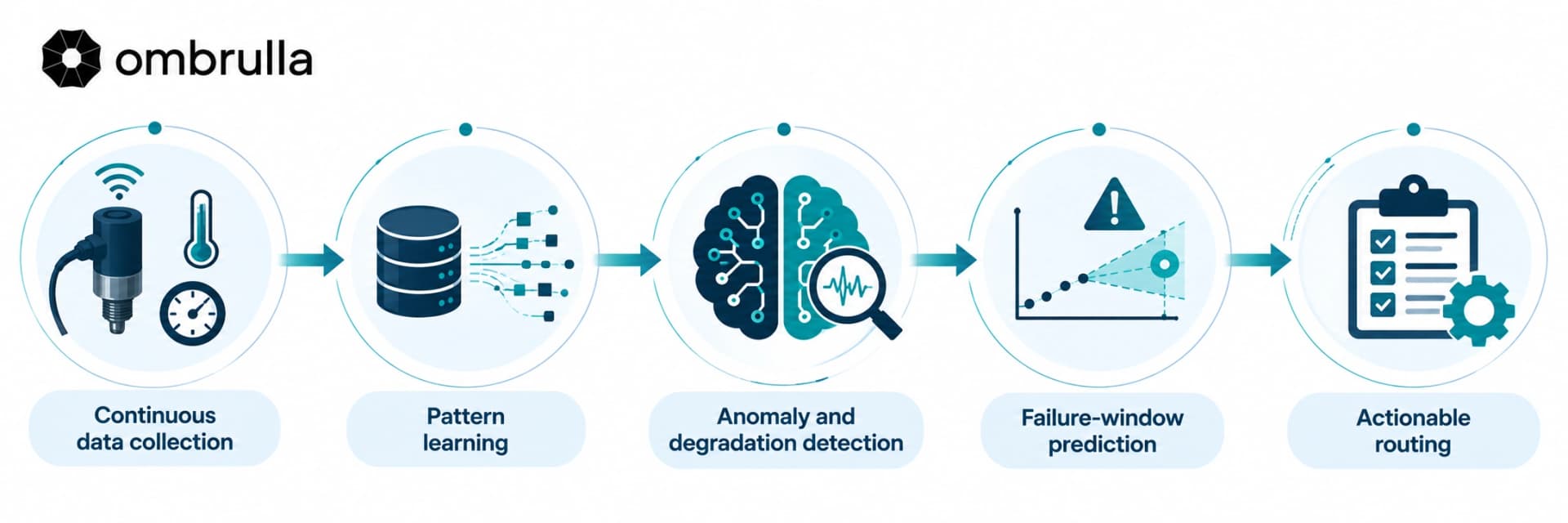
Petran AI Predictive Maintenance product is Ombrulla's AI-driven Asset Performance Management platform. It ingests real-time IIoT sensor data across all critical assets — vibration, temperature, pressure, acoustic, flow, corrosion — and applies machine learning failure prediction models trained on equipment-specific histories to identify developing faults 30–90 days before failure. Agentic AI then orchestrates the right maintenance response automatically: generating work orders, scheduling crews, triggering digital twin simulations, and logging every decision for compliance — all with operator confirmation before execution.
Core Platform Capabilities
- IIoT sensor integrationReal-time ingestion from vibration, temperature, pressure, acoustic, flow, and corrosion sensors — live asset health dashboard updates continuously as anomalies emerge.
- ML failure predictionModels trained on equipment-specific sensor histories predict failure probability 30–90 days ahead — giving maintenance teams actionable lead time, not just alarms.
- Agentic AI orchestrationPetran proposes corrective actions (valve adjustments, inspection work orders, crew scheduling, digital twin simulation) — operators approve with one click; full decision audit trail auto-generated.
- Risk-based maintenance schedulingAssets ranked by failure probability and production criticality — eliminating over-maintenance of healthy assets and under-maintenance of at-risk ones.
- Energy optimisationAI tracks energy consumption by asset and identifies inefficient operating patterns for targeted efficiency improvement.
- Tritva quality integrationDefect pattern data from Tritva AI Visual Inspection product feeds directly into Petran — quality anomalies become maintenance intelligence, closing the loop between the production line and the maintenance schedule.
- Regulatory compliance loggingAutomated maintenance records, overdue inspection alerts, and environmental threshold monitoring — audit-ready at all times.
Proven Petran Results
- 30–50% reductionIn unplanned maintenance costs across deployed operations.
- 15–25% OEE improvementThrough reduced downtime and optimised asset utilisation.
- 60%+ compliance audit time reductionThrough automated maintenance logging.
- Offshore case studyPetran identified micro-corrosion on a flare stack 4 months before failure — maintenance dispatched early, preventing an estimated £3M+ downtime event.
- 20–35% improvementIn maintenance schedule efficiency through risk-based prioritisation.
Learn more: ombrulla.com/products/petran
How AI Predictive Maintenance Works: The Technical Process
Understanding the technical mechanism behind predictive maintenance software — not just that it works — enables better deployment decisions, more realistic expectations, and more effective troubleshooting when models underperform. The following five-step process describes what happens inside Petran for every monitored asset.

Step 1: IIoT Sensor Data Acquisition
Petran ingests real-time data from IIoT sensors installed on or near critical assets. Sensor selection is a deployment decision made during the asset criticality assessment: different failure modes require different sensor types. The table below maps sensor type to failure detection capability and Petran integration.
| Sensor Type | Measures | Detects | Industries | Petran Integration |
|---|---|---|---|---|
| Vibration (accelerometer) | Frequency, amplitude | Bearing failure, imbalance, misalignment, looseness | Manufacturing, Oil & Gas, Utilities | Real-time FFT analysis — anomaly alerts |
| Temperature (IR + contact) | Surface + ambient °C | Overheating, friction loss, insulation failure | All sectors | Thermal drift correlation with failure models |
| Acoustic Emission | High-freq stress waves | Crack propagation, leaks, valve failure | Oil & Gas, Nuclear, Infrastructure | Pattern recognition on acoustic signatures |
| Pressure | Process pressure (bar/psi) | Pump cavitation, valve degradation, blockages | Oil & Gas, Pharma, Food | Pressure deviation alerts — root cause isolation |
| Current / Power Draw | Motor current (A), kWh | Motor degradation, overload, inefficiency | Manufacturing, Utilities | Energy anomaly detection — efficiency scoring |
| Corrosion (ER/LPR) | Metal loss rate | Pipeline wall thinning, coating failure | Oil & Gas, Infrastructure | Petran integrity models — remaining life calc |
| Flow | Fluid volume / velocity | Blockages, leaks, pump wear | Oil & Gas, Pharma, Water | Flow deviation — maintenance priority trigger |
| Oil Quality (in-line) | Particle count, viscosity | Gear/bearing wear, contamination | Heavy Industry, Aviation | Wear particle trend — lubrication action |
Petran's Universal Connectivity
Petran supports OPC-UA, MQTT, REST API, and Modbus protocols for sensor data ingestion — integrating with existing PLC, SCADA, and historian systems without requiring sensor replacement. Where Tritva AI inspection cameras are deployed, Petran also receives defect pattern data from Tritva — providing quality-derived maintenance signals that IoT sensors alone cannot generate.
Step 2: Signal Processing and Feature Extraction
Raw sensor signals contain noise, environmental interference, and process variability that would degrade ML model performance without preprocessing. Petran's signal processing pipeline filters and transforms raw data before it reaches the ML layer. For vibration data, Fast Fourier Transform (FFT) analysis converts time-domain signals into frequency spectra — enabling Petran to detect the specific frequency signatures of bearing defects, gear mesh frequencies, and imbalance harmonics. Temperature signals are detrended for ambient variation. Acoustic emission data is filtered for production noise artefacts. This preprocessing step is one reason Petran models trained in commissioning conditions maintain accuracy as operating environments evolve over time.
Step 3: Petran ML Failure Prediction Models
The core of Petran's predictive capability is a suite of ML models trained on equipment-specific historical data — sensor readings correlated with documented past failure events for each asset class. Petran supports multiple ML architectures matched to asset type and data characteristics.
- LSTM (Long Short-Term Memory)Neural networks for time-series anomaly detection on continuous sensor streams — identifying gradual degradation trends invisible in snapshot data.
- Random ForestClassifiers for multi-sensor pattern classification — combining vibration, temperature, and acoustic features into unified failure probability scores.
- Gradient BoostingModels for remaining useful life (RUL) estimation — predicting the number of operating hours before maintenance intervention is required.
- Isolation ForestUnsupervised anomaly detection on new asset classes with limited failure history — detecting deviations from normal operating patterns without labelled failure data.
Petran Model Retraining — Without Data Scientists
Petran's maintenance engineering interface allows reliability engineers to review model predictions, flag incorrect forecasts, and trigger model retraining without ML expertise. Models improve continuously as operational data accumulates — a bearing model deployed at month 1 consistently outperforms at month 12, with no vendor involvement in the retraining cycle.
Step 4: Failure Probability Forecasting and Risk Prioritisation
Petran produces a failure probability score for each monitored asset on a rolling basis — updated with each new sensor reading batch. The forecast includes: failure probability (percentage likelihood within the defined maintenance planning horizon), remaining useful life estimate, confidence interval (narrower for well-trained models with abundant history), failure mode identification (which specific fault is developing), and recommended intervention timing (optimal maintenance window within the operational schedule).
Risk-based prioritisation is the operational output that maintenance teams use daily. Petran ranks all monitored assets by the product of failure probability and asset criticality — ensuring maintenance resources are concentrated on assets where failure consequence is highest, not just where sensor readings have changed most.
Step 5: Agentic AI Maintenance Orchestration
Petran's AI agent layer translates failure probability forecasts into concrete maintenance actions — automatically, with operator confirmation before execution. When a bearing failure forecast crosses the configured probability threshold with 15 days of planning lead time, Petran's agent proposes: a specific inspection work order with part specification and required skill set; crew scheduling in the next planned maintenance window; a digital twin simulation of the planned maintenance procedure to validate the intervention without production risk; and an asset health target post-maintenance.
The Tritva → Petran Closed Loop
When Tritva AI Visual Inspection product detects a defect pattern cluster on a specific production line — an increase in surface scratch density on stamped components linked to a specific press — that defect pattern data flows automatically into Petran AI Predictive Maintenance product. Petran correlates the quality anomaly with vibration sensor data from the press bearing, identifies the statistical relationship, calculates failure probability, and schedules bearing inspection during the next maintenance window. The bearing is replaced before catastrophic failure, the quality defect spike resolves, and the production stoppage that would otherwise have occurred is avoided entirely. Quality inspection data becomes maintenance intelligence.
IIoT Architecture for Predictive Maintenance
Effective AI predictive maintenance requires both the right hardware architecture and the right data infrastructure. Petran is designed to integrate with existing industrial systems rather than requiring wholesale replacement — but understanding the architecture helps operations leaders plan deployments and set realistic expectations.

- Sensor and Edge LayerIIoT sensors are installed on or near critical assets according to the failure modes targeted by the Petran deployment. Sensors transmit data to edge gateways — industrial-grade computing devices installed in the plant or field environment that perform initial signal processing and protocol translation before transmitting to Petran. Edge gateways provide resilience against network outages (local buffering) and reduce cloud data volume by transmitting processed features rather than raw waveforms.
- Connectivity and Integration LayerPetran supports OPC-UA (industrial automation standard), MQTT (lightweight IoT messaging), REST API, and Modbus protocols — covering the connectivity landscape of both legacy and modern industrial systems. For operations with existing PI historians, OSIsoft, or AVEVA SCADA infrastructure, Petran provides certified integrations that consume existing data streams without requiring additional sensor installation in already-instrumented locations.
- Petran AI Platform and CMMS IntegrationPetran's ML inference layer runs asset failure probability models continuously on incoming sensor data. When failure probability crosses action thresholds, the agentic orchestration layer generates maintenance proposals and pushes them to the connected CMMS — SAP PM, IBM Maximo, ServiceNow, Oracle eAM, and others via Petran's pre-built connector library. Maintenance work orders appear in the CMMS with Petran failure context attached: sensor readings, failure mode, confidence level, and recommended parts — giving maintenance engineers the information they need without requiring them to access the Petran interface directly.
Petran in Action Across Industries
Predictive maintenance value is strongest where failure consequence and unplanned downtime costs are highest.

Manufacturing
In manufacturing industry page, the most expensive maintenance event is not the planned overhaul — it is the bearing that fails at 03:00 on a Saturday, triggering four hours of unplanned downtime, an emergency maintenance call-out, and a delayed delivery that activates customer penalty clauses. Petran identifies these failures weeks in advance by detecting the vibration frequency signature of bearing race defects (typically 30–60 days before failure), the temperature gradient indicating loss of lubrication effectiveness, and the acoustic emission signature of incipient fatigue cracking.
Petran Manufacturing Result
Motor bearing failure identified 47 days before failure in a Tier 1 automotive press application. Planned bearing replacement during scheduled maintenance window. Avoided: unplanned 6-hour line stoppage (£340,000 estimated production loss), emergency parts expediting at 3× standard cost, and IATF 16949 quality incident documentation. Total maintenance intervention cost: £4,200.
Oil and Gas
Oil and gas industry page operations span assets of extreme criticality — rotating equipment on unmanned offshore platforms, 800km pipeline infrastructure, and fired pressure vessels operating near design limits. Petran's deployment in oil and gas integrates with existing ILI (inline inspection tool) data, SCADA historian streams, and Tritva AI Visual Inspection product drone inspection imagery to build the most comprehensive asset health model available to operators. Failure prediction in this context is not about convenience; it is about preventing events with multi-million-pound consequence and regulatory investigation timelines measured in years.
Petran Oil & Gas Result
Petran identified micro-corrosion propagation on a North Sea flare stack 4 months before the point of structural concern — combining Tritva AI Visual Inspection product drone imagery with corrosion sensor trend data. Maintenance was dispatched and the affected section replaced during a planned outage. Avoided estimated consequence: £3.2M downtime value + £800K remediation cost + regulatory incident classification.
Utilities and Energy
Power generation and distribution assets — gas turbines, wind turbine drivetrains, transformer windings, hydro plant bearings — operate under regulatory uptime obligations with failure consequence measured in both financial and public safety terms. Petran's vibration and thermal monitoring for rotating turbomachinery provides the multi-week failure prediction lead time that distinguishes a managed planned outage from an emergency grid event. For wind turbine gearboxes, where replacement costs can exceed £400,000 and offshore crane mobilisation adds further cost, predicting gearbox failure 6–8 weeks out converts an extraordinary cost event into a manageable maintenance intervention.
Pharmaceutical and Regulated Manufacturing
In pharmaceutical manufacturing, equipment failure has two costs: the direct maintenance cost and the batch loss cost. A failed lyophilisation cycle, a mixing vessel temperature excursion, or a filling line pump failure can destroy a batch worth £500K–2M before the downstream regulatory documentation burden begins. Petran's predictive maintenance solution for GMP equipment includes automated maintenance record generation in 21 CFR Part 11-compliant format — ensuring every maintenance decision, sensor reading, and intervention is documented for regulatory inspection. When Tritva AI Visual Inspection product detects coating process drift that correlates with tablet quality degradation, Petran receives the signal and schedules coating pan calibration before a quality OOS event forces batch rejection.
The Business Case: Predictive Maintenance ROI
The investment case for Petran AI predictive maintenance is justified on financial grounds across most mid-to-high criticality asset operations. The table below maps the primary value streams, their financial mechanism, typical impact, and Petran's specific contribution.

Petran Value Drivers
| Value Driver | Mechanism | Typical Impact | Petran Contribution |
|---|---|---|---|
| Unplanned downtime elimination | AI predicts failure 30–90 days ahead — maintenance scheduled during planned window | 30–50% reduction in unplanned stops | Petran failure probability models trigger work orders before breakdown |
| Emergency repair cost avoidance | Proactive parts + crew vs emergency response premium | 40–65% maintenance cost reduction | Petran risk scoring prioritises assets — right resource, right time |
| Asset life extension | Precision maintenance — parts replaced when needed, not prematurely | 15–25% longer asset service life | Petran remaining useful life models schedule optimal intervention point |
| Energy optimisation | AI identifies inefficient operating patterns | 8–15% energy cost reduction | Petran energy anomaly detection — efficiency tuning alerts |
| Compliance automation | Automated maintenance records, overdue alerts, audit logs | 60–80% audit prep time saving | Petran regulatory logging — full decision chain documented |
| OEE improvement | Reduced downtime + optimised asset utilisation | 15–25% OEE gain | Combined Tritva quality data + Petran maintenance = full production intelligence |
| Safety risk reduction | Equipment failure prevented before catastrophic event | 3–5 safety incidents avoided per year per facility | Petran schedules inspections of high-risk assets before failure window |
ROI Calculation Guidance: To estimate your operation's ROI from Petran AI Predictive Maintenance product: multiply your current annual unplanned downtime cost (production loss + emergency labour + emergency parts premium) by the reduction achievable with predictive maintenance (typically 30–50% for well-implemented deployments). Add avoided warranty and compliance costs. Add estimated energy savings. Divide total system investment by annual net benefit to calculate payback period. For operations deploying Petran with Tritva AI Visual Inspection product, add the quality defect escape cost reduction to the maintenance ROI — the combined system consistently delivers payback periods 20–30% shorter than either platform alone.
Factors That Accelerate Petran ROI
- High unplanned downtime baselineOperations with ≥40 hours of unplanned downtime per asset per year realise faster payback — the improvement delta is larger, generating greater cost avoidance per year.
- High-criticality assetsWhen a single failure event exceeds £500K in consequence, the risk reduction value dominates the ROI calculation and justifies Petran deployment at lower asset counts than commodity operations.
- 24/7 continuous productionPetran performs identically at 3am on Sunday as at 10am on Monday. Operations where current reactive maintenance creates disproportionate weekend/night emergency costs realise immediate savings.
- Multi-site deploymentML model development is amortised across multiple facilities — marginal deployment cost is primarily hardware and integration. Maintenance programme standardisation across plants is an additional strategic benefit.
- Petran + Tritva combined deploymentThe closed-loop ROI consistently exceeds the sum of individual ROI projections — quality pattern data prevents both defect escapes and the equipment failures that cause them.
How to Implement Petran Predictive Maintenance: 6-Step Guide
Petran is designed to accelerate the path from scoping to production deployment — with pre-built CMMS connectors, equipment-class ML model libraries, and structured deployment support from Ombrulla's engineering team. The six-step roadmap below reflects the deployment sequence used in successful Petran implementations.

- 1. Asset Criticality Assessment and Scope DefinitionIdentify assets for inclusion in the Petran deployment based on failure consequence (production loss, safety risk, regulatory exposure) and current maintenance cost. For each asset, define the primary failure modes to predict, the sensor suite required to detect each mode, and the minimum acceptable lead time for planned intervention. Calculate the economic case using current unplanned downtime data.
Petran: Ombrulla's deployment engineers conduct a structured asset criticality workshop, reviewing your maintenance history, production risk profile, and existing sensor infrastructure to produce a Petran deployment specification, sensor gap analysis, and ROI projection. - 2. IIoT Instrumentation and Data InfrastructureInstall IIoT sensors on identified assets according to the deployment specification. Configure edge gateways for signal processing and protocol translation. Establish connectivity from edge layer to Petran platform — via OPC-UA, MQTT, or REST API. Integrate with existing PI historian or SCADA data streams where available to avoid duplicate sensor installation. Petran: Petran's connectivity library supports 40+ industrial protocols and certified integrations with SAP PM, IBM Maximo, Oracle eAM, Emerson, Honeywell, and major SCADA platforms. Ombrulla's deployment team conducts sensor installation validation — confirming signal quality meets ML model requirements before training begins.
- 3. ML Model Training and ValidationTrain Petran's ML failure prediction models on historical sensor data correlated with documented failure events. For assets with limited failure history, Petran's transfer learning capability leverages pre-trained models from the equipment class library — significantly reducing the data requirement for initial deployment. Validate models against a held-out dataset; confirm failure prediction accuracy and lead time meet targets before production deployment. Petran: Petran's model training pipeline is managed through the platform — reliability engineers review model performance dashboards, validate predictions against engineering knowledge, and approve models for production without ML expertise. Equipment class libraries for common rotating machinery (motors, pumps, compressors, turbines, gearboxes) reduce training time by 40–60% versus building from first principles.
- 4. Pilot Deployment with Shadow Mode ValidationDeploy Petran on the highest-priority asset subset. Run in shadow mode — generating failure probability forecasts without triggering automatic maintenance actions — for 4–8 weeks. Compare Petran predictions against actual maintenance events and engineering assessment. Identify false positive patterns; adjust model thresholds or retrain where needed. Use shadow mode data to build the internal business case for full deployment. Petran: Petran's shadow mode dashboard displays side-by-side comparison of AI predictions and engineering assessments — providing the evidence base for change management with maintenance teams, who are most effective as Petran advocates when they have validated its predictions against their own experience.
- 5. Full Deployment, CMMS Integration, and Tritva ConnectionScale Petran to all target assets and sites. Activate CMMS integration — Petran-generated work orders flow directly into the maintenance management workflow. Connect Petran to Tritva AI Visual Inspection product where deployed — activating the quality-to-maintenance closed loop. Configure maintenance team dashboards, alert thresholds, and escalation workflows. Transition maintenance planning from calendar-based to condition-driven scheduling. Petran: Ombrulla provides pre-built connectors for SAP, Oracle, IBM Maximo, ServiceNow, and Microsoft Dynamics. The Tritva-Petran connection is activated through the Ombrulla platform — no separate integration project required. Petran's agentic AI layer begins autonomous work order generation immediately on activation.
- 6. Continuous Improvement and Model MaintenanceMonitor Petran model performance metrics (prediction accuracy, false positive rate, lead time achievement) on a rolling basis. Establish retraining triggers based on performance data. Update models when new equipment variants are installed or failure taxonomy changes. Use Petran's asset health trends and failure pattern analysis for ongoing reliability improvement initiatives — feeding maintenance intelligence back into capital planning decisions. Petran: Petran's model performance monitoring flags degradation automatically — alerting reliability engineers when prediction accuracy falls below threshold and recommending whether additional training data, sensor recalibration, or model architecture adjustment is the appropriate response.
The Most Common Petran Implementation Mistake
Under-investing in asset criticality assessment while over-investing in sensor hardware. A Petran deployment covering 20 truly critical assets with well-trained models and robust sensor data will consistently outperform a deployment covering 200 assets with sparse maintenance history and poor sensor placement. Asset criticality rigour at the scoping stage is the single most impactful investment in a successful Petran deployment.
Petran in Production: Measured Results Across Industries
Measured outcomes from production Petran deployments across industries.
CASE STUDY: Automotive OEM Machining — CNC Predictive & Condition Monitoring (Spindle + Axis Health)
Challenge: An automobile powertrain plant operating 18 CNC machining centers (3 shifts) was facing 2–3 spindle-related failures/year plus frequent ball-screw/linear guide degradation. Failures were typically detected only after chatter, surface-finish issues, or sudden alarms—causing 8–14 hours of downtime per incident and secondary costs from scrap/rework and missed takt. Weekly operator checks and quarterly service inspections weren't providing enough lead time. Quality inspection data (bore geometry, surface roughness) showed drift patterns but wasn't linked to machine health.
Petran Solution: Petran was deployed with continuous vibration, spindle current signature, temperature, and acoustic emission monitoring on all CNC spindles and critical axes. ML models were trained on 12 months of historical data and maintenance logs (bearing swaps, lubrication issues, servo tuning). Quality measurement signals (CMM + in-line gauging) were integrated so feature drift (e.g., bore taper, roundness, Ra) automatically triggered machine health re-scoring for the responsible CNC and tool-spindle combination. Petran's agentic AI generated planned interventions (spindle bearing replacement, lubrication correction, axis backlash check, alignment/tuning) with 21–35 day lead times and recommended process parameter adjustments to prevent damage progression.
- Unplanned spindle failures3/year → 0 in 11 months post-deployment.
- Scrap/rework due to chatter/finish defects−23% in 2 quarters.
- Average downtime per incident10.5 hrs → eliminated for spindle failures.
- Emergency maintenance callouts−58% in year 1.
- Planned spindle service cost−46% vs emergency rebuild scenarios.
- ROI payback9 months.
- Integration insightOne spindle degradation was flagged from bore roundness drift 12 days before vibration exceeded alert threshold.
CASE STUDY: Industrial Energy — Transformer Predictive Maintenance (Condition-Based Risk Control)
Challenge: A multi-site manufacturing group running 14 oil-immersed transformers (critical to furnaces, compressors, and main plant distribution) experienced recurring high-risk events: bushing overheating, cooling fan failures, and intermittent partial discharge concerns. Traditional maintenance relied on quarterly oil sampling and periodic thermography — often missing fast-evolving faults. Each forced outage risked production losses of £250k–£600k/day, with long lead times for major transformer repair/replacement.
Petran Solution: Petran was deployed with continuous monitoring across critical assets: top-oil temperature, winding hotspot estimation, load/current, ambient, vibration (cooling bank), acoustic/ultrasonic partial discharge sensors, and integration with DGA lab results + moisture/BDV trends. ML models were trained on historical operating profiles, weather/load conditions, prior alarm history, and maintenance records. Petran's agentic AI generated risk-ranked actions: cooling system service, bushing inspection, oil dehydration scheduling, targeted DGA retest requests, and relay/protection verification — timed into planned shutdown windows. Alerts were tuned to separate load-driven thermal behavior from abnormal degradation patterns.
- High-severity transformer incidents4/year → 1/year (and managed without outage).
- Unplanned outage hours−72% in year 1.
- Avoided catastrophic failure1 event avoided (early PD signature + bushing thermal anomaly).
- Emergency contractor callouts−55%.
- Maintenance efficiencyOil interventions moved from reactive to planned; planned work adherence +31%.
- Estimated year-1 cost avoidance£480,000 (downtime + emergency works).
- ROI payback11–13 months.
- Early detectionPD risk was flagged ~5 weeks before DGA results crossed internal escalation thresholds.
CASE STUDY: Automotive Manufacturing — Employee Skill Matrix (Real-Time Capability + Training Governance)
Challenge: A tiered automotive plant with ~450 employees across production, maintenance, and quality relied on spreadsheets and manual supervisor inputs to track skills, certifications, and cross-training. The matrix was frequently outdated, making it hard to staff lines for absences, launches, and changeovers. Audit findings showed gaps in certification traceability, and training investments were not targeted—leading to higher overtime, slower line recovery after breakdowns, and inconsistent quality during shift changes.
Petran Solution: Petran's workforce capability module centralized skills into a live digital skill matrix by role, station, machine, and certification level. Data was integrated from HR records, LMS/training logs, and shop-floor sign-offs. AI-driven profiling mapped each employee's verified competencies, recency, and proficiency score. The agentic AI recommended cross-training plans, flagged certification expiry risks, and generated shift staffing suggestions to ensure every line met minimum coverage rules (e.g., "2 certified setters per press line," "1 calibration-qualified tech per shift"). Supervisors received actionable dashboards for coverage gaps, succession risk, and training ROI.
- Skill matrix accuracy~65% (manual) → >95% (system-verified + governed updates).
- Certification compliance82% → 98% within 4 months.
- Time to build weekly rosters−45% with coverage checks.
- Overtime spend−18% (better allocation + fewer last-minute gaps).
- Training hours wasted on non-priority skills−22% (targeted learning paths).
- Quality escalations during shift handovers−16%.
- ROI payback~6–8 months.
- Operational insightStaffing recommendations reduced single-point-of-failure dependencies by identifying 3 critical stations with insufficient depth and closing the gap through prioritized cross-skilling.
Frequently Asked Questions: Petran AI Predictive Maintenance Software
Conclusion: Petran as the Foundation of Zero-Unplanned-Downtime Operations
The question for operations and maintenance leaders in 2026 is not whether AI predictive maintenance works. The documented evidence from Petran deployments across manufacturing, oil & gas, pharmaceutical, utilities, and infrastructure operations is conclusive — ML failure prediction consistently outperforms reactive maintenance, fixed-interval preventive maintenance, and threshold-based condition monitoring in both failure prevention effectiveness and total maintenance cost.
The question is whether your organisation has the data infrastructure, the deployment rigour, and the organisational commitment to realise that potential — and which platform is the right foundation.
Petran AI Predictive Maintenance product is distinguished from alternative APM platforms by two characteristics: it is purpose-built for industrial failure prediction, reducing the configuration and data science burden that general-purpose ML platforms require; and it connects maintenance intelligence directly to Tritva AI Visual Inspection product quality data, creating a closed-loop asset performance management system that identifies equipment degradation from quality output signals before sensor thresholds are breached.
The operations achieving the best results from Petran are not those with the most sensors. They are those that invested in the most rigorous deployment — comprehensive asset criticality assessment, validated ML models, disciplined shadow mode commissioning, and a genuine commitment to condition-driven maintenance culture. Petran is the infrastructure that makes that capability possible. The data advantage it builds compounds: better models, better failure intelligence, better maintenance decisions, better asset reliability.
Every breakdown that does not happen is the measurable proof.
About Ombrulla
Ombrulla builds AI-powered quality inspection, predictive maintenance solution, and operational intelligence solutions for manufacturing industry page, oil and gas industry page, infrastructure, and utilities sectors. Tritva AI Visual Inspection product, Ombrulla's AI Visual Inspection platform, detects defects in real time from production line cameras, drones, rovers, cobots, and mobile devices. Petran AI Predictive Maintenance product, Ombrulla's Asset Performance Management platform, converts IIoT sensor data and Tritva defect intelligence into predictive maintenance actions — preventing equipment failures before they occur. Ombrulla operates from offices in the UK, USA, Germany, and India.