
Prescriptive Maintenance and Autonomous Diagnostics: Closing the Loop on Asset Intelligence
Abstract
Industrial organizations have widely adopted predictive maintenance to forecast asset failures and optimize maintenance timing. However, predictive maintenance often stops at prediction: human experts still translate model outputs into work orders, setpoint changes, and operational responses. The next evolution, prescriptive maintenance and autonomous diagnostics, closes this loop by recommending, prioritizing, and increasingly executing interventions in near real time. Powered by digital twins, reinforcement learning (RL), and explainable artificial intelligence (XAI), prescriptive systems reason not only about what will happen, but what should be done now and why.
This paper surveys the state and trajectory of prescriptive maintenance as part of the broader asset intelligence stack. We (i) differentiate descriptive, diagnostic, predictive, and prescriptive maintenance; (ii) propose a layered six-tier architecture in which data-driven diagnostics, physics-informed digital twins, and RL-based decision policies interact under human oversight; (iii) review industrial use cases across rotating equipment, process units, and vehicle fleets where autonomous diagnostics and action recommendation are emerging; and (iv) analyze how XAI and human-in-the-loop workflows support trust, safety, and regulatory compliance. We further discuss enabling technologies, including model-based simulation, constrained RL, causal inference, and policy optimization, and examine integration patterns with existing asset performance management (APM) platforms and industrial control systems.
Finally, we outline open challenges around multi-objective optimization encompassing safety, cost, and sustainability; governance frameworks for partially autonomous execution; and standardized evaluation of prescriptive strategies. We argue that by 2030, prescriptive maintenance, autonomous diagnostics, and closed-loop optimization will form the core of self-optimizing industrial assets, shifting maintenance from a cost center into a continuous, data-driven value lever.
Introduction
Over the past decade, predictive maintenance moved from academic pilots to mainstream industrial deployment, supported by Industrial IoT (IIoT) connectivity, scalable data platforms, and machine learning models that forecast failures, anomalies, and degradation trajectories. Reports from vendors and independent analysts document reduced unplanned downtime, better spare-parts utilization, and improved overall equipment effectiveness (OEE) across sectors ranging from oil and gas to automotive manufacturing.
Yet organizations frequently report a 'last-mile gap': predictive models produce scores and alerts, but human experts still manually interpret them, decide which actions to take, and execute changes via separate systems such as computerized maintenance management systems (CMMS), distributed control systems (DCS), and programmable logic controllers (PLCs). The result is latency, inconsistency, and systematic underutilization of predictive insights. Fully unlocking the value of predictive maintenance requires systems that not only predict but prescribe: ranking options, simulating trade-offs, and in some cases acting autonomously under defined safety constraints.
The concept of prescriptive maintenance, leveraging optimization and simulation to recommend the best actions given predictions and constraints, has been discussed in the academic and vendor literature for several years and is now being embedded into commercial APM solutions and industrial AI platforms. Simultaneously, advances in digital twins, reinforcement learning (RL), and explainable AI (XAI) are providing the building blocks for autonomous diagnostics: systems that continuously interpret condition data, test possible interventions in virtual replicas, and propose or execute optimal policies without waiting for human initiation.
This paper explores how these strands are converging into closed-loop asset intelligence. Digital twins provide dynamic behavioral models of assets under varying operating conditions. Predictive models estimate future failure risk and degradation. Prescriptive engines, drawing on RL, optimization, and rule-based reasoning, map from system state and predictions to recommended interventions. Autonomous diagnostics and execution modules integrate with APM, CMMS, and control systems to close the feedback loop, with XAI and human oversight preserving safety and trust.
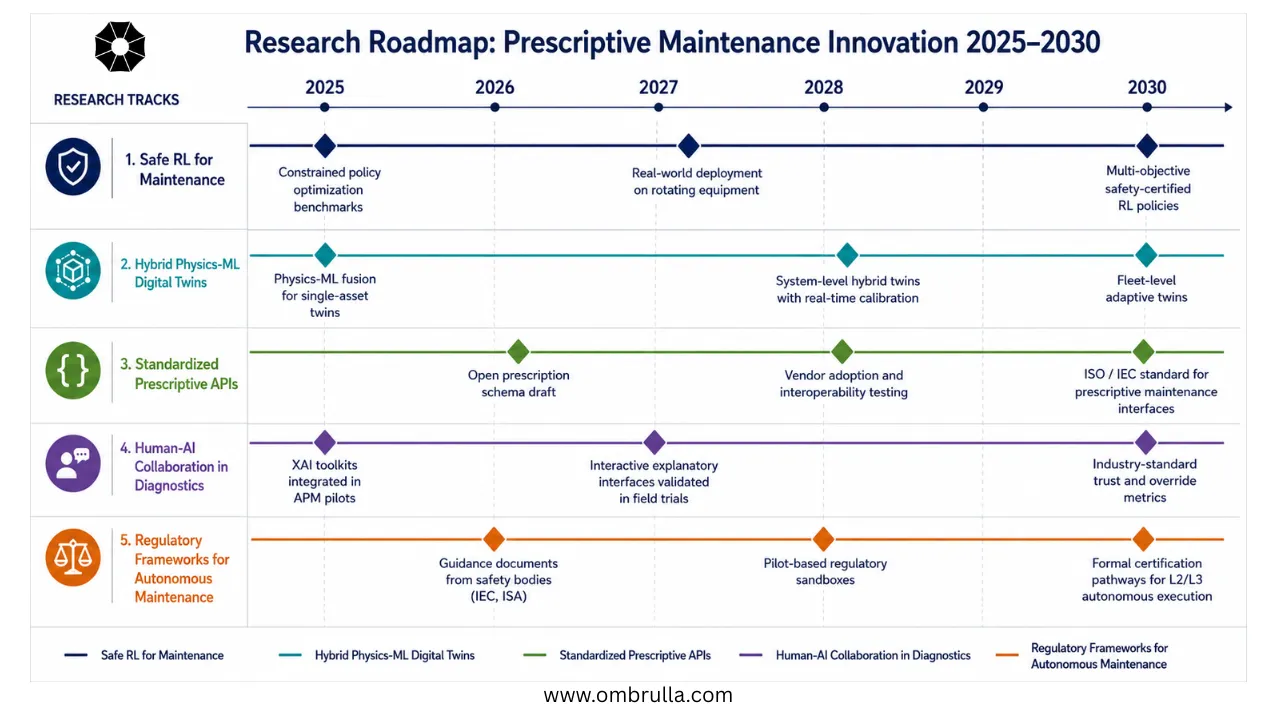
The paper makes four specific contributions. First, it presents a four-stage taxonomy (descriptive, diagnostic, predictive, prescriptive) and precisely characterizes the technical requirements of the prescriptive stage (Section 3). Second, it proposes a detailed six-tier reference architecture for closed-loop asset intelligence (Section 4). Third, it surveys enabling technologies, including digital twins, constrained RL, and XAI, with explicit coverage of integration into IIoT and APM platforms (Sections 5 through 9). Fourth, it introduces a structured evaluation framework (Section 10) and proposes a five-track research roadmap toward autonomous asset management by 2030 (Section 11).
Related Work
Research relevant to prescriptive maintenance and autonomous diagnostics spans four bodies of literature: predictive maintenance and condition monitoring, digital twins for asset management, reinforcement learning in industrial control and maintenance scheduling, and explainable AI in safety-critical systems.
The predictive maintenance literature is extensive, covering convolutional neural network (CNN) and recurrent architectures for vibration-based fault detection, LSTM autoencoders for anomaly detection, and benchmark Remaining Useful Life (RUL) estimation studies using the NASA C-MAPSS turbofan dataset. Reviews in this area consistently identify the prediction-to-action gap as a limiting factor in value realization from predictive systems, motivating the prescriptive layer that this paper addresses.
Digital twin research has matured from isolated asset models toward hierarchical, system-level representations. Leng et al. provide a reference model for digital-twin-driven smart manufacturing, distinguishing physical entities, virtual models, service layer, and data space. Subsequent work by Nweke and Ezugwu demonstrates the specific combination of digital-twin environments with RL agents for intelligent predictive maintenance in Industry 4.0 settings, reporting improved policy convergence when RL training is conducted inside a high-fidelity simulation rather than on historical data alone.
In RL for maintenance and industrial control, Hussain et al. review Q-learning, Deep Q-Network (DQN), and actor-critic methods applied to maintenance scheduling, concluding that constrained and safe RL formulations are essential for realistic deployment because unconstrained RL agents regularly discover policies that exploit operating limits in ways that are physically unsafe. Bousdekis and Mentzas examine the broader applicability of RL to predictive maintenance problems within Industry 4.0, identifying multi-objective reward design and distribution shift as the principal open problems.
For explainability, the XAI survey by Arrieta et al. provides a comprehensive taxonomy of post-hoc and intrinsically interpretable methods, covering SHAP and LIME attribution, counterfactual explanation, and attention-based architectures. Miller further situates AI explanation within the social science literature on human explanatory cognition, highlighting that engineers and operators require contrastive and selective explanations rather than complete causal accounts. Teso and Kersting propose explanatory interactive machine learning as a framework in which model explanations invite user feedback, progressively improving both model and user understanding.
The present paper differs from each of these individual streams by integrating them into a single reference architecture and evaluation framework, explicitly situating digital twins, RL, and XAI within a governance model that addresses autonomy levels, accountability, and regulatory compliance in live industrial environments.
From Predictive to Prescriptive Maintenance: A Taxonomy
Four-Stage Analytics Continuum
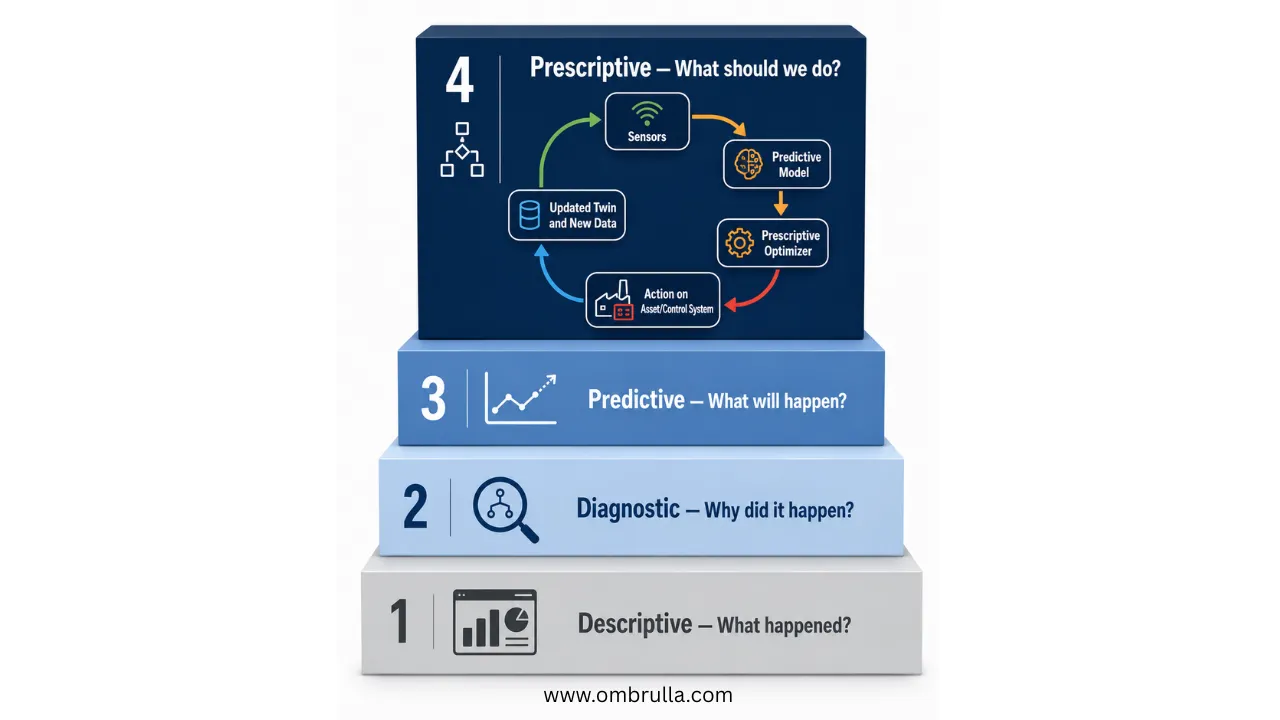
Maintenance analytics is commonly described as a four-stage continuum. Descriptive analytics encompasses key performance indicator (KPI) dashboards and reports that summarize past performance and failure events. Diagnostic analytics covers root-cause analysis (RCA) that explains why failures occurred, typically by correlating event sequences with asset histories and process data. Predictive analytics uses machine learning and physics-informed models to forecast remaining useful life (RUL), probability of failure, or condition trends. Prescriptive analytics goes further, using optimization and decision-support logic to recommend what to do, when, and under what constraints, including cost, scheduled downtime windows, and safety limits.
In practice, many industrial deployments labeled as predictive blend predictive and diagnostic outputs, but lack the systematic algorithmic decision recommendation and optimization that define the prescriptive stage. The prescriptive maintenance layer closes this gap and is now beginning to appear as a distinct capability in commercial APM platforms.Defining Characteristics of Prescriptive Systems
Prescriptive maintenance systems are defined by four functional characteristics that distinguish them from purely predictive deployments. First, they consume multi-source inputs, including RUL estimates, anomaly scores, production schedules, spare parts availability, and labor calendars. Second, they generate ranked action recommendations, such as repair now versus defer, load derating, parameter tuning, or inspection scheduling, each with associated expected outcomes. Third, they evaluate multi-dimensional trade-offs across production loss, failure risk, short-term versus long-term cost, and increasingly environmental impact. Fourth, they provide structured explanations covering why a specific action is recommended, what outcomes are expected under alternative choices, and what the model's confidence is in each prediction.
| Stage | Core Question | Primary Output | Representative Technology | Typical Data Inputs |
|---|---|---|---|---|
| Descriptive | What happened? | KPI dashboards, failure event reports | BI tools, historian queries, CMMS reports | Event logs, work orders, process historians |
| Diagnostic | Why did it happen? | Root-cause analysis, fault attribution | Rule engines, Bayesian networks, knowledge graphs | Sensor data, failure logs, expert rules |
| Predictive | What will happen? | RUL estimates, failure probability, anomaly alerts | CNNs, LSTMs, Random Forests, LSTM autoencoders | Vibration, temperature, current, pressure time series |
| Prescriptive | What should we do? | Ranked action recommendations with trade-off explanations | RL agents, constrained optimization, XAI modules, digital twins | Predictive model outputs, production plans, parts inventory, safety constraints |
Layered Reference Architecture for Closed-Loop Asset Intelligence
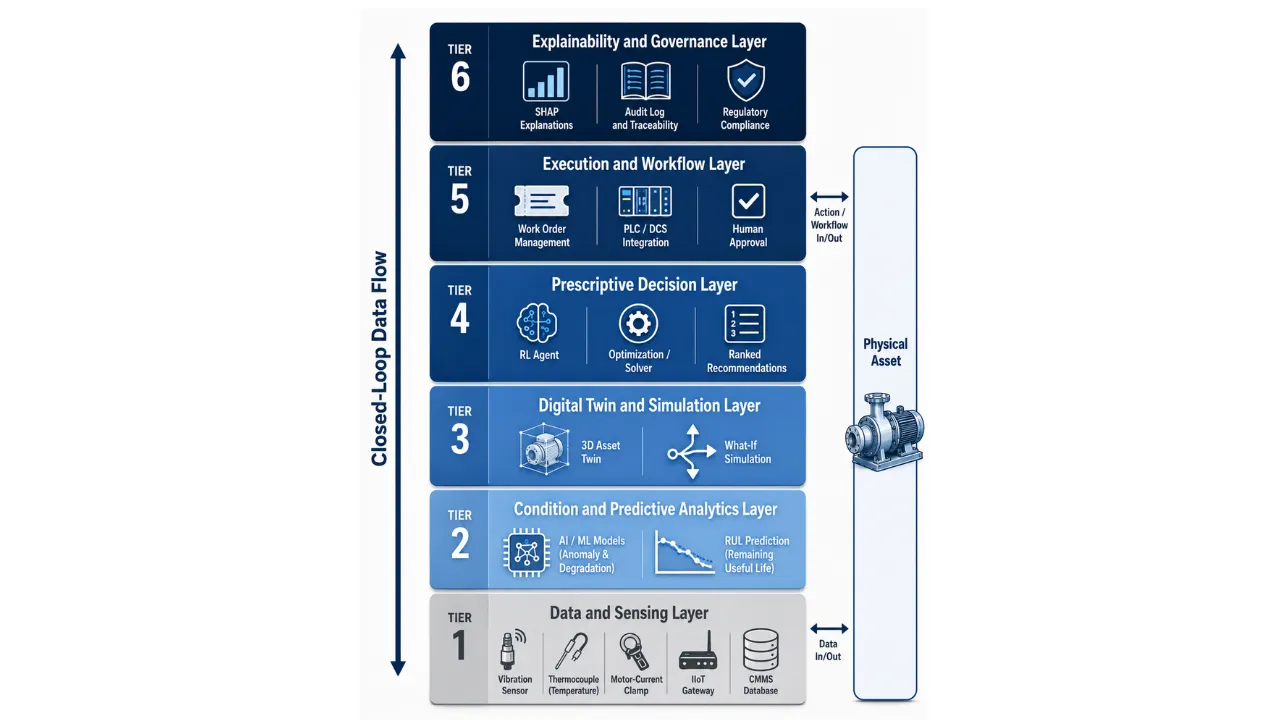
We propose a six-tier layered reference architecture for closed-loop asset intelligence. The architecture is designed to support progressive deployment, with each tier providing value independently while enabling richer closed-loop behavior when integrated with adjacent tiers.
Tier Descriptions
Tier 1 - Data and Sensing Layer: Vibration, acoustic, electrical, process, and environmental sensors; edge gateways and IIoT connectivity; event logs and CMMS/APM data streams; data quality management and time alignment.
Tier 2 - Condition and Predictive Analytics Layer: Feature extraction, signal processing, anomaly detection, RUL prediction, and fault classification models; model serving infrastructure and versioning.
Tier 3 - Digital Twin and Simulation Layer: Asset-specific or system-level twins for what-if simulation and scenario evaluation; virtual sensors for unmeasured variables; twin calibration and update pipelines.
Tier 4 - Prescriptive Decision Layer: Rule-based decision logic, multi-objective optimization engines, and RL agents that map system states and predictions to ranked action recommendations; policy management and version control.
Tier 5 - Execution and Workflow Layer: Integration with CMMS/EAM, APM, and control systems (PLC/DCS/SCADA); automated work order creation and prioritization; human-in-the-loop approval workflows and autonomy-level gating.
Tier 6 - Explainability and Governance Layer: XAI modules generating attributions, counterfactuals, and natural-language summaries; audit trails; policy enforcement and regulatory compliance checks; human oversight dashboards.
Closed-Loop Data Flow
The closed loop proceeds as follows. Raw sensor data from the physical asset enters Tier 1, where it is cleaned, aligned, and distributed to both the predictive models (Tier 2) and the digital twin (Tier 3). The predictive layer produces RUL estimates, fault classifications, and anomaly scores. The digital twin ingests current operating state and calibrates its parameters to match observed behavior. The prescriptive decision layer (Tier 4) takes the combined output of Tiers 2 and 3, runs candidate actions through the twin, and generates a ranked recommendation set. Approved actions flow through Tier 5 into CMMS work orders or control system setpoints. Physical asset behavior changes as a result, new sensor data is generated, and the loop continues.
Digital Twins as the Substrate for Prescriptive Decisions
Types of Digital Twins in Maintenance
Digital twins in maintenance contexts range across three levels of scope. Component-level twins are high-fidelity models of individual critical assets, such as turbines, compressors, or pumps, and may incorporate finite element analysis, thermodynamic modeling, or rotor-dynamics simulation. System-level twins integrate multiple components into models of process units or entire production lines, enabling analysis of inter-asset interactions such as thermal coupling, flow sharing, or load redistribution following a partial failure. Fleet-level twins use statistical and machine learning representations capturing behavior across many similar assets, supporting cross-fleet benchmarking and transfer of learned degradation patterns.
Twins themselves may be physics-based, data-driven (surrogate models, reduced-order machine learning), or hybrid. Hybrid approaches are particularly attractive for industrial maintenance because they preserve physical interpretability, an important requirement for XAI and regulatory compliance, while enabling real-time calibration from live sensor data.Role in Prescriptive Maintenance
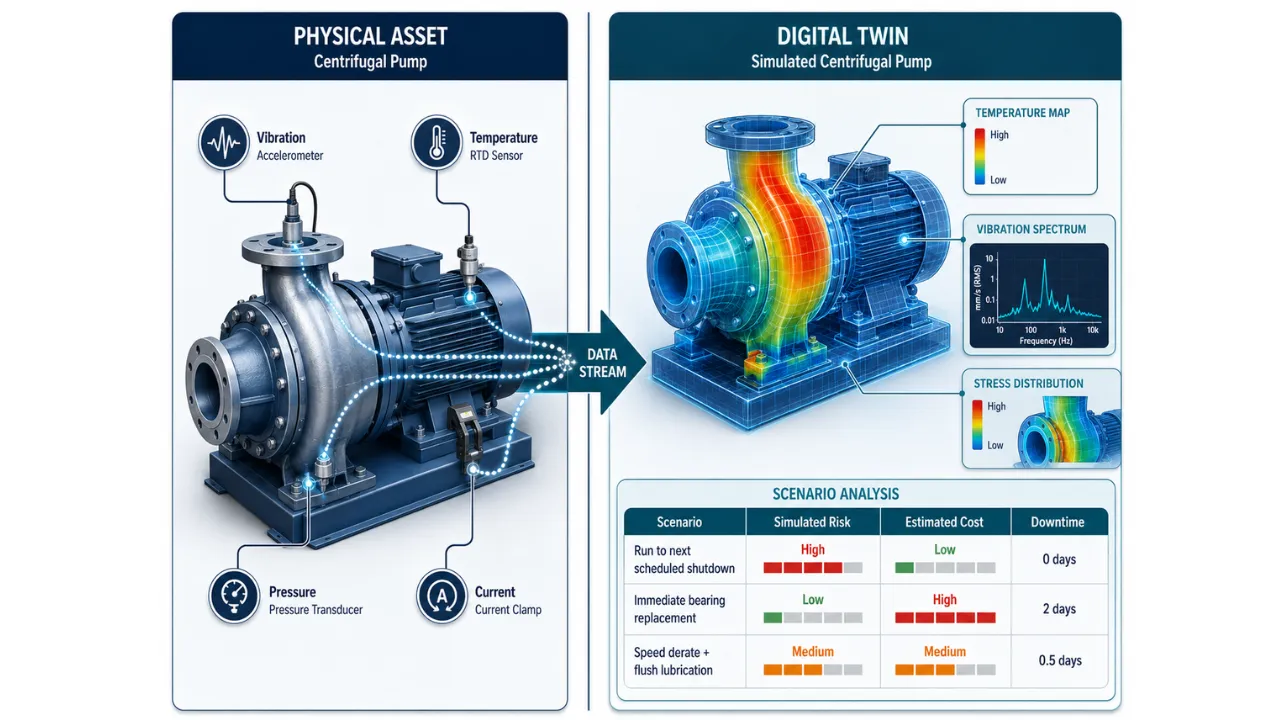
Digital twins serve three distinct functions within the prescriptive maintenance architecture. First, they support what-if simulation: for a given asset state and a candidate intervention, such as operating at reduced speed, performing a partial maintenance action, or changing lubrication intervals, the twin estimates resulting failure risk, performance change, and energy consumption. Second, they act as a training and validation environment for RL agents and optimization routines, allowing candidate policies to be tested against simulated degradation and production scenarios before deployment on the physical asset. Third, they support virtual sensing, inferring unmeasured process or mechanical variables, such as internal temperatures or contact stresses, that are critical for diagnosis but not directly instrumented.
Reinforcement Learning for Maintenance Policies
Why Reinforcement Learning?
Reinforcement learning is well-suited to sequential decision-making under uncertainty, which is the natural framing of maintenance scheduling and operational control. An RL agent learns a policy that maps from a state representation, comprising age, condition indicators, operating context, and production queue, to a discrete or continuous action, such as inspect, repair, overhaul, or adjust operating mode, in order to maximize a cumulative reward signal capturing uptime, safety, revenue, and cost over time.
Reviews of RL in predictive maintenance and industrial control highlight three structural advantages. RL naturally handles stochastic degradation processes and uncertain failure times without requiring an explicit probabilistic failure model. It offers flexibility in encoding complex cost structures and multi-dimensional constraints as reward shaping or Lagrangian penalty terms. It supports continuous policy improvement as operating data accumulates, making it increasingly effective over the asset's life.RL and the Digital Twin Environment
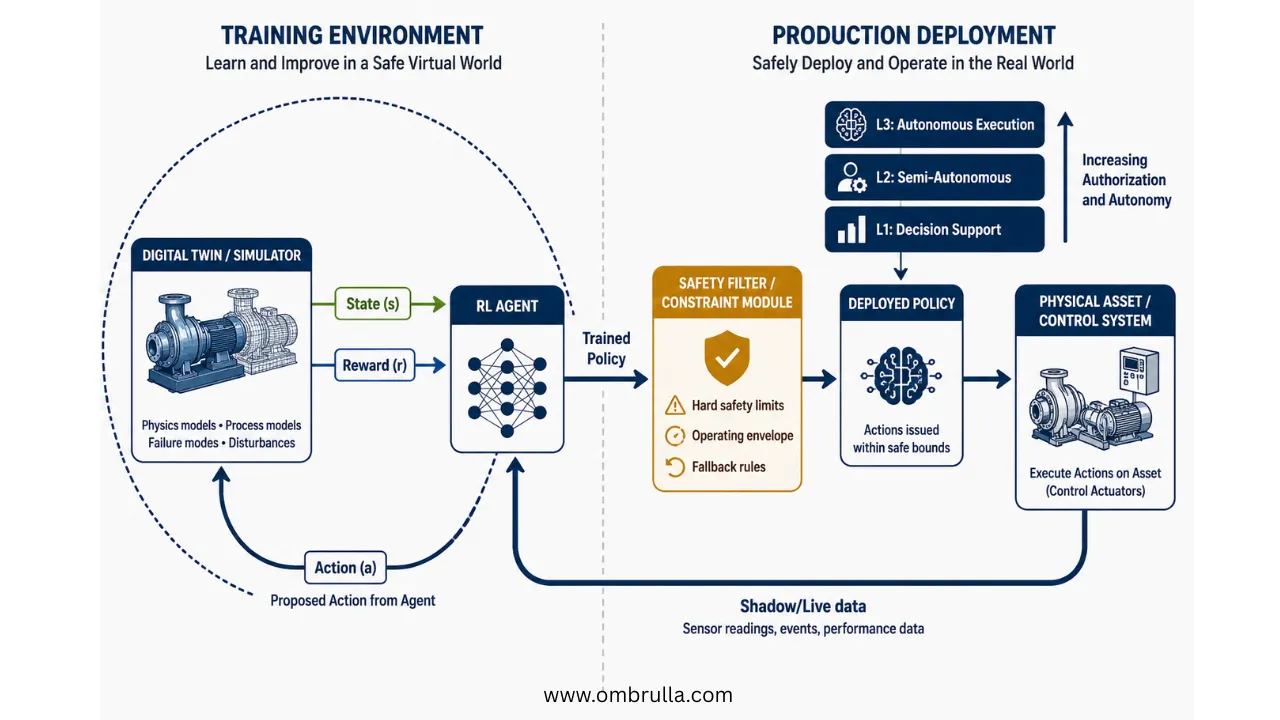
Exploring bad maintenance policies on live industrial assets is unsafe and economically unacceptable. RL training therefore typically uses digital twin environments or separately built physics-based simulators as the agent's training domain. Simulated degradation processes and production scenarios feed RL training episodes, safety constraints and rare-event failure modes can be oversampled beyond their real-world frequency to ensure robust policy coverage, and trained policies are initially deployed in shadow mode, receiving real asset data and generating recommendations without executing them, before gradually being authorized to act within defined bounds.
Methods reported in the literature include Q-learning and Deep Q-Networks (DQN) for discrete action spaces, such as binary repair-or-defer decisions; policy gradient methods such as Proximal Policy Optimization (PPO) for continuous action spaces, such as parameter tuning and load adjustment; and actor-critic architectures for multi-variate, multi-step control problems.Safe and Constrained RL
For real industrial deployments, unconstrained RL is insufficient. Constrained RL and safe RL frameworks enforce hard safety and regulatory limits as invariant constraints rather than soft reward terms, incorporate risk-sensitive objectives that penalize low-probability catastrophic failures more heavily than their expected-value contribution would suggest, and ensure the existence of interpretable fallback strategies triggered by out-of-distribution states or policy uncertainty. Constrained policy optimization (CPO) and safety-layer approaches, which project RL-proposed actions onto a feasibility set defined by physics or engineering limits before execution, are representative techniques used in industrial deployments.
Autonomous Diagnostics: From Alerts to Self-Directed Insight
Capabilities of Autonomous Diagnostic Systems
Autonomous diagnostics in the context of prescriptive maintenance refers to AI systems that perform four functions without requiring human initiation for each analysis cycle. They continuously monitor multi-sensor data streams, processing vibration, acoustic, electrical, and process signals in near real time. They detect and classify anomalies or incipient faults, including bearing wear, impeller fouling, shaft misalignment, and valve leakage, using combinations of deep learning classifiers and physics-informed signal processing. They automatically generate diagnostic narratives, for example 'likely suction-side cavitation; risk elevated by low net positive suction head (NPSH) margin and rising discharge temperature trend', combining model confidence scores with engineering context. They route outputs appropriately, either linking to a prescriptive engine for automated recommendation generation or escalating to human experts when model uncertainty is high or fault classification is ambiguous.
Recent industrial AI platforms combine time-series anomaly detection, multi-class fault classification, and rule-based knowledge graphs to automate large portions of diagnostic workflows that previously required a trained reliability engineer to initiate and complete manually.Integration with the Prescriptive Layer
The output of autonomous diagnostics feeds the prescriptive decision layer (Tier 4 of the reference architecture) in two ways. Single-fault diagnoses with high confidence, such as incipient bearing wear classified with greater than 90 percent posterior probability, directly inform RL or optimization-based policies that recommend whether to slow the asset, schedule immediate replacement, or defer. Multi-fault diagnoses, such as co-occurring fouling and vibration anomaly, require the prescriptive engine to evaluate interaction effects and prioritize among competing interventions, a task that pure rule-based systems handle poorly but that multi-objective RL or constrained optimization can address systematically. In advanced deployments, diagnostic agents and prescriptive agents operate as distinct but collaborating components within an APM or agentic AI platform, with the diagnostic agent specializing in fault identification and the prescriptive agent specializing in action selection.
Explainable Prescriptive Maintenance
Why Explainability is Non-Negotiable
Maintenance decisions affect safety-critical operations and large capital assets, and in many jurisdictions are subject to regulatory audit requirements. Engineers and managers must understand why a prescriptive system recommends a specific intervention, particularly when the recommendation deviates from established practice or prior human judgment. Surveys on XAI in industrial AI, including the meta-review by Arrieta et al., consistently identify explainability as a prerequisite for adoption, and field studies report that inspection and maintenance professionals are unwilling to act on AI recommendations that cannot be explained in terms they recognize from engineering training.
Beyond adoption, explainability serves an operational assurance function: if the XAI module reveals that a recommendation is driven by a feature whose influence does not match physical expectations, this is a signal to review the model rather than trust it. Explainability and model monitoring are therefore co-requisites in a well-governed prescriptive maintenance deployment.XAI Techniques for Prescriptive Systems
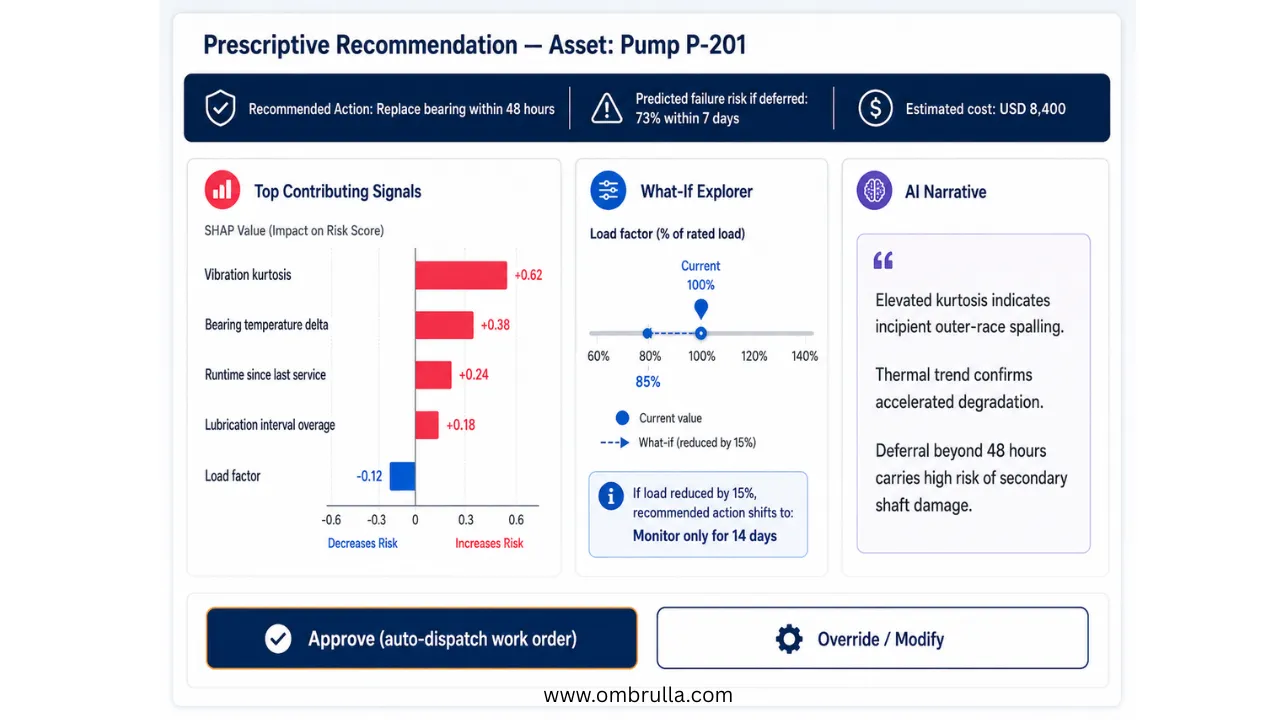
Three classes of XAI technique are particularly relevant to prescriptive maintenance. Feature importance methods, including SHAP (SHapley Additive exPlanations) and LIME (Local Interpretable Model-agnostic Explanations), attribute each model prediction or policy action to individual input features or condition indicators, allowing an engineer to verify that the right signals are driving the recommendation. Counterfactual explanation answers the contrastive question that practitioners most commonly ask: if vibration amplitude were 20 percent lower, would the recommended action change from immediate replacement to monitoring only? This form of explanation directly supports the what-if reasoning that maintenance planners perform when evaluating AI recommendations. Policy summarization for RL-based systems produces charts or decision trees that map regions of the state space, defined by combinations of condition indicators and operating context, to recommended actions and predicted reward differences, making the learned policy auditable without requiring access to the underlying neural network weights.
Industrial prototypes reported in the literature show that combining visual explanations, particularly SHAP bar charts, with brief textual diagnostic narratives increases engineer trust and significantly reduces the time required to approve prescriptive recommendations, shortening the action latency that the prescriptive layer is designed to eliminate.
Integration with APM, CMMS, and Control Systems
Closing the Loop via Work Management
Prescriptive maintenance delivers value only when recommendations are translated into action. This requires seamless integration across three categories of operational system. Within APM and CMMS/EAM platforms, integration means automatically creating, prioritizing, and updating work orders linked to prescriptive recommendations; associating recommendations with asset criticality ratings, spare parts records, and historical failure data; and closing the loop by recording which prescriptions were executed, modified, or rejected, to support ongoing model improvement. Within control and automation systems, including DCS, SCADA, and PLCs, integration at the highest autonomy levels means implementing approved soft actions, such as setpoint adjustments or operating mode changes, directly through standardized interfaces under defined authorization conditions.
Autonomy Levels for Prescriptive Execution
We define three autonomy levels for prescriptive maintenance execution, analogous to the SAE automation levels for autonomous vehicles. At Level 1, Decision Support, the prescriptive system suggests ranked actions with explanations; humans make all decisions and manually initiate execution through existing workflows. At Level 2, Semi-Autonomous, the system automatically populates work orders and may execute low-risk control actions, such as minor setpoint adjustments within predefined operating envelopes, with human approval required before implementation. At Level 3, Autonomous Execution, the system executes routine, well-understood, low-risk prescriptions automatically, with logging, periodic audit, and exception escalation to human oversight. Most current industrial deployments sit at Level 1 or in the early stages of Level 2, with movement toward Level 3 restricted to specific, well-characterized action classes in environments with high-confidence digital twin validation.
| Autonomy Level | Who Executes Action? | Governance Requirements | Representative Examples |
|---|---|---|---|
| L1 - Decision Support | Human decides and manually executes | Full human sign-off; audit trail of recommendations shown and decisions made | Prescriptive work-order suggestion displayed in APM for engineer approval |
| L2 - Semi-Autonomous | System initiates; human approves before execution | Dual-authorization model; time-limited approval window; rollback capability | Auto-populated work order auto-dispatched after 4-hour approval window unless overridden; minor setpoint nudge with email approval |
| L3 - Autonomous Execution | System executes; human monitors and can override | Real-time monitoring dashboard; automatic escalation on anomaly; quarterly audit of policy decisions | Automatic lubrication-interval adjustment within ±5% of setpoint; auto-scheduling of routine inspection within pre-approved window |
Evaluation Framework for Prescriptive Maintenance Systems
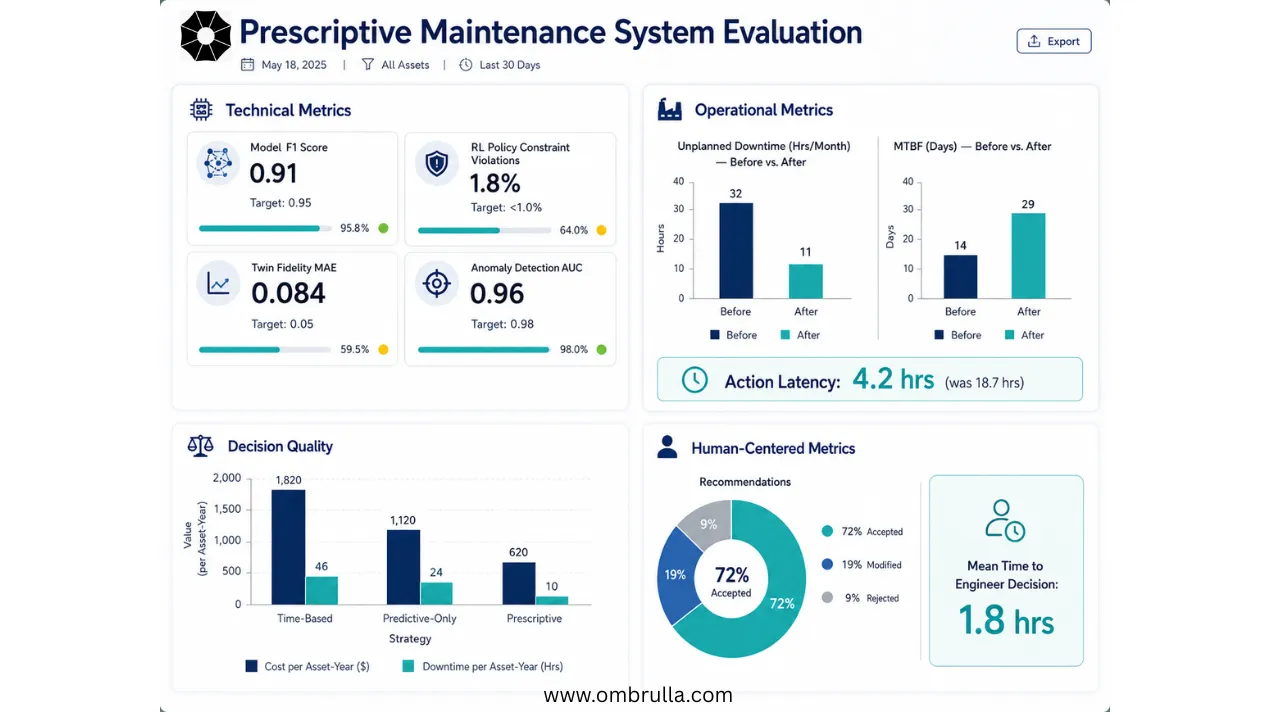
Evaluating prescriptive maintenance requires a broader and more multi-dimensional framework than that typically applied to predictive models alone. We propose four evaluation dimensions:
1. Technical Model Metrics
Technical evaluation covers the component models within the prescriptive stack: prediction accuracy for RUL and fault classification (including precision, recall, F1, and AUC per fault class); anomaly detection performance (precision, recall, and time-to-detect on held-out fault injection events); RL policy stability and convergence (cumulative reward across training episodes, constraint violation rate during training and deployment); and digital twin fidelity (mean absolute error of simulated versus measured state variables across the operating envelope).
2. Operational Metrics
Operational evaluation quantifies the impact of the complete prescriptive system on asset and plant performance: reduction in unplanned downtime and mean time to repair (MTTR) relative to a baseline period or control group; improvement in mean time between failures (MTBF) and overall equipment effectiveness (OEE); spare-parts inventory optimization, measured by reduction in emergency procurement events and carrying cost; and action latency, the time from recommendation generation to work-order execution, which the prescriptive layer is specifically designed to compress.
3. Decision Quality
Compares prescriptive policies against alternatives: A/B comparisons between assets managed under prescriptive recommendations vs. time-based or purely predictive baselines; retrospective simulation replaying historical periods under candidate policies; counterfactual analysis estimating cost and downtime outcomes of alternative action choices.
4. Human-Centered Metrics
Human factors evaluation captures the system's effectiveness from the perspective of the maintenance workforce: user trust and perceived usefulness, measured through structured surveys such as the Technology Acceptance Model (TAM) instrument; override rate and override direction, indicating whether engineers systematically accept, defer, or reject prescriptive recommendations and whether override decisions align with subsequent outcomes; and time to action, measuring the elapsed time from recommendation display to engineer decision, which quantifies the XAI layer's effectiveness in accelerating approval.
Challenges and Research Directions
Open Challenges
- -Multi-objective policy optimization: balancing safety, reliability, production throughput, cost, and increasingly environmental metrics within a single RL reward structure or constrained optimization formulation remains technically challenging and organizationally contentious, since different stakeholders hold different objective weightings.
- -Data scarcity for rare failures: prescriptive policies must handle rare, catastrophic failure modes for which operational data is limited or absent; techniques including domain-knowledge encoding in digital twins, physics-based failure simulation, and synthetic data generation address this partially, but no fully satisfactory solution exists.
- -Robustness to distribution shift: as assets age, process conditions change, or new operating modes are introduced, both predictive models and learned RL policies degrade; continuous learning, model drift monitoring, and online policy adaptation are active research areas.
- -Governance and accountability: defining accountability when an autonomous diagnostic system makes or executes decisions that contribute to an asset failure or a safety incident is unresolved in most regulatory frameworks; alignment with functional safety standards such as IEC 61508/61511 and emerging AI governance frameworks is needed.
- -Standardization and interoperability: the absence of standard data schemas and open interfaces across APM, digital twin, CMMS, and prescriptive engine products creates integration friction that disproportionately burdens smaller operators; emerging standards such as OPC UA over MQTT and the Asset Administration Shell (AAS) initiative address aspects of this, but prescriptive-specific APIs remain unstandardized.
Comparative Technology Positioning
| Technology | Maturity (TRL) | Key Industrial Benefit | Primary Technical Challenge | Deployment Readiness |
|---|---|---|---|---|
| Physics-based digital twins (component level) | 7-9 | High-fidelity what-if simulation, virtual sensing | Calibration cost, model maintenance overhead | High; widely deployed in turbomachinery |
| Data-driven / ML surrogate twins | 6-8 | Scalable, auto-calibrating, lower setup cost | Limited extrapolation beyond training distribution | Medium-High; growing in IIoT platforms |
| Deep learning predictive models (CNN/LSTM) | 8-9 | High accuracy on vibration/thermal fault detection | Requires labeled failure data; model drift | High; mainstream in APM/PdM platforms |
| Constrained RL for maintenance policies | 4-6 | Continuous policy improvement, handles uncertainty | Safe exploration, reward design, data hunger | Low-Medium; pilot deployments only |
| Autonomous diagnostics (AI-generated narratives) | 5-7 | Reduced analyst workload, faster time-to-insight | Hallucination risk, knowledge-graph maintenance | Medium; emerging in advanced APM platforms |
| SHAP/LIME XAI for maintenance | 7-9 | Engineer trust, regulatory compliance support | Computational overhead; misleading if model is biased | High; available in major ML frameworks |
Conclusion
Prescriptive maintenance and autonomous diagnostics represent the natural evolution of industrial asset analytics: from understanding what might fail to deciding, and increasingly acting on, what should be done, when, and why. By integrating predictive maintenance models, physics-informed digital twins, reinforcement learning, and explainable AI within the six-tier reference architecture proposed in this paper, organizations can build closed-loop asset intelligence systems that continuously optimize maintenance and operational strategies under real-world constraints.
The reference architecture described in Section 4 provides a practical blueprint for progressive deployment. Organizations can begin at Tier 1 and Tier 2, strengthening IIoT sensing and predictive model foundations, before introducing digital-twin-based simulation (Tier 3) and prescriptive decision support (Tier 4). Integration with CMMS, APM, and control systems (Tier 5), governed by the XAI and audit mechanisms of Tier 6, then enables the progression from decision support through semi-autonomous to fully autonomous execution in well-understood action classes.
While fully autonomous execution at Level 3 will remain appropriately restricted to constrained, well-validated contexts in the near term, even decision-support-level prescriptive systems operating at Level 1 can deliver significant, measurable reductions in action latency, unplanned downtime, and maintenance cost relative to systems that stop at prediction. The evaluation framework proposed in Section 10 provides the measurement infrastructure needed to demonstrate and sustain these gains.
For practitioners, the pragmatic path forward involves four steps: strengthening predictive maintenance data foundations through improved sensing, labeling pipelines, and model versioning; introducing digital twins for high-value assets and using them as sandboxes for both policy exploration and what-if simulation; piloting prescriptive decision-support modules integrated with existing CMMS and APM platforms, with human-in-the-loop controls and XAI explanations built in from the outset; and gradually extending RL-based and autonomous diagnostic capabilities, constrained by safety policies and supported by the governance and accountability mechanisms described in Section 11. Pursued thoughtfully, this approach can transform maintenance from a reactive, human-intensive cost center into an integrated, intelligent decision layer that closes the loop on asset intelligence and enables self-optimizing industrial operations.
References
1 Joshi, R. "Prescriptive Maintenance: The Next Step in Predictive Analytics." Solutions Review, 2024.
2 IBM. "Predictive Maintenance for Industrial Equipment: An IBM Industry 4.0 Solution." Whitepaper, 2023.
3 AVEVA. "Advancing Predictive Maintenance to Prescriptive Asset Management." Whitepaper, 2022.
4 Deloitte. "Driving Value with Predictive Maintenance in Industrial Operations." 2022.
5 Accenture. "From Predictive to Prescriptive Maintenance: Unlocking the Next Level of Asset Performance." 2023.
6 SAS. "From Predictive to Prescriptive Maintenance." 2021.
7 McKinsey & Company. "From Predictive to Prescriptive Maintenance: How Advanced Analytics Can Close the Loop." 2020.
8 Siemens. "Digital Twins and AI for Predictive and Prescriptive Maintenance." Whitepaper, 2023.
9 Microsoft Azure. "Predictive Maintenance for Remote Manufacturing Assets." Solution Architecture, 2023.
10 Hitachi Energy. "Prescriptive Maintenance in Asset Performance Management." Product Brief, 2024.
11 Nweke, H. and Ezugwu, A. "Digital Twin-Driven Reinforcement Learning for Intelligent Predictive Maintenance in Industry 4.0." Applied Sciences, 2023.
12 Hussain, A. et al. "A Reinforcement Learning-Based Approach for Predictive Maintenance in Manufacturing Systems: A Review." Journal of Manufacturing Systems, 2022.
13 Bentley Systems. "AssetWise APM: Predictive and Prescriptive Maintenance." Product Documentation, 2024.
14 Leng, J. et al. "Digital Twins-Driven Smart Manufacturing: Connotation, Reference Model, Applications and Research Issues." Robotics and Computer-Integrated Manufacturing, 2021.
15 Arcadis. "Digital Twins for Asset Optimization and Decarbonization." Insight Paper, 2024.
16 Bousdekis, A. and Mentzas, G. "Reinforcement Learning for Predictive Maintenance in the Context of Industry 4.0: Challenges and Opportunities." Computers & Industrial Engineering, 2022.
17 Arrieta, A. B. et al. "Explainable Artificial Intelligence (XAI): Concepts, Taxonomies, Opportunities and Challenges." Information Fusion, 2020.
18 Teso, S. and Kersting, K. "Explanatory Interactive Machine Learning." ACM Computing Surveys, 2019.
19 Miller, T. "Explanation in Artificial Intelligence: Insights from the Social Sciences." Artificial Intelligence, 2019.
20 Siemens. "Explainable AI for Industrial Maintenance Analytics." Technical Note, 2023.