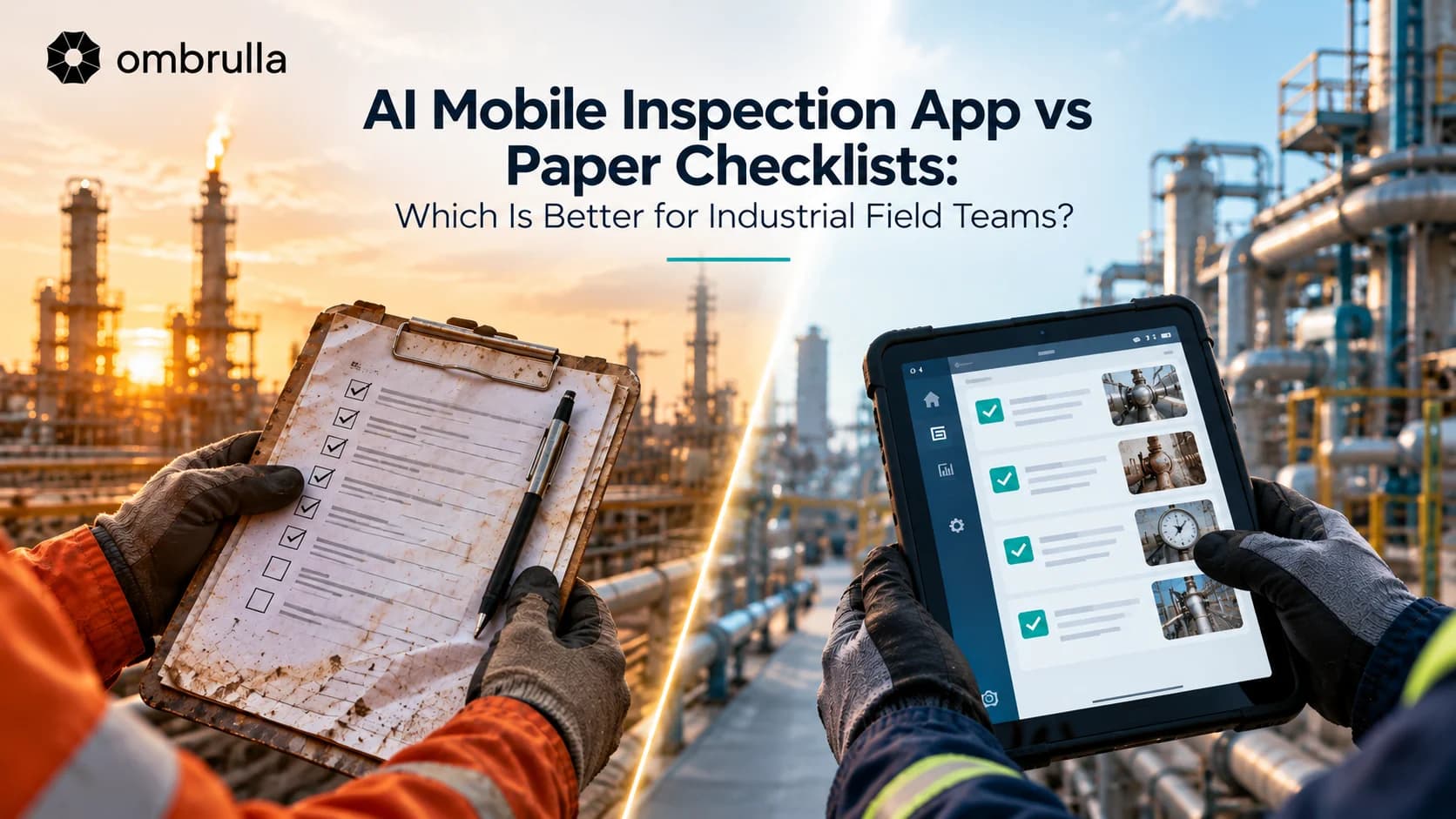

Introduction: The Inspection Problem No One Is Talking About
Every year, industrial organisations across oil and gas, manufacturing, construction, and chemical sectors lose millions to a problem hiding in plain sight - not in the equipment, but in the inspection process itself.
A missed crack on a pressure vessel. A valve corrosion finding scribbled on a form that was never digitised. A compliance audit that fails because an inspector's paper record was damaged, lost, or simply unreadable. These are not edge cases. They are systemic failures rooted in a practice that industry has relied on for over a century: the paper inspection checklist.
The question is no longer whether paper checklists have limitations. They clearly do. The real question that senior operations, safety, and maintenance leaders are asking today is:

"Is an AI mobile inspection apps app mature enough, reliable enough, and operationally practical enough to replace our paper-based inspection workflow - and what is the measurable business case for doing so?"
This guide answers that question directly. We compare AI mobile inspection apps versus paper checklists across every dimension that matters to field teams - accuracy, offline functionality, photo evidence capture, CMMS integration, report generation, audit trail, AI-powered defect detection, and total cost of ownership.
By the end, you will have a clear, evidence-based decision framework to determine which approach is right for your organisation, your sites, and your assets.
The Current State - Paper Checklists in Industrial Environments
Paper-based inspection checklists have been the operational backbone of industrial asset inspection for decades. In the oil and gas sector, inspection forms govern everything from routine valve checks to statutory pressure vessel inspections under API 510. In manufacturing, they drive ISO 55001 asset management compliance. In construction, they manage site safety walkdowns. In the chemical industry, they are central to Process Safety Management (PSM) obligations under OSHA 1910.119.
The fact that these industries still rely so heavily on paper is not a sign of complacency - it reflects the reality that paper is universally available, requires no infrastructure, and has been accepted as a legally valid record format for generations.
Where Paper Checklists Genuinely Work
- - Remote sites with no connectivity and no power availability
- - Low-stakes spot checks with minimal compliance obligation
- - Emergency backup when digital systems fail
- - Where regulatory acceptance of digital records has not yet been confirmed
Where Paper Checklists Consistently Fail
Despite their simplicity, paper checklists introduce compounding operational failures across the inspection lifecycle:
| Failure Point | Business Impact |
|---|---|
| Human Transcription Errors | Studies by Aberdeen Group indicate data entry error rates of up to 23% in manual paper-based processes. In inspection contexts, a single transcription error can mask a safety-critical defect. |
| No Real-Time Visibility | Managers cannot see inspection progress until forms are physically returned. In large facilities with multiple concurrent inspections, this creates dangerous blind spots. |
| Lost or Damaged Records | Paper records are vulnerable to moisture, fire, and physical deterioration. In coastal oil and gas environments, this is a persistent problem. |
| Slow, Unreliable Reporting | Converting paper inspection findings into actionable maintenance work orders takes hours - sometimes days - delaying corrective action. |
| No Photo Evidence Integration | Paper forms cannot embed photo evidence. Inspectors must manage separate cameras, then manually correlate images to findings - a process prone to errors and omissions. |
| Weak Audit Trails | Paper-based records offer limited protection in regulatory audits. There is no digital timestamp, no geolocation, no proof of who completed a check and when. |
| Knowledge Silos | Inspection knowledge lives in the head of the individual inspector. When that person leaves, so does the institutional knowledge embedded in their paper habits. |
What Is an AI Mobile Inspection App?

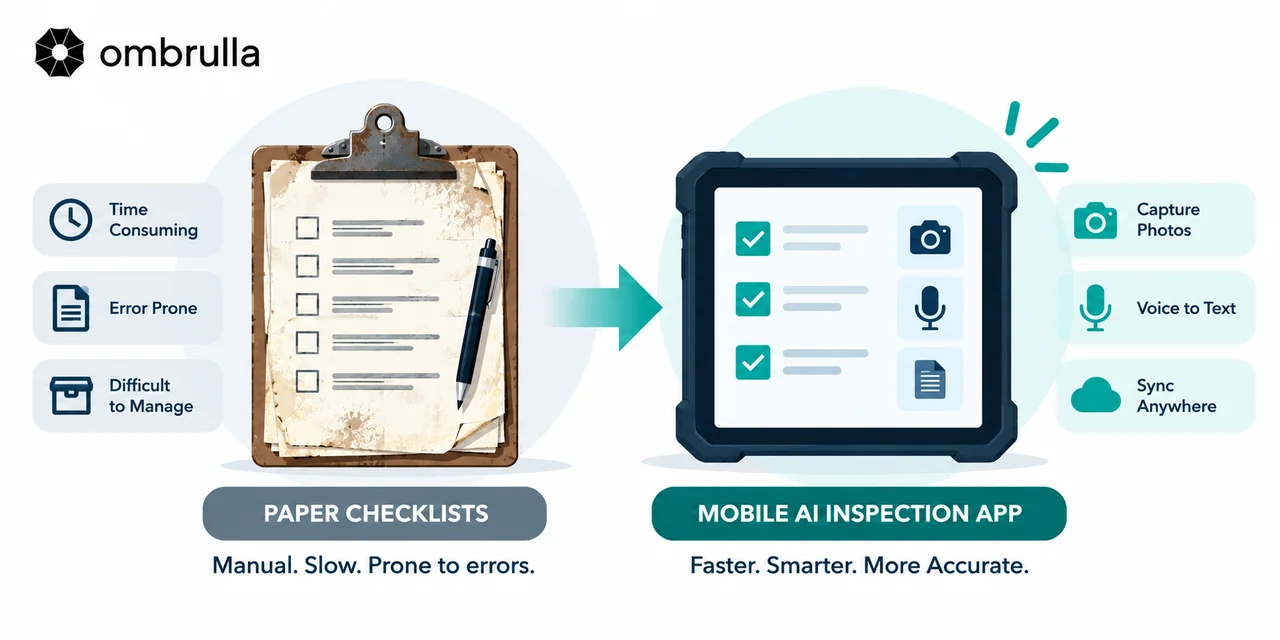
An AI mobile inspection app is a smartphone or tablet-based software platform that guides field engineers through structured inspection workflows using artificial intelligence. It replaces paper checklists with dynamic digital forms, integrates a device camera for photo evidence capture, uses machine learning models to detect anomalies and defects in real time, generates automated inspection reports, and synchronises data with enterprise systems including CMMS, ERP, and EHS platforms - all with full offline functionality for remote field use.
Core Capabilities of a Modern AI Mobile Inspection App
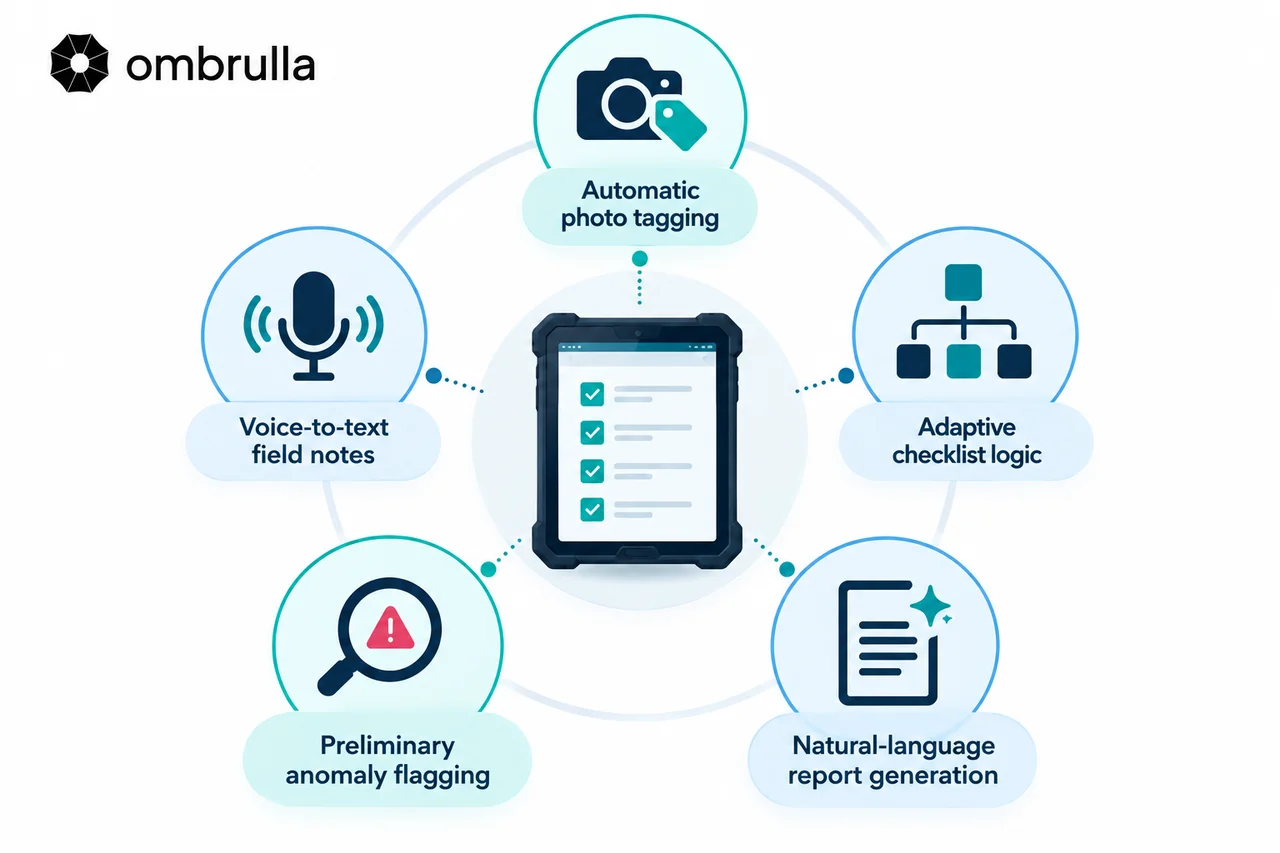
The best AI-powered field inspection apps combine five foundational capability layers:
- - AI-Guided Digital Checklists:Instead of static paper forms, AI mobile inspection apps present dynamic, context-aware checklists that adapt based on asset type, inspection history, previous findings, and regulatory requirements. Inspectors are guided step by step, reducing the risk of missed checks.
- - Real-Time AI Defect Detection:Using computer vision and machine learning models trained on industrial imagery, the app analyses photos taken by the inspector and flags potential anomalies - corrosion, cracks, leaks, misalignments, and deterioration - in real time. This is a capability that paper checklists simply cannot replicate.
- - Offline Inspection Mode:Industrial field work frequently occurs in areas with no cellular or Wi-Fi connectivity - offshore platforms, underground facilities, remote pipelines. AI mobile inspection apps operate fully offline, storing data locally and synchronising automatically when connectivity is restored.
- - Photo Evidence Capture with Metadata:Integrated camera functionality allows inspectors to capture photos directly within the inspection workflow. Each image is automatically tagged with timestamp, GPS location, asset ID, and inspection finding - creating an immutable, auditable photographic record.
- - Automated Inspection Reporting:Once an inspection is complete, the app generates a structured PDF or digital report automatically - including all findings, photos, severity ratings, and corrective action recommendations. What previously took hours of manual effort now takes seconds.
- - CMMS and ERP Integration:AI inspection apps integrate directly with Computerised Maintenance Management Systems (CMMS) and ERP platforms, automatically creating work orders for findings that require corrective action - eliminating the manual data re-entry that creates delays and errors in paper-based workflows.
Head-to-Head Comparison: AI Mobile Inspection App vs Paper Checklists

The table below provides a comprehensive, side-by-side comparison of paper checklists versus AI mobile inspection apps across the dimensions that matter most to senior operations and maintenance leaders in industrial sectors.
| Inspection Criteria | Paper Checklists | AI Mobile Inspection App |
|---|---|---|
| Speed of Inspection | Slow - manual entry, handwriting errors | Fast - guided digital forms, auto-fill |
| Offline Functionality | Works anywhere | Works offline; syncs when connected |
| Photo Evidence Capture | Requires separate camera + manual labeling | Integrated camera with AI tagging |
| AI Defect Detection | None - fully human-dependent | Real-time AI anomaly detection |
| Report Generation | Hours to days of manual effort | Automated PDF/digital reports in minutes |
| Audit Trail | Paper-based - easily lost or altered | Tamper-proof digital audit trail |
| CMMS Integration | Manual data re-entry required | Direct API integration with CMMS/ERP |
| Data Accuracy | High error rate - up to 23% (studies) | Near-zero data entry errors |
| Regulatory Compliance | Difficult to prove, fragile records | Built-in compliance mapping & traceability |
| Scalability | Linear cost growth with headcount | Scales digitally across sites & assets |
| Cost Over Time | Hidden costs: storage, admin, re-inspection | Lower TCO - ROI in 6–18 months |
| Knowledge Retention | Inspector-dependent, lost on attrition | Institutional knowledge encoded in checklist |
| Remote Oversight | Impossible without physical presence | Real-time dashboards for remote managers |
| Environmental Risk | Paper waste, physical storage burden | Paperless, cloud-stored, sustainable |
Source: Aberdeen Group; IOGP Safety Data; McKinsey Digital Industrial Report; Ombrulla Platform Analysis.
Deep Dive - 6 Critical Dimensions Where AI Wins
1. Photo Evidence Capture - From Afterthought to Core Evidence Layer

In paper-based inspection workflows, photo evidence is an afterthought. Inspectors carry separate cameras or use personal phones, take photos that exist in isolation from the inspection record, and must later manually correlate images to paper findings - a process that is both time-consuming and error-prone.
AI mobile inspection apps transform photo evidence into a first-class data asset. Every photo captured within the inspection workflow is automatically linked to the specific checklist item, tagged with GPS coordinates and timestamp, labelled with the asset ID and inspection reference number, and uploaded directly to the inspection record in real time.
More critically, AI defect detection models analyse each photo and surface potential issues that the human eye might miss - early-stage corrosion, micro-cracks in welds, discoloration suggesting heat damage, or mechanical misalignment. This effectively creates a two-layer inspection: human observation plus AI-powered analysis.
Industry Fact: In oil and gas pipeline inspections, studies have shown that AI-assisted visual inspection can identify defects up to 40% earlier than traditional human-only visual inspection - significantly reducing the risk of unplanned shutdowns (Source: IOGP Report 2024).
2. Audit Trail - The Difference Between Compliance and Liability
In regulated industries, the audit trail is not a nice-to-have feature - it is a legal and regulatory requirement. Whether you are managing API 510 pressure vessel inspection records, demonstrating OSHA PSM compliance, or responding to an insurance investigation following an incident, the quality and completeness of your inspection audit trail can determine whether your organisation faces fines, operational shutdowns, or legal liability.
Paper checklists create fragile audit trails. They can be backdated, altered, damaged, or simply lost. They offer no proof of when an inspection occurred, who conducted it, how long it took, or whether all steps were completed.
AI mobile inspection apps create tamper-proof, timestamped, geofenced audit trails. Every checklist item completed, every photo taken, every finding recorded, and every report generated creates an immutable digital record with a verifiable chain of custody. For senior managers, this transforms inspection records from a liability into an asset.
- - Timestamped entry for every inspection action
- - Inspector identity linked to biometric or credential-based login
- - GPS geofencing confirmation that inspection occurred at the correct location
- - Device ID and signature confirmation for regulatory submissions
- - Full version history of inspection records - no hidden edits
3. Offline Inspection - Field Reality vs Office Assumptions
One of the most common objections raised by operations managers evaluating AI mobile inspection apps is the question of connectivity. "Our sites are remote. There is no Wi-Fi, and cellular coverage is unreliable. How can a digital app work in those conditions?"
The answer is that purpose-built AI mobile inspection apps are designed from the ground up for offline-first operation. This means the app, the inspection checklists, the asset database, the AI model for defect detection, and the local data storage all reside on the device - fully functional without any network connection.
When a field engineer completes an inspection on an offshore platform, a remote pipeline right-of-way, or an underground electrical substation, the data is stored locally and encrypted on the device. The moment the device reconnects - whether that is onsite Wi-Fi, cellular, or satellite - the inspection data is automatically synchronised to the central platform, triggering report generation, CMMS work order creation, and management dashboard updates.
Paper works offline because it requires no technology. AI mobile inspection apps work offline because they are architecturally designed for offline-first field operation. For industrial field teams, the operational experience is comparable - but the data quality and downstream value are dramatically different.
4. Automated Report Generation - Hours to Minutes
The hidden labour cost in paper-based inspection programmes is the administrative burden of report generation. After completing a field inspection, an engineer must return to the office, transcribe handwritten notes into a report template, locate and attach photographs, assign severity ratings, calculate compliance metrics, and submit the report for review. In complex industrial environments, this process can consume as much time as the inspection itself.
AI mobile inspection apps generate inspection reports automatically. At the point of inspection completion, the app compiles all checklist responses, photo evidence, AI defect flags, inspector notes, and asset data into a structured, professionally formatted PDF report. This report can be automatically emailed to relevant stakeholders, uploaded to a document management system, and linked to a CMMS work order - all without any manual effort.
For a maintenance manager overseeing 50 inspection activities per week, this represents a significant time saving. For a facility with regulatory reporting obligations, it represents a reduction in compliance risk. For the inspector in the field, it means less administrative burden and more time for actual inspection work.
| Paper-Based Report: Time Breakdown | AI App: Time Breakdown |
|---|---|
| Transcribe handwritten notes: 30–60 min | Report auto-generated at inspection end: 0 min |
| Attach and label photographs: 20–40 min | Photos auto-linked and labelled: 0 min |
| Format report template: 20–30 min | Severity/compliance auto-calculated: 0 min |
| Route for review and approval: 1–2 days | Auto-distributed to stakeholders: < 5 min |
| Total: 4–6 hours per inspection report | Total: < 5 minutes per inspection report |
5. CMMS Integration - Closing the Inspection-to-Action Gap
The purpose of an inspection is not to generate a report - it is to identify conditions that require corrective action and ensure that action is taken. Paper-based inspection workflows create a critical gap between finding identification and corrective action initiation. The paper form must be collected, the finding transcribed into a CMMS work order, and the work order assigned to a maintenance team - a process that can introduce delays of hours, days, or even weeks.
In industrial environments, delay between defect identification and corrective action directly increases operational risk. A developing crack in a pressure vessel, a corroding pipe flange, or a failing bearing are conditions that worsen with time. Every hour of delay between identification and response represents incremental risk.
AI mobile inspection apps integrate directly with CMMS platforms - including SAP PM, IBM Maximo, Infor EAM, and others - via API connections. When an inspector records a finding that meets predefined severity thresholds, the app can automatically create a CMMS work order, assign it to the appropriate maintenance team, link the inspection evidence, and set a priority level - all in real time, with no manual data re-entry.
6. AI Anomaly Detection - Adding a Second Expert to Every Inspection

The most transformative capability of an AI mobile inspection app - and the one that most clearly separates it from any paper-based alternative - is real-time AI anomaly detection.
Computer vision models trained on industrial imagery can identify visual indicators of defects, degradation, and safety hazards with a consistency and precision that even experienced inspectors cannot always replicate. Fatigue, time pressure, limited visibility, and simple human variability all affect the completeness of manual visual inspection. AI models do not suffer from these limitations.
When an inspector captures a photo of a pressure vessel, a weld joint, a rotating component, or a structural element, the AI model analyses the image and returns a defect assessment in real time - flagging specific areas of concern, assigning confidence scores, and recommending follow-up actions. This creates a collaborative inspection dynamic: the human inspector applies contextual knowledge and physical observation, while the AI layer adds computational image analysis.
- - Corrosion detection:Identifying pitting, general corrosion, and deposit formation on metallic surfaces
- - Crack identification:Detecting surface and near-surface cracks in welds, structural components, and pressure-retaining equipment
- - Leak detection:Identifying liquid or vapour leaks through visual or thermal imaging analysis
- - Structural anomalies:Detecting misalignment, deformation, or settlement in civil and structural assets
- - Surface condition assessment:Evaluating coating integrity, paint deterioration, and insulation damage
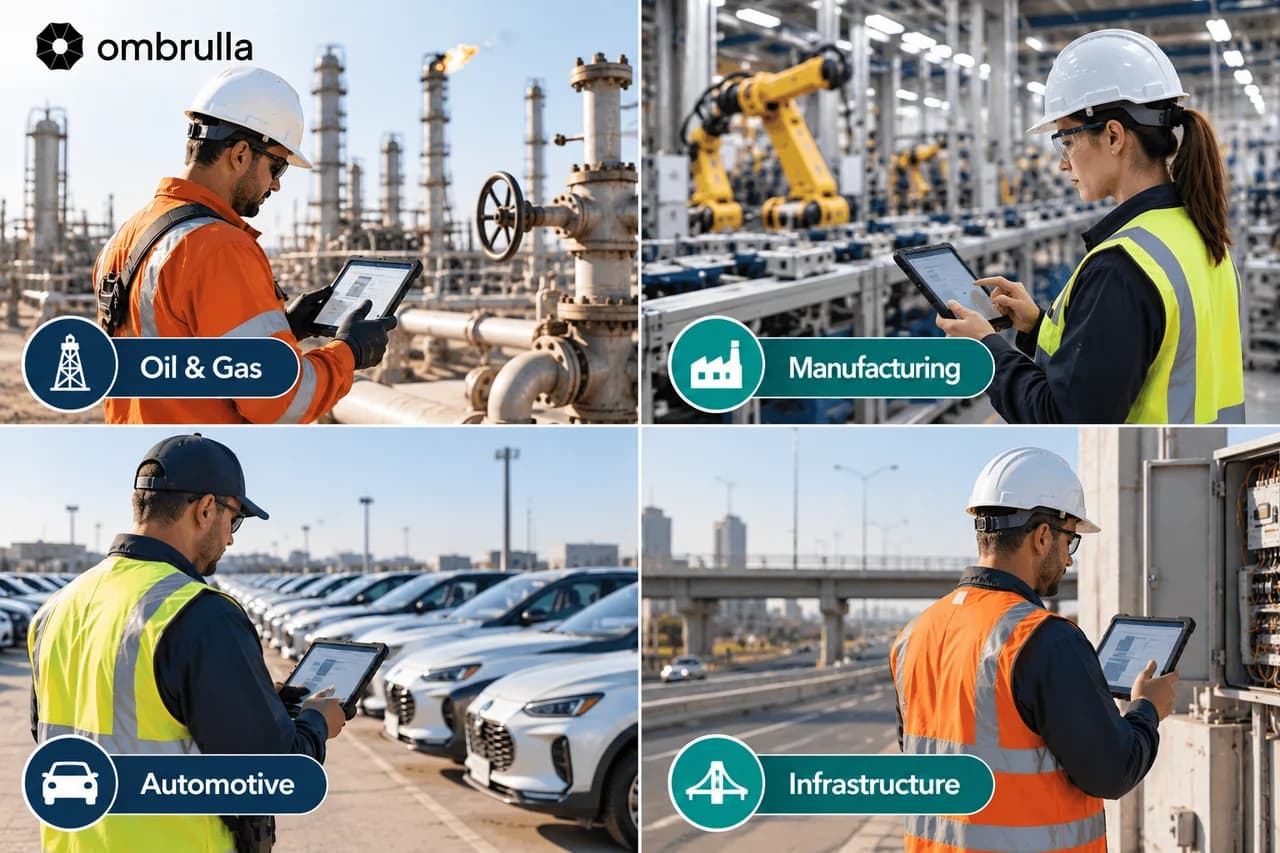
Industry-Specific Use Cases

Oil & Gas: Pipeline Integrity, Pressure Vessel, and Rotating Equipment Inspection
The oil and gas industry operates under some of the most stringent inspection and integrity management obligations of any sector. API 510 (Pressure Vessel Inspection Code), API 570 (Piping Inspection Code), API 653 (Storage Tank Inspection), and API 580/581 (Risk-Based Inspection) all require documented, traceable inspection records maintained over the operational life of assets - which can span decades.
AI mobile inspection apps deliver specific value in this context through risk-based inspection (RBI) workflow integration, where AI models can correlate inspection findings with damage mechanism libraries to update probability of failure (PoF) estimates in real time. Inspectors working on corrosion under insulation (CUI) - one of the most prevalent and costly integrity threats in oil and gas - benefit particularly from AI-assisted photo analysis, which can identify early-stage CUI indicators invisible to the naked eye.
For field teams operating on offshore platforms or in remote pipeline corridors, the offline-first architecture of purpose-built AI inspection apps ensures that inspection productivity is not compromised by connectivity limitations — a critical operational requirement in these environments.
Manufacturing: Quality Assurance and Asset Integrity Inspection
In manufacturing environments, AI mobile inspection apps support two distinct inspection use cases. First, quality assurance inspection at production lines, where AI-powered visual inspection can detect component defects, surface finish deviations, and assembly errors with greater consistency than manual visual QC. Second, asset integrity inspection of plant equipment - compressors, heat exchangers, motors, conveyors - where AI-guided checklists ensure consistent inspection coverage across complex, multi-asset facilities.
ISO 55001 asset management compliance requires organisations to demonstrate systematic, documented asset inspection processes. AI mobile inspection apps provide the evidence trail and audit capability that ISO 55001 auditors require, with significantly less administrative burden than paper-based documentation systems.
Construction: Site Safety and Compliance Inspection
Construction sites are dynamic environments where inspection needs change daily. Scaffold integrity checks, crane pre-use inspections, temporary structure assessments, and site safety walkdowns must be conducted frequently, documented accurately, and actioned immediately when hazards are identified.
AI mobile inspection apps provide construction safety managers with the ability to conduct and document safety inspections on any device, from any location on site, with photo evidence capture that creates an incontrovertible record of conditions observed. When a non-conformance is identified - an unsecured working platform, an inadequate edge protection system, a defective lifting appliance - the app instantly generates a corrective action request and notifies the responsible site manager, dramatically reducing the time from hazard identification to hazard elimination.
Chemical: Process Safety Management and PSM Compliance Inspection
Under OSHA 1910.119 (Process Safety Management of Highly Hazardous Chemicals) and equivalent international standards, chemical facilities are required to maintain comprehensive mechanical integrity inspection programmes for pressure vessels, piping systems, relief devices, emergency shutdown systems, and other critical process equipment.
The documentation requirements under PSM are exacting. Inspection records must demonstrate that inspections were conducted by qualified inspectors, at the required frequency, according to recognised and generally accepted good engineering practices (RAGAGEP). AI mobile inspection apps create the structured, traceable records that meet PSM documentation requirements — while also leveraging AI defect detection to support the identification of conditions that could compromise process safety before they escalate to incidents.
Addressing the Counterarguments - When Paper Still Has a Case
A genuinely useful comparison requires an honest acknowledgement of the contexts in which paper checklists still hold a legitimate operational role. Omitting these would undermine the credibility of this analysis.
Extreme Remote Environments Without Power
In the most remote field locations - deep rainforest infrastructure, arctic survey sites, certain offshore locations without reliable device charging - paper provides a resilience that digital tools cannot fully replicate. However, it should be noted that modern rugged tablets designed for field inspection can operate for 12–16 hours on a single charge, and many AI inspection apps support data capture on standard smartphones - considerably reducing the practical scope of this limitation.
Organisations with Zero Digital Infrastructure Budget
Smaller contractors and sub-contractors operating on extremely tight margins may not have the budget to invest in enterprise inspection software. For these organisations, a well-structured paper checklist is better than a poorly implemented digital alternative. However, cloud-based AI inspection apps with per-user subscription pricing have significantly lowered the entry cost compared to traditional enterprise software deployments.
Short-Term Regulatory Transition Periods
Some regulatory frameworks in specific geographies have not yet formally accepted electronic inspection records as substitutes for wet-signature paper records. Organisations operating in these jurisdictions may need to maintain parallel paper records during transition periods - though this is increasingly rare as regulators across the oil and gas, manufacturing, and construction sectors update their requirements to accommodate digital records.
Balanced Conclusion
Paper checklists retain a limited but legitimate role in specific, constrained operational contexts. However, for the overwhelming majority of industrial inspection programmes - particularly those with regulatory compliance obligations, multi-site operations, asset integrity management requirements, or safety-critical inspection activities - an AI mobile inspection app delivers measurably superior outcomes across every performance dimension.
How to Evaluate an AI Inspection App - A Buyer's Checklist for Senior Managers
If you are evaluating AI mobile inspection software for your organisation, the following eight criteria will help you assess the maturity and operational fit of any solution you are considering:
| # | Evaluation Criterion | What to Look For |
|---|---|---|
| 1 | Offline-First Architecture | Can the app function with zero connectivity? Are AI models and asset data stored on-device? What is the sync behaviour on reconnection? |
| 2 | AI Defect Detection Maturity | What defect types can the AI detect? What are the model accuracy benchmarks? Has the AI been trained on data from your specific industry and asset types? |
| 3 | CMMS/ERP Integration Depth | Does the app integrate natively with your CMMS platform (SAP PM, Maximo, etc.)? Can it auto-create work orders? What are the data mapping capabilities? |
| 4 | Regulatory Compliance Support | Does the app support specific regulatory frameworks relevant to your sector (API 510/570, ISO 55001, OSHA PSM)? Does it produce regulatory-compliant reports? |
| 5 | Audit Trail Quality | Is the audit trail tamper-proof? Does it capture timestamps, GPS location, inspector identity, and device ID? Can records be exported for regulatory submission? |
| 6 | Customisation Flexibility | Can you configure custom checklists for your specific assets and inspection procedures? How quickly can checklist templates be created or modified? |
| 7 | User Experience for Field Teams | Is the interface optimised for use with gloves? Does it work on standard iOS and Android devices? What is the training time to onboard a new field inspector? |
| 8 | Data Security and Sovereignty | Where is inspection data stored? Who has access to it? Does the platform meet your organisation's data security and sovereignty requirements? |
How Ombrulla's AI Mobile Inspection App Addresses These Challenges

Ombrulla has built its AI mobile inspection platform specifically to address the operational realities faced by field inspection teams in oil and gas, manufacturing, construction, and chemical industries. Rather than adapting a generic mobile forms tool to the demands of industrial inspection, Ombrulla's solution has been purpose-designed for the environments, regulatory frameworks, and asset types that characterise these sectors.
Key Capabilities of Ombrulla's AI Mobile Inspection App
- - Offline-First Architecture:Ombrulla's app operates in fully offline mode, with all checklists, asset data, and AI models stored on-device. Inspection data syncs automatically when connectivity is restored - ensuring that remote field locations are never a barrier to digital inspection.
- - AI-Powered Visual Defect Detection:Ombrulla integrates trained computer vision models that analyse field inspection photos in real time, flagging anomalies including corrosion, cracking, surface damage, and mechanical defects - with confidence scores and recommended actions for each finding.
- - Dynamic, Configurable Inspection Checklists:Operations teams can configure inspection templates for any asset type, any inspection procedure, and any regulatory framework - without needing IT development resources. Checklists can be updated centrally and pushed to all field devices instantly.
- - Automated Report Generation:At the conclusion of every inspection, Ombrulla automatically generates a structured, professionally formatted inspection report with all findings, photo evidence, AI flags, and corrective action recommendations embedded - ready for immediate distribution and regulatory submission.
- - CMMS and ERP Integration:Ombrulla integrates with leading CMMS and ERP platforms via API, enabling automatic work order creation from inspection findings, real-time data synchronisation, and elimination of manual data re-entry between inspection records and maintenance management systems.
- - Tamper-Proof Audit Trail:Every action taken within the Ombrulla platform creates a timestamped, GPS-verified, immutable audit record - providing the documentary evidence required for regulatory compliance, insurance claims, and incident investigations.
- - Management Dashboard and Analytics:Remote site managers and senior operations leaders access real-time inspection progress dashboards, aggregate defect trend analysis, compliance completion reporting, and predictive maintenance insights - all derived from field inspection data.
About Ombrulla
Ombrulla delivers AI-powered mobile inspection and asset integrity management solutions designed for industrial field teams operating in demanding, high-consequence environments. Our platform combines offline-first mobile inspection apps, real-time AI defect detection, and enterprise integration capabilities to help organisations in oil and gas, manufacturing, construction, and chemical industries transform their inspection programmes from a compliance burden into a strategic asset management advantage.
Conclusion
The comparison between AI mobile inspection apps and paper checklists is not simply a debate between old technology and new technology. It is a question about the operational standards your organisation is willing to accept - and the risk profile you are prepared to carry.
Paper checklists are familiar, inexpensive to start, and universally available. But they carry hidden costs: in data errors, delayed reporting, weak audit trails, missed defects, and administrative burden that compounds with every inspection cycle. For organisations with significant regulatory obligations, multi-site operations, or safety-critical asset inspection requirements, these costs consistently exceed the investment required to implement a purpose-built AI mobile inspection solution.
AI mobile inspection apps - when properly selected, configured, and implemented - deliver measurable improvements across every dimension that matters to senior operations and maintenance leaders: inspection accuracy, reporting speed, audit trail quality, CMMS integration, regulatory compliance, and total cost of ownership.
The question is no longer whether digital inspection is better than paper. The evidence is clear. The question is which AI mobile inspection platform is the right fit for your organisation - and how quickly you can begin capturing the operational benefits that your field inspection programme should already be delivering.
Quick Decision Framework: Is Your Organisation Ready to Move Beyond Paper?
| Condition | Recommendation |
|---|---|
| You have regulatory inspection obligations (API, ISO, OSHA PSM, etc.) | AI App |
| You manage assets across multiple sites or facilities | AI App |
| Your inspections require photo evidence and traceability | AI App |
| You need CMMS integration for corrective action workflow | AI App |
| You operate in remote locations with limited connectivity | AI App (Offline-First) |
| You are a small team with a single fixed-location, low-risk asset | Paper or Basic Digital Form |
| You have zero digital infrastructure and no implementation support | Consider a phased transition plan |
Ready to Modernise Your Field Inspection Programme?
Ombrulla's AI mobile inspection app is built for industrial field teams that demand accuracy, traceability, and efficiency - even in the most demanding environments.
Request a personalised demo for your industry and asset typeFrequently Asked Questions
What is an AI mobile inspection app and how does it work?
An AI mobile inspection app is a smartphone or tablet-based platform that digitises industrial inspection workflows using artificial intelligence. It replaces paper checklists with guided digital forms, uses computer vision to detect defects in photos captured by the inspector, records tamper-proof audit trails with GPS and timestamp data, generates automated inspection reports, and integrates with CMMS and ERP systems. The app operates in fully offline mode and synchronises data automatically when connectivity is restored.
Is an AI mobile inspection app better than paper checklists for oil and gas field inspections?
Yes - for the vast majority of oil and gas inspection scenarios, a mobile AI inspection app delivers measurably superior outcomes. It provides tamper-proof digital audit trails required under API 510/570, enables photo evidence capture with automatic asset tagging, supports offline operation in remote locations, and eliminates the administrative burden of manual report generation. Paper checklists may retain a limited role in extreme remote environments with no power availability, but they are not appropriate as the primary inspection record system for regulatory-compliant asset integrity programmes.
Can AI inspection apps work without an internet connection?
Yes. Purpose-built mobile AI inspection apps for industrial field use are architected for offline-first operation. All inspection checklists, asset data, AI defect detection models, and local data storage function on the device without any network connection. When connectivity is restored - via Wi-Fi, cellular, or satellite - the app automatically synchronises all collected inspection data to the central platform and triggers report generation, CMMS work order creation, and stakeholder notifications.
What types of defects can AI inspection software detect?
Modern AI inspection apps can detect a range of visual defects including surface corrosion and pitting on metallic components, cracks and surface discontinuities in welds and structural elements, coating and paint deterioration, insulation damage, mechanical misalignment or deformation, and signs of leakage or contamination. Detection capability varies by solution and depends on the quality and volume of training data used to develop the underlying AI models. The best solutions are trained on industry-specific asset imagery and continuously updated with new inspection data.
How do AI mobile inspection apps integrate with CMMS systems?
Mobile based AI inspection solutions integrate with CMMS platforms such as SAP Plant Maintenance, IBM Maximo, Infor EAM, and others via API connections. When an inspection finding meets a predefined severity threshold, the app can automatically create a corrective maintenance work order in the CMMS, pre-populate it with the finding details, link the supporting photo evidence, and route it to the appropriate maintenance team - all without manual data re-entry. This closes the inspection-to-action gap that is a persistent operational challenge in paper-based inspection programmes.
What is the ROI of switching from paper inspections to AI mobile inspection software?
The ROI of transitioning from paper to mobile AI inspection software depends on inspection volume, regulatory context, and asset criticality, but typical value drivers include a reduction of 60–90% in report preparation time, elimination of manual data re-entry between inspection records and CMMS systems, earlier defect detection reducing unplanned maintenance and shutdown costs, improved regulatory compliance posture reducing audit and penalty exposure, and better inspection coverage through AI-guided workflows that ensure all checklist items are completed. Most industrial organisations achieve positive ROI within 6–18 months of full deployment.
How is an AI mobile inspection app different from iAuditor or similar general inspection apps?
General-purpose inspection apps such as iAuditor provide digital checklist and form management but are not specifically designed for the AI-powered defect detection, CMMS integration depth, or regulatory compliance workflows required in industrial asset inspection contexts. AI mobile inspection apps purpose-built for industrial use - such as Ombrulla - include integrated computer vision defect detection, offline AI model operation, industry-specific compliance framework mapping (API, ISO, OSHA PSM), and native CMMS integration that general-purpose apps typically do not provide at the same level of capability.
What industries benefit most from AI mobile inspection apps?
AI mobile inspection applications deliver the highest value in industries with significant regulatory inspection obligations, complex asset bases, and safety-critical operational environments. These include oil and gas (upstream, midstream, downstream), petrochemical and chemical processing, heavy manufacturing and automotive, power generation and utilities, construction and civil infrastructure, and mining and metals processing. In each of these sectors, the combination of compliance requirements, asset complexity, and safety consequence makes AI-powered inspection a strategic operational investment rather than a discretionary technology upgrade.