


Ombrulla - home
Field inspector in industrial PPE holding rugged tablet displaying AI inspection interface with defect detection zones on corroded pipeline, oil refinery in background.

Transforming Asset Inspections with AI-Powered Mobile Inspection Apps

Zara Elizabeth - Business Development Associate - Ombrulla

Zara Elizabeth

Business Development Associate

June 11, 2026

Discover how AI mobile inspection apps detect defects faster, automate reports, and strengthen asset integrity across oil & gas, manufacturing, and construction. The definitive 2025 guide for senior leaders.
Introduction

Introduction: The Inspection Problem Costing Industries Billions

Asset inspections are the operational backbone of the oil and gas, manufacturing, construction, and chemical industries. They govern everything from regulatory compliance and insurance underwriting to maintenance planning and, most critically, the safety of the people working alongside high-consequence assets every day.

Yet despite this centrality, most organisations in these sectors are still managing asset inspections the same way they were managed two decades ago: paper-based checklists, manual photography, handwritten site notes, and hours of post-inspection report writing back at the desk.

The consequences of this status quo are well-documented and costly. A 2023 analysis by the International Association of Oil & Gas Producers (IOGP) identified inspection data inconsistency as one of the top five contributors to unplanned downtime events in upstream and midstream operations. The Manufacturing Institute estimates that unplanned equipment failures cost US manufacturers over USD 50 billion annually in lost production, repair costs, and safety incidents - many of which trace back to degradation that was photographed during an inspection but never properly flagged.

The underlying issue is not a shortage of inspection activity. It is a shortage of inspection intelligence.

AI-powered mobile inspection apps are changing this equation by bringing real-time defect detection, adaptive guided workflows, and automated reporting directly to the field. For senior managers responsible for asset integrity, operational efficiency, and regulatory compliance, this technology represents one of the highest-value digital investments available today.

This guide explains exactly how AI mobile inspection technology works, where it delivers the most impact across industry sectors, and how to evaluate the right solution for your operations.
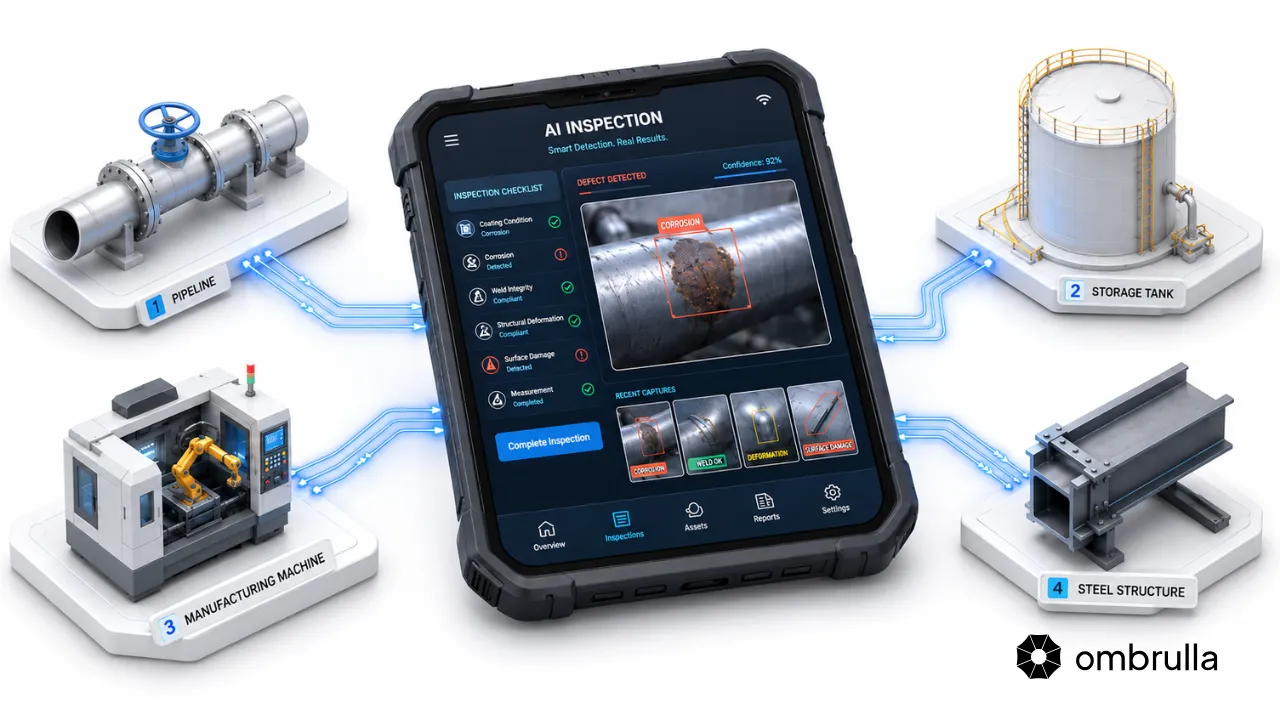
AI visual inspection platform connecting industrial assets including pipelines, storage tanks, manufacturing equipment, and construction infrastructure through a mobile inspection interface.

What Is an AI-Powered Mobile Inspection App?

An AI-powered mobile inspection app is a field inspection software platform that combines mobile data collection with artificial intelligence capabilities - including computer vision-based defect detection, adaptive guided checklists, and automated report generation - to help field teams conduct more accurate, consistent, and efficient asset inspections.

Unlike standard digital inspection tools, AI-native platforms actively analyse the data being captured, flag anomalies in real time, and continuously improve through machine learning.

Unlike the previous generation of mobile inspection tools - which were essentially digital versions of paper checklists with photo attachments - AI-powered inspection platforms are active participants in the inspection process. They observe what is being captured, apply trained machine learning models to identify anomalies, and guide inspectors toward the most important findings.

The Core Architecture of an AI Mobile Inspection Platform

At a technical level, AI mobile inspection apps integrate several distinct capabilities into a single, field-ready application:

  • -
    Computer Vision Engine:Machine learning models trained on thousands of labelled inspection images, capable of identifying corrosion, cracks, coating failures, mechanical wear, and other defect types with high accuracy in real-world lighting conditions.
  • -
    Adaptive Checklist Engine:Inspection workflows that dynamically adjust based on findings captured during the inspection. If corrosion is detected on a flange, the checklist automatically adds steps to inspect adjacent components and document thickness measurements.
  • -
    Offline-First Data Layer:Full platform functionality - including AI analysis - without network connectivity, with automatic synchronisation when connectivity is restored.
  • -
    Automated Reporting Engine:Structured inspection reports generated automatically from captured data, including findings, images, severity ratings, and recommended maintenance actions.
  • -
    Integration Layer:Bidirectional integration with CMMS, EAM, and ERP systems to convert inspection findings into maintenance work orders without manual data entry.
  • -
    Analytics and Intelligence Dashboard:Aggregate inspection data analysis for asset condition trending, team performance monitoring, and predictive maintenance prioritisation.

These capabilities are purpose-built for the conditions that field inspection teams actually work in: remote locations, variable lighting, connectivity limitations, time pressure, and the cognitive demands of working safely around high-consequence assets.
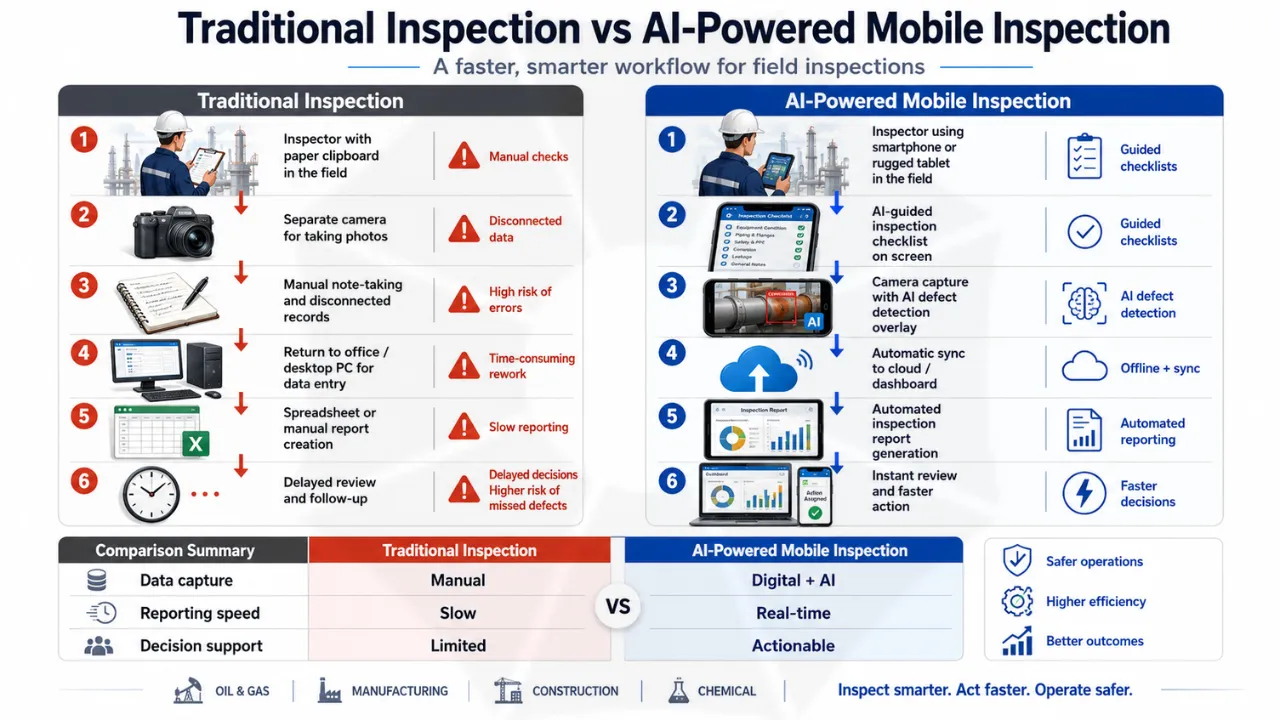
Side-by-side comparison of traditional inspection and AI-powered inspection workflows showing faster reporting, automation, and improved efficiency with AI technology.

How AI Transforms Traditional Asset Inspection Workflows

To understand why AI mobile inspection technology matters, it is worth examining what traditional inspection workflows look like in practice - and where they consistently break down.

The Traditional Inspection Workflow: Where It Fails

A typical manual inspection cycle in an asset-intensive organisation follows a predictive maintenance pattern. An inspector arrives at a site with a paper checklist or a basic digital form. They conduct a visual walkthrough of the asset, record observations by hand, take photographs with a separate camera or smartphone, and return to the office to write up a formal inspection report - a process that typically takes between one and three hours per inspection. The report is reviewed, approved, and filed - often 24 to 72 hours after the inspection was conducted.

This process has several structurally embedded failure modes that affect inspection quality regardless of how skilled or diligent the individual inspector is:

  • -
    Inspector Variability:Two inspectors assessing the same asset will often produce significantly different findings, not because one is wrong, but because visual inspection is inherently subjective. This variability makes trend analysis over time unreliable.
  • -
    Photo-Finding Disconnect:Images captured in the field are rarely automatically linked to the specific findings they document. The connection is made manually during report writing, creating ambiguity, especially when hundreds of photos are captured across a complex asset.
  • -
    Reporting Delay:Manual report writing introduces a lag of hours or days between when a defect is observed and when a maintenance work order is raised. For high-consequence defects, this delay represents direct operational and safety risk.
  • -
    Checklist Fatigue:On long, complex assets, inspectors following static checklists are susceptible to fatigue-driven checkbox behaviour, marking items complete without the level of scrutiny the asset requires.
  • -
    No Real-Time Defect Intelligence:Without AI analysis, a photograph of early-stage pitting corrosion or a hairline crack in a weld may be captured but not recognised as significant until it has progressed to a point where repair is substantially more expensive - or until it causes a failure.

How AI Transforms Each Stage of the Workflow

AI-powered mobile inspection platforms address each of these failure modes at the point in the workflow where they occur:

  • -
    Pre-Inspection Intelligence:AI analyses the historical inspection record for a specific asset and pre-populates the inspection checklist with items most likely to require attention based on past findings, asset age, operating conditions, and peer asset comparisons. Inspectors arrive with a smarter starting point.
  • -
    Real-Time Defect Detection:During the inspection, computer vision models analyse photographs as they are captured. Corrosion, coating degradation, mechanical wear, cracking, and other defect types are identified immediately, flagged with severity scores, and linked automatically to the relevant checklist item and asset component.
  • -
    Adaptive Checklists:The inspection checklist responds to what is being found. A detected defect triggers additional inspection steps, escalation prompts, or measurement requirements - ensuring inspectors follow the optimal process for every finding without relying on experience alone.
  • -
    Automated Report Generation:At the end of the inspection, the AI engine compiles all captured data into a structured, standardised inspection report - findings, severity ratings, supporting images, recommended actions - typically within minutes. What previously required hours of manual write-up is completed before the inspector leaves the site.
  • -
    Work Order Integration:Completed inspection findings flow automatically into the organisation's CMMS or EAM system, generating maintenance work orders without manual data transfer. The lag between detection and action is measured in minutes, not days.

Key Capabilities to Look For in AI Mobile Inspection Software

The term 'AI inspection app' now appears in the marketing materials of a wide range of software products, with significant variation in what the AI actually does. When evaluating mobile AI inspection software for your organisation, these are the capabilities that differentiate genuine AI-native platforms from basic digital forms tools with AI branding.

1. Asset-Specific Computer Vision Models

The most strategically important differentiator in any AI inspection platform is the quality and specificity of its computer vision models. A model trained on thousands of real-world images of pipeline corrosion in oil and gas operating environments will substantially outperform a generic image classification model when applied to the same task.

During evaluation, ask vendors for evidence of model performance on your specific asset types and defect categories. Defect detection accuracy rates, false positive rates, and training dataset composition are all legitimate questions that credible vendors should be able to answer clearly.

2. Offline-First Architecture

In oil and gas, construction, and manufacturing environments, field teams frequently operate in areas with limited or no mobile connectivity - offshore platforms, underground facilities, remote pipeline routes, and enclosed plant areas with signal attenuation.

Full offline functionality is non-negotiable. This means AI defect detection, adaptive checklist guidance, data capture, and report generation must all function completely without network connectivity, with reliable automatic synchronisation when the device returns to range. During any evaluation process, test offline capability explicitly and independently - do not rely on vendor assurances alone.

3. Adaptive, Logic-Driven Inspection Checklists

AI-guided inspection checklists dynamically adjust the inspection workflow based on findings and context. A detected anomaly should automatically trigger additional inspection steps, measurement prompts, and escalation criteria. This logic-driven behaviour both improves inspection thoroughness and reduces the cognitive burden on field inspectors - particularly beneficial for less experienced team members whose work benefits from AI-augmented guidance.

4. Automated, Structured Inspection Reporting

Inspection report generation is typically one of the most time-consuming administrative tasks in an inspection programme. AI-powered automated reporting compiles all captured data - findings, images, severity ratings, and recommended actions - into a standardised report without requiring manual write-up from the inspector. Reports should be searchable, digitally signed, timestamped, GPS-tagged, and immediately suitable for submission to asset owners, regulators, or insurance assessors.

5. Deep CMMS and EAM Integration

Inspection data that does not flow into maintenance planning is inspection data that does not realise its full value. Evaluate the depth of the platform's integration with your existing CMMS or EAM system - whether that is SAP Plant Maintenance, IBM Maximo, Oracle EAM, or an industry-specific platform. Pre-built connectors, bidirectional data exchange, and the ability to automatically generate maintenance work orders from inspection findings are key integration requirements.

6. Inspection Analytics and Trend Intelligence

Aggregate inspection data, analysed over time, is one of the most underutilised strategic assets in industrial organisations. AI inspection platforms should provide dashboards that surface recurring defect patterns, high-risk assets, inspection coverage gaps, and inspector performance metrics. This intelligence enables proactive maintenance scheduling, risk-based inspection planning, and informed capital allocation decisions.
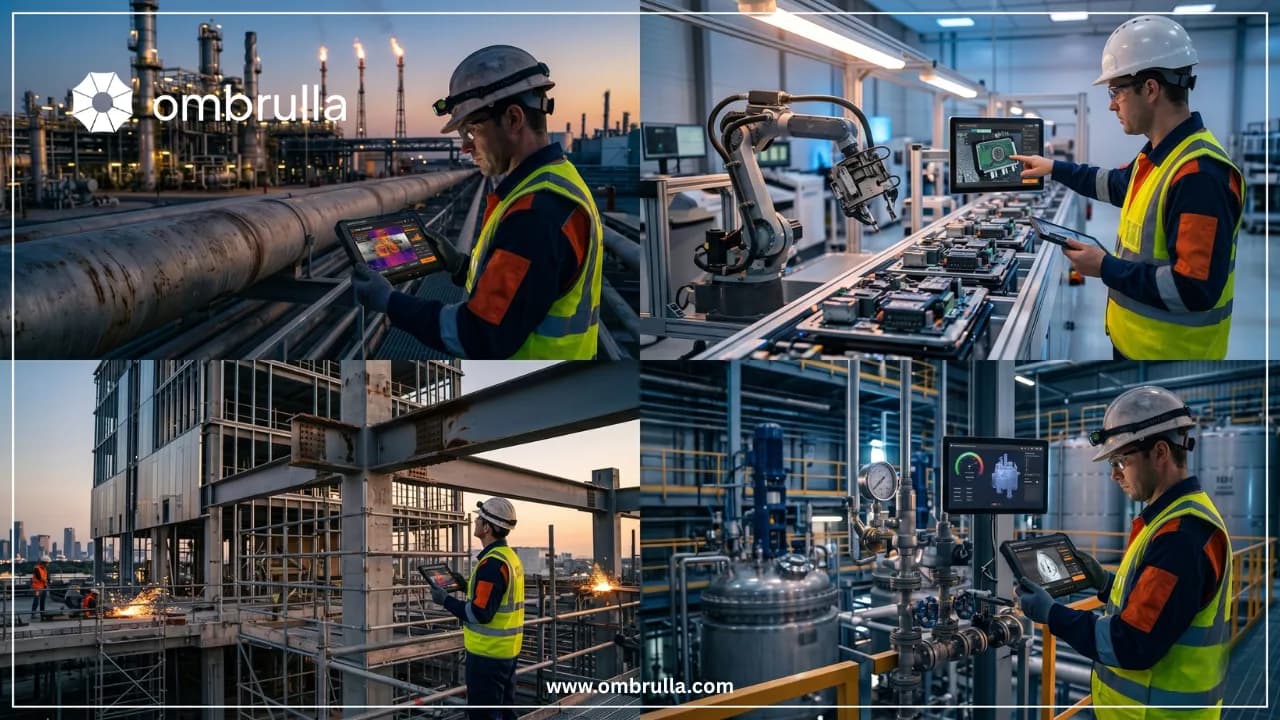
Inspectors using digital tablets for visual inspections across oil and gas, manufacturing, construction, and chemical processing industries.

Industry-Specific Use Cases

AI mobile inspection technology is not a one-size-fits-all solution. Its application and the specific value it delivers varies significantly across industry sectors. The following use cases reflect deployment patterns in organisations operating at scale.

Oil and Gas

Asset integrity management in the oil and gas sector is governed by stringent regulatory frameworks - including API 510 (Pressure Vessel Inspection Code), API 570 (Piping Inspection Code), API 653 (Aboveground Storage Tanks), and ASME standards - applied across complex, high-consequence assets operating under demanding process conditions.

  • -
    Pressure Vessel and Piping Inspection:AI vision models detect external corrosion, pitting, coating degradation, and mechanical damage on pressure vessels, heat exchangers, and piping circuits. Findings are automatically cross-referenced against previous inspection records to flag accelerated degradation rates.
  • -
    Pipeline Integrity:Mobile inspection apps with AI defect detection support both operator walkover inspections and close-interval survey programmes, identifying surface anomalies and documenting pipeline condition with GPS-tagged, severity-rated findings.
  • -
    Process Safety Management (PSM) Compliance:AI-guided checklists aligned with OSHA 29 CFR 1910.119 ensure mechanical integrity inspections cover every required element, generating automatically structured compliance records for regulatory audits.
  • -
    Turnaround Planning and Execution:During planned shutdowns, AI inspection apps coordinate simultaneous inspection activities across multiple teams, ensuring findings are captured consistently and maintenance work orders are generated in real time without bottlenecks in report processing.

Manufacturing

In discrete and process manufacturing, AI mobile inspection is deployed across quality control, equipment maintenance, and environment, health, and safety (EHS) compliance programmes.

  • -
    Production Quality Inspection:Computer vision models identify surface defects, dimensional non-conformances, and assembly errors in manufactured components - at speeds and consistency levels that exceed manual visual inspection.
  • -
    Preventive Maintenance Inspection:Field inspectors use AI-guided checklists for condition-based maintenance walks on CNC machines, conveyors, compressors, HVAC systems, and electrical panels - with AI flagging deviations from baseline condition before failures occur.
  • -
    Multi-Site EHS Compliance:AI inspection apps standardise safety audits across multiple manufacturing facilities, enabling corporate HSE teams to monitor compliance uniformly and compare site performance in real time.
  • -
    Incoming Inspection and Supplier Quality:AI-assisted inspection of raw materials and components at goods receipt, with automatic non-conformance report (NCR) generation and supplier scorecard integration.

Construction

Construction inspection involves diverse activities across rapidly changing site conditions, multiple subcontractors, and complex regulatory requirements for structural integrity, safety, and commissioning.

  • -
    AI Structural and Civil Inspection:AI defect detection identifies concrete cracking, formwork defects, rebar positioning issues, and weld quality problems before they are enclosed, when correction costs are a fraction of remediation after handover.
  • -
    Progress and Quality Inspection:Inspection findings are captured against project scope items and linked to BIM model elements and project programme milestones, creating an auditable quality record from foundation to final commissioning.
  • -
    Site Safety Inspection:AI-guided safety checklists cover scaffolding integrity, temporary works, PPE compliance, and hazardous material storage, with photographic evidence automatically linked to compliance records.
  • -
    Commissioning and Systems Handover:Mechanical and electrical systems are inspected against commissioning checklists with AI-guided verification, ensuring handover documentation packages are complete and defect-free.

Chemical

Chemical plant inspections must balance operational continuity with rigorous process safety requirements, asset reliability, and compliance with OSHA PSM, EPA RMP, and IEC 61511 (SIS) standards.

  • -
    Mechanical Integrity Programme:Reactors, distillation columns, heat exchangers, and storage vessels are inspected on AI-guided schedules aligned with PHA recommendations, with findings automatically updating the asset's risk register.
  • -
    Leak Detection and Prevention:AI vision models trained to identify early signs of seal degradation, flange leaks, and external corrosion on critical process lines - enabling predictive maintenance before releases occur.
  • -
    PSM Compliance Documentation:Automated inspection reporting generates audit-ready mechanical integrity records aligned with OSHA 29 CFR 1910.119 requirements, with complete digital traceability from inspection to work order closure.

AI Mobile Inspection vs. Traditional Methods - Feature Comparison

The following table provides a direct comparison of inspection approaches. It is designed to support internal business case development and vendor evaluation discussions.

Capability / FactorPaper-Based InspectionBasic Digital FormsAI-Powered Mobile Inspection
Defect DetectionManual; highly subjectiveManual; subjectiveAI-assisted; objective, consistent
Checklist AdaptabilityStatic onlyStatic / limited logicDynamic; adapts to findings in real time
Report GenerationManual (1–3 hours)Semi-automatedFully automated (minutes)
Offline CapabilityFull (paper)PartialFull AI + data capture offline
Photo-Finding LinkageManual; error-proneManualAutomatic; AI-linked
Anomaly FlaggingNoneNoneReal-time; AI severity-scored
Audit ReadinessLowMediumHigh; timestamp, GPS, digital signature
CMMS / EAM IntegrationNoneLimited / manualNative API; auto work order creation
Cross-Team ConsistencyLowMediumHigh; standardised AI-guided process
Analytics & TrendingNoneLimitedAdvanced; predictive risk modelling
Total Cost of InspectionHigh (labour-intensive)MediumLower at scale; ROI in 6–12 months

AI-Native Inspection App vs. iAuditor - What Is the Difference?

iAuditor, now operating under the SafetyCulture brand, is one of the most widely used digital inspection platforms globally. It provides a strong set of capabilities for digitising checklists, capturing photographs, and generating reports - and it has earned its market position through usability and breadth of deployment.

However, iAuditor is fundamentally a structured data collection and forms management platform. It digitises the inspection process. It does not intelligently analyse the data being collected.

For organisations in the early stages of inspection digitisation, iAuditor represents a significant improvement over paper. For organisations in asset-intensive industries where the cost of a missed defect is measured in safety incidents, unplanned downtime, or regulatory enforcement actions, AI-native platforms like Ombrulla offer a fundamentally different level of inspection intelligence.

CapabilityiAuditor / SafetyCultureOmbrulla (AI-Native Platform)
Checklist digitisation✓ Comprehensive✓ Comprehensive + AI-adaptive
Photo capture & annotation✓ Standard✓ AI-linked, auto-tagged
Inspection report generation✓ Template-based✓ AI-automated, structured
AI computer vision defect detection✗ Not available✓ Asset-specific CV models
Real-time anomaly scoring✗ Not available✓ AI severity classification
Adaptive AI-guided checklists✗ Static templates only✓ Dynamic, finding-responsive
Full offline AI capabilityPartial - basic forms only✓ Full AI + data capture offline
Asset integrity-specific models✗ Generic platform✓ Industry-trained models
Native CMMS / EAM integrationLimited API - third-party tools required✓ Native SAP PM, IBM Maximo
Predictive risk analytics✗ Basic reporting only✓ Asset condition trending
Industry compliance alignmentGeneral HSE / ISO 45001✓ API 510/570/653, ASME, PSM

iAuditor helps inspection teams collect structured data more efficiently. AI-native inspection platforms like Ombrulla help inspection teams find things they might otherwise miss - and respond faster when they do. For organisations managing high-consequence assets, the difference is the distance between a near-miss and an incident.
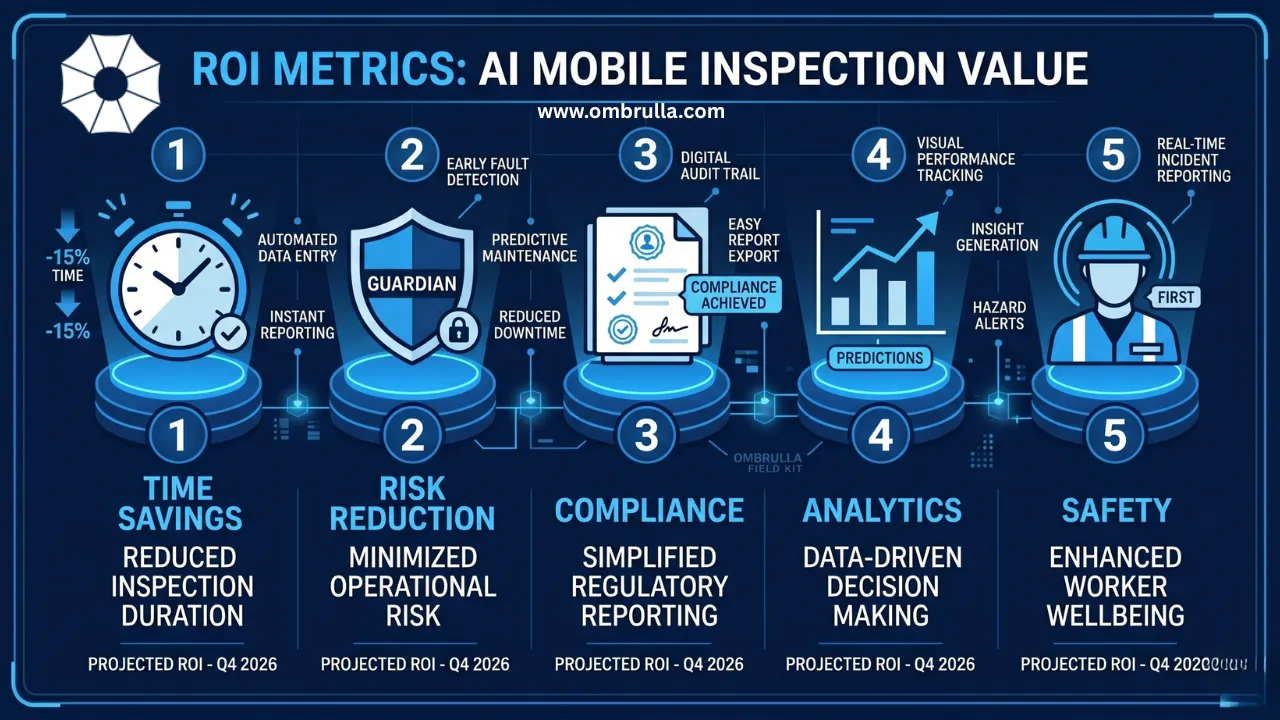
Business infographic highlighting key ROI benefits of AI-powered inspections including time savings, risk reduction, compliance management, analytics, and worker safety.

Business Benefits for Senior Management

Senior leaders evaluating AI mobile inspection technology need to understand the business case in terms they can defend in capital investment decisions. The following is a structured overview of the quantifiable and strategic value drivers.

1. Reduction in Inspection Cycle Time and Labour Cost

AI-guided checklists reduce the time each inspector spends on an individual inspection by eliminating redundant steps, focusing attention on risk-based findings, and removing the cognitive overhead of determining what to inspect next. Automated report generation eliminates what is typically 30 to 90 minutes of post-inspection administrative work per inspection cycle. Across an inspection programme covering hundreds of assets and multiple inspection events per year, this translates to a substantial reduction in inspection programme labour costs without any reduction in coverage or quality.

2. Reduced Risk and Cost of Unplanned Downtime

AI defect detection identifies asset degradation at earlier stages than manual inspection typically allows. Surface corrosion, hairline cracking, and seal degradation that might be captured in a photograph but not recognised as critical during a manual inspection are flagged immediately with severity scores. Early detection means maintenance teams can address issues during planned maintenance windows rather than emergency shutdown events. A single avoided unplanned outage in an oil refinery, chemical plant, or major manufacturing facility can generate cost savings that exceed the full cost of an AI inspection platform deployment.

3. Strengthened Regulatory Compliance and Audit Readiness

Automated inspection reporting and complete digital audit trails eliminate the compliance gaps that arise from incomplete, inconsistent, or delayed manual records. AI inspection platforms generate standardised, timestamped, GPS-tagged inspection records that are immediately audit-ready. Regulatory inspection preparation time is reduced dramatically, and the risk of enforcement action arising from documentation gaps is substantially mitigated.

4. Transformed Asset Integrity Management Programme

Continuous, structured inspection data feeds into predictive maintenance models, giving asset integrity managers real-time visibility into the condition of every asset across the portfolio. Inspection moves from a periodic compliance activity, a box to be ticked before the next shutdown, to a continuous intelligence function that drives proactive maintenance scheduling and risk-based capital allocation.

5. Improved Inspector Productivity and Knowledge Transfer

Field inspectors spend less time on administrative tasks and more time on high-value field activity. AI-guided workflows reduce cognitive load and standardise inspection quality across inspection teams with different levels of experience. The AI embedded in the platform reflects the knowledge of senior inspection specialists and ensures that less experienced inspectors follow best-practice protocols for every scenario.

Indicative ROI Metrics to Track

ROI MetricTypical BaselineWith AI Mobile InspectionImprovement
Report write-up time per inspection60–90 min5–10 min (automated)80–90% reduction
Inspection cycle timeBaseline15–30% fasterSignificant
Defect detection rateBaseline manual rate+20–40% improvementHigh-value
Audit preparation timeDays to weeksHours70–90% reduction
Unplanned maintenance eventsBaselineMeasurable reduction YoYAsset-dependent
Inspector admin hours/week8–15 hrs/inspector2–4 hrs/inspector65–75% reduction

Addressing Common Objections and Honest Limitations

A credible evaluation of any technology requires an honest assessment of both its capabilities and its limitations. The following addresses the objections that senior managers and field teams most frequently raise, alongside a transparent discussion of where the technology has genuine constraints.

"Our field teams are not technology-savvy enough."

Modern AI inspection apps are specifically designed for field use by inspectors, technicians, and operators, not IT specialists. The best platforms offer intuitive interfaces requiring minimal training, typically measured in hours rather than days. The AI handles the analytical complexity in the background; the inspector's experience remains fundamentally hands-on, physical, and practical. Pilot programmes consistently report high adoption rates within the first two to three weeks of deployment.

"We operate in environments with no connectivity."

Offline-first architecture is a core design requirement for any credible AI inspection platform targeting asset-intensive industries. Full AI defect detection, adaptive checklist guidance, and data capture must function entirely without network connectivity, synchronising automatically when a connection becomes available. This capability should be verified explicitly during any product evaluation - test it in the conditions your teams actually work in.

"AI models won't understand our specific assets."

This is a legitimate concern, and it is one of the most important differentiators between AI inspection platforms. Platforms that offer asset-specific model fine-tuning, where the AI is trained on images and data from your actual assets in your operating environment, deliver substantially higher detection accuracy than generic computer vision tools. It is a fair question to ask any vendor: 'What is your model performance on specific asset type, and what does the training dataset consist of?'

"We already use iAuditor / other digital tools."

The question is what value your existing tools are delivering in terms of defect detection and inspection intelligence, not just digital data collection. If your current tools are not providing AI defect detection, adaptive guidance, or automated reporting, you are still dependent on individual inspector skill and vigilance as your primary quality control mechanism. For low-risk, low-consequence assets, that may be an acceptable position. For pressure vessels, pipelines, and structural elements in high-consequence operating environments, it is a risk management question worth revisiting.

Honest Limitations of AI Mobile Inspection Technology

  • -
    Model Accuracy is Not Absolute:AI defect detection models have false positive and false negative rates. They augment, but do not replace, inspector judgement. The AI flags what it detects; the qualified inspector makes the determination. This is the correct division of responsibility.
  • -
    Training Data Requirements:AI models require quality training data to perform well. For unusual or highly specialised asset types with limited inspection image libraries, model performance may be lower initially and improves over time as the system learns from your operating environment.
  • -
    Integration Complexity:Deep integration with legacy CMMS and EAM systems can require technical project resources and careful configuration. Organisations with highly customised or outdated asset management systems should factor integration complexity into their deployment planning.
  • -
    Change Management:Technology alone does not transform inspection programmes. Sustained adoption requires clear sponsorship from operational leadership, well-designed training, and a deployment approach that involves experienced inspectors in the configuration of AI checklists and defect models.

How to Evaluate and Choose the Right AI Inspection App

Selecting an AI mobile inspection platform is a strategic decision that will affect inspection programme performance, regulatory compliance posture, and asset integrity management capability for years. The following structured evaluation process is based on best practices from organisations that have successfully deployed AI inspection technology at scale.

  • -
    1. Define Your Inspection Use Cases and Asset TypesBegin with clarity on the specific defect types you need to detect, the inspection standards and regulatory requirements you need to comply with, and the asset categories that represent the highest consequence of inspection failure.
  • -
    2. Verify Offline Capability Under Real ConditionsDo not rely on vendor demonstrations in controlled, connected environments. Test the platform offline in conditions that reflect your actual operating environment - no Wi-Fi, no mobile signal - and validate that AI defect detection, checklist guidance, and report generation all function without connectivity.
  • -
    3. Evaluate AI Model Performance With EvidenceRequest documented evidence of model performance on assets similar to yours. Defect detection accuracy rates, false positive rates, and training dataset characteristics are all legitimate evaluation criteria. A vendor unable or unwilling to provide this information is a vendor whose AI capability should be treated with scepticism.
  • -
    4. Assess Integration Depth With Your CMMS or EAMRequest a live demonstration of integration with your specific asset management system. Verify the availability of pre-built connectors, the scope of bidirectional data exchange, and the process for automated work order generation from inspection findings.
  • -
    5. Run a Structured Pilot on a Defined Asset SetAny credible AI inspection platform vendor should support a structured proof-of-concept pilot on a defined set of assets with agreed success criteria and timelines. This gives your team a low-risk path to validating the technology before committing to enterprise deployment.
  • -
    6. Evaluate the Vendor's Industry Expertise and Support ModelAI inspection for oil and gas pressure vessels requires different domain knowledge than AI inspection for manufacturing quality control or construction structural integrity. Look for a vendor with demonstrable expertise in your industry, including knowledge of the relevant inspection codes, standards, and regulatory frameworks that govern your operations.
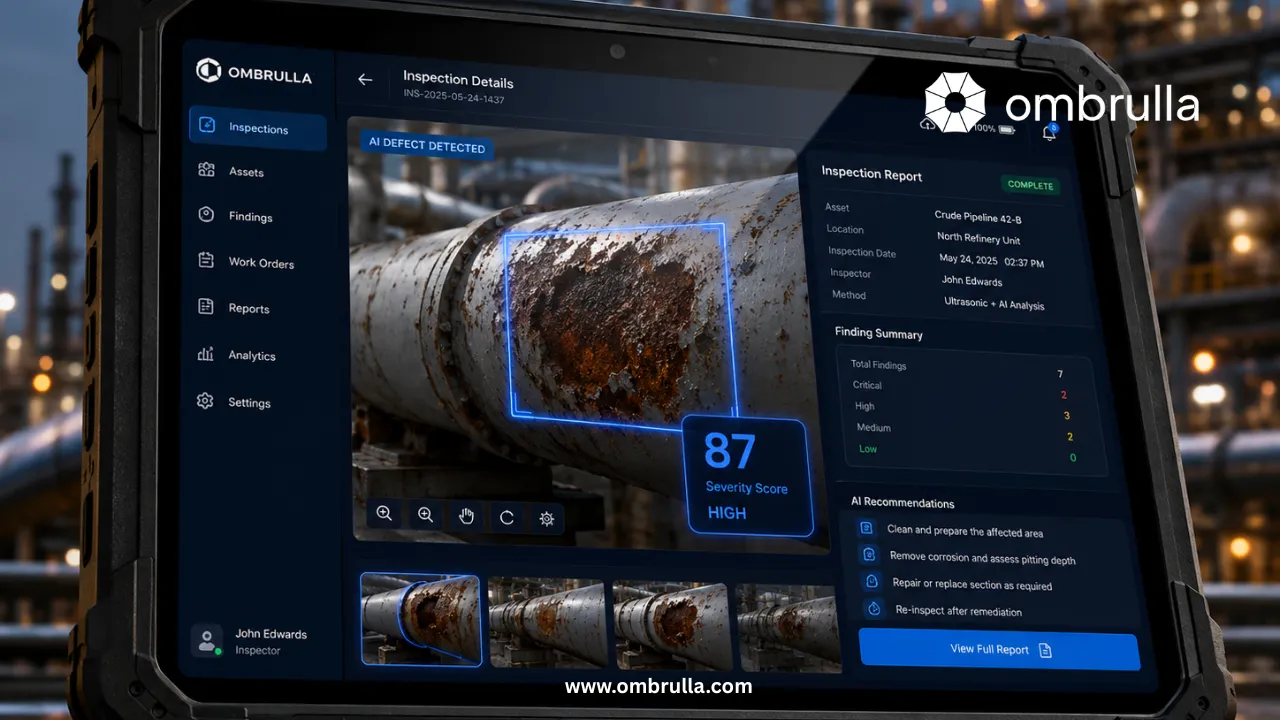
Ombrulla AI inspection platform displayed on a rugged tablet showing corrosion detection, severity analysis, and automated inspection reporting for industrial assets.

Why Ombrulla Is Built for This Challenge

Ombrulla is an AI-powered mobile inspection platform purpose-built for asset-intensive industries. Designed from the ground up for the operational realities of oil and gas, manufacturing, construction, and chemical sector environments, Ombrulla brings together computer vision-based defect detection, adaptive AI-guided inspection checklists, and fully automated report generation in a single mobile-first platform that operates completely offline.

Ombrulla is not a general-purpose forms management tool that has retrofitted AI branding. It is an inspection intelligence platform developed around the specific requirements of asset integrity management - including alignment with API 510, API 570, API 653, ASME, and OSHA PSM inspection standards that govern operations in the industries it serves.

What Distinguishes Ombrulla

  • -
    Asset-Specific AI Models:Ombrulla's computer vision models are trained on real-world field data from asset-intensive environments, enabling accurate detection of corrosion, coating failures, cracks, mechanical anomalies, and other defect types across a broad range of industrial assets.
  • -
    Complete Offline AI Capability:Full AI defect detection, adaptive checklist guidance, and automated report generation function entirely without network connectivity, purpose-designed for remote and connectivity-limited field environments.
  • -
    Adaptive Inspection Checklists:Ombrulla's checklist engine responds dynamically to inspection findings, ensuring inspectors follow the optimal procedure for every asset condition, embedding the knowledge of experienced inspection specialists into the platform's guidance logic.
  • -
    Native CMMS and EAM Integration:Seamless integration with SAP Plant Maintenance, IBM Maximo, and other major asset management systems, enabling inspection findings to flow directly into maintenance work orders without manual data transfer.
  • -
    Industry Compliance Alignment:Inspection checklists and reporting frameworks aligned with the specific regulatory requirements and industry standards that govern oil and gas, manufacturing, construction, and chemical sector operations.
  • -
    Structured Pilot Programme:Ombrulla offers a defined pilot programme that allows your organisation to validate platform performance on your specific assets before committing to full enterprise deployment - a low-risk entry point for organisations evaluating AI inspection technology for the first time.

Ready to Transform Your Inspection Programme?

Your assets are generating inspection data with every field visit. The question is whether that data is working hard enough to protect your operations, your compliance posture, and your people.

Ombrulla is built specifically for asset-intensive industries. We'd like to show you what AI defect detection, adaptive guided inspection, and automated reporting look like when they're applied to your assets.

REQUEST A PERSONALISED DEMO

Frequently Asked Questions

What is an AI-powered mobile inspection app?

An AI-powered mobile inspection app is a field inspection software platform that combines mobile data collection with artificial intelligence capabilities - including computer vision-based defect detection, adaptive guided checklists, and automated report generation. Unlike standard digital inspection tools, AI-native platforms actively analyse captured data, flag anomalies in real time, score defect severity, and generate structured inspection reports automatically. They are purpose-designed for field teams in asset-intensive industries operating in demanding environments, including areas without network connectivity.

How does AI defect detection work in a mobile inspection app?

AI defect detection in mobile inspection apps uses computer vision models - trained on thousands of labelled inspection images - to identify visual anomalies such as corrosion, surface cracking, coating degradation, and mechanical wear in photographs captured in the field. The model analyses the image in real time (or during offline synchronisation), identifies the presence and type of defect, assigns a severity classification, and links the finding automatically to the relevant inspection checklist item and asset component. The accuracy of detection is directly related to the quality and domain-specificity of the training dataset.

Can AI mobile inspection apps work without internet connectivity?

Yes - and offline capability is a non-negotiable requirement for field deployment in most asset-intensive industries. Purpose-built AI inspection apps operate on an offline-first architecture, meaning full platform functionality - including AI defect detection, adaptive checklist guidance, data capture, and automated report generation - operates completely without network connectivity. Data synchronises automatically with the cloud platform when connectivity is restored. This capability should be tested explicitly during any product evaluation process.

What is the difference between an AI inspection app and iAuditor?

iAuditor (SafetyCulture) is a well-established digital inspection and forms management platform that enables efficient checklist completion, photo capture, and report generation. It is a data collection platform. AI-native inspection platforms such as Ombrulla add a layer of inspection intelligence: computer vision defect detection, real-time anomaly scoring, adaptive AI-guided checklists that respond to findings, fully automated AI-structured reporting, and asset integrity-specific compliance alignment. The core distinction is between recording what an inspector observes and actively helping inspectors identify what might otherwise be missed.

Which industries benefit most from AI mobile inspection software?

Industries with high-value physical assets, significant safety consequences from inspection failures, and stringent regulatory compliance requirements benefit most from AI mobile inspection technology. These include: oil and gas (upstream, midstream, downstream), petrochemicals and chemical processing, heavy manufacturing and automotive, power generation and utilities, construction and infrastructure, and mining and minerals processing. Any industry where a missed defect can result in unplanned downtime, a safety incident, or a regulatory enforcement action represents a strong use case for AI-augmented inspection.

How long does it take to implement an AI inspection app?

Structured pilot programmes typically begin delivering value within two to four weeks of engagement. Full enterprise deployment timelines vary based on integration requirements, the number of assets to be configured, AI model training needs, and the scope of the initial rollout. For most organisations, a phased deployment covering one asset category or one operational site can be completed within six to eight weeks, with broader rollout following over a three to six month period. Organisations with existing CMMS integration requirements should expect additional project resource allocation for the integration workstream.

What ROI can organisations realistically expect from AI-powered field inspection?

The primary ROI drivers are: (1) elimination of manual inspection report writing, typically saving 30–90 minutes per inspection cycle; (2) earlier defect detection that prevents low-severity findings from escalating to unplanned maintenance events; (3) reduced regulatory audit preparation time; and (4) improved consistency and coverage across inspection teams. Organisations that have deployed AI inspection platforms at scale report measurable ROI within 6–12 months of deployment, with the largest financial returns typically generated by avoided unplanned downtime events rather than direct labour savings.

Do AI inspection models need to be trained on our specific assets to be effective?

Pre-trained AI models provide substantial value from day one - particularly for common defect types such as surface corrosion, coating degradation, and mechanical wear that appear similarly across many asset types. However, AI inspection platforms that offer fine-tuning on asset-specific data - training the model on images from your actual assets in your operating environment - will deliver materially higher defect detection accuracy over time. This is an important differentiator to evaluate when comparing platforms. Ask vendors specifically about their approach to asset-specific model training, the process for improving model performance over the deployment lifecycle, and current performance benchmarks for your asset categories.