

Ombrulla Logo
Technical illustration of an automated AI visual inspection system, showing an industrial camera scanning a mechanical component on a conveyor belt, with an inspection panel displaying a checkmark and a detected defect alert

AI Visual Inspection ROI: A 2026 Investment Case for Plant and Quality Executives

Ombrulla

Industrial AI & AIoT

Aug 14, 2026

A numbers-first 2026 investment case for plant, quality, and operations executives: what drives AI visual inspection ROI, how to model it for your own facility, what derails the business case, and how manufacturers across automotive, oil & gas, chemical, and packaging are turning AI inspection into a board-level decision.
Executive Summary

Executive Summary: The 2026 ROI Case at a Glance

  • -
    Payback in 6–18 monthsAI visual inspection typically pays for itself within 6–18 months, driven by lower scrap, fewer defect escapes, and reduced manual inspection labor — not by software cost alone.
  • -
    Accuracy that beats human limitsManual visual inspection catches roughly 70–85% of defects under real production conditions; deep-learning-based AI inspection systems routinely reach 97–99.5%+.
  • -
    The biggest lever: cost of poor qualityCOPQ — scrap, rework, warranty, and recalls — consumes 15–20% of revenue for the average manufacturer without a mature quality system, per American Society for Quality (ASQ) benchmarks. This is the single biggest lever in the ROI case.
  • -
    Industry validation, not early-adopter riskThe global AI visual inspection market is projected to grow from roughly $36.8 billion in 2026 to over $85 billion by 2030 — a signal of broad industry validation, not early-adopter risk.
  • -
    Combine hard and strategic valueThe strongest business cases combine hard savings (scrap, rework, warranty, labor) with strategic value (compliance, brand protection, throughput, and data that feeds predictive maintenance).
  • -
    Scale in phases, not big bangA phased pilot-to-scale rollout — not a plant-wide big-bang deployment — is the pattern most consistently associated with hitting payback targets.
  • -
    Evaluate TCO, not list priceVendor and architecture choice (edge vs. cloud, deep learning vs. rule-based) changes both the cost curve and the achievable accuracy; evaluate total cost of ownership, not list price.

Why Every Plant Head Should Care About AI Inspection ROI

Every plant head knows the sting of a defect that made it out the door — a customer complaint, a line stoppage, a recall notice that lands on a desk with no warning. Quality teams have spent decades building layered inspection processes, and yet most operations still lean heavily on trained human inspectors staring at parts under fluorescent light, shift after shift, part after part, trusting experience and attentiveness to catch what a checklist cannot.

The problem is not effort. It is physiology and economics. Human visual attention measurably degrades after 20–30 minutes of repetitive inspection work, and no amount of training overcomes a hairline defect that is a fraction of a millimeter wide moving past on a line running hundreds of parts per minute. Add shift changes, lighting variation, and the sheer monotony of the task, and even the best-trained inspection team will miss things — not occasionally, but predictably. Meanwhile, every capital committee asks the same question of an AI visual inspection system proposal: where, exactly, does the money come back, and how fast?

This guide gives plant, quality, and operations executives a complete, numbers-first way to answer that question: what actually drives AI visual inspection ROI, how to model it for your own facility, what derails the business case before it reaches the board, and how manufacturers across automotive, oil & gas, chemical, and packaging environments are turning AI visual inspection from a line-item cost into a board-level investment decision for 2026 and beyond.

What Is an AI Visual Inspection System?

AI visual inspection uses cameras, sensors, and deep learning models to automatically detect defects, dimensional errors, and quality deviations in manufactured products, replacing or augmenting manual visual checks on the production line.
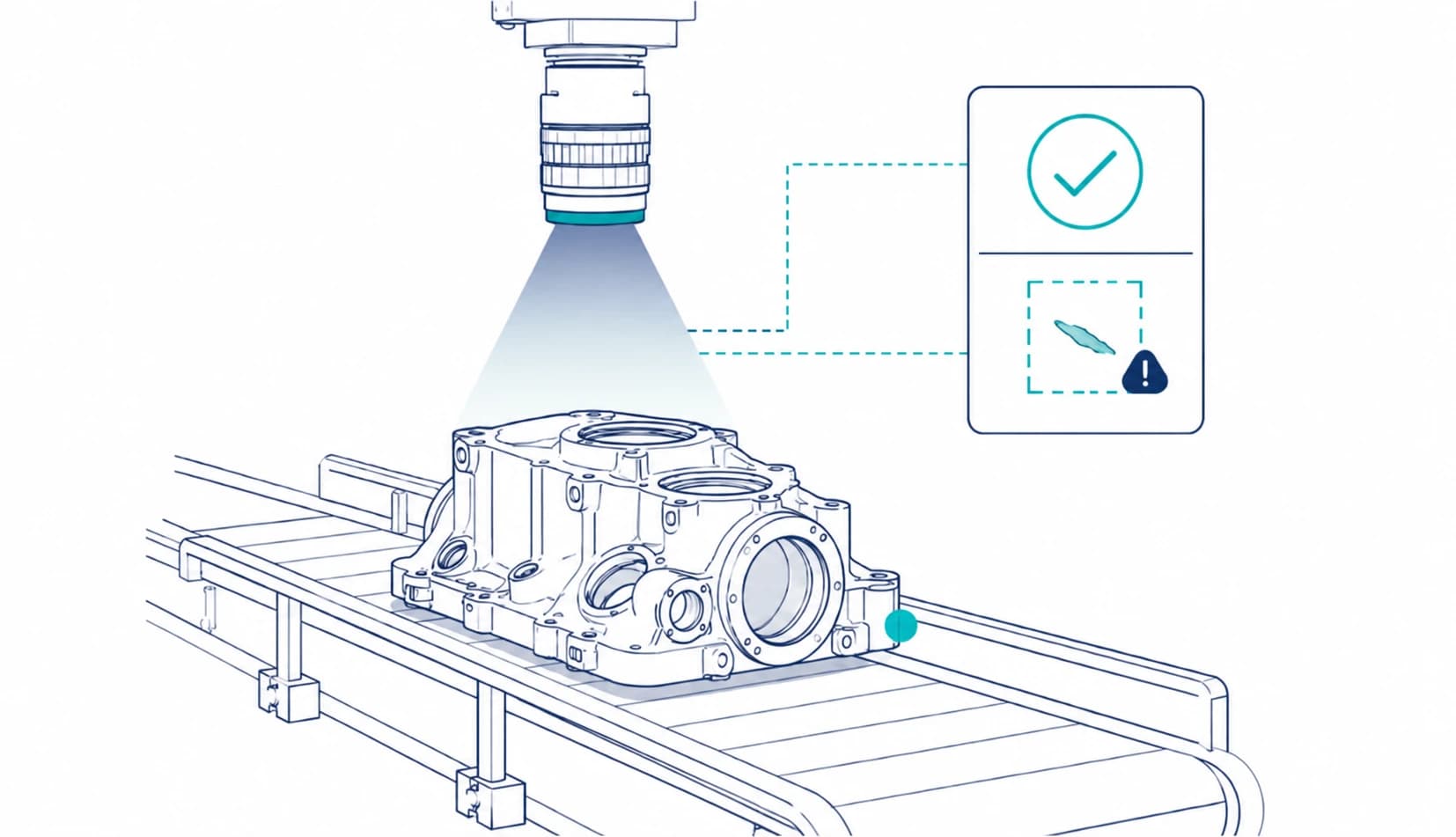
Technical illustration of an automated visual inspection system, showing an industrial camera scanning a mechanical component on a conveyor belt, with a connected inspection panel displaying a checkmark and a detected defect alert
What an AI Visual Inspection System Does

An AI visual inspection system pairs high-resolution imaging hardware — cameras, line scanners, sometimes 3D or hyperspectral sensors — with a trained deep learning model that has learned what a “good” part looks like and, critically, what the countless variations of a “bad” part look like. Unlike a person, the system never blinks, never gets tired at hour six of a shift, and applies the exact same standard to part number one and part number ten thousand.

The category sits at the intersection of two older disciplines: machine vision, which has inspected parts on production lines since the 1980s using fixed rules and thresholds, and modern computer vision powered by convolutional neural networks (CNNs) and other deep learning architectures, which learn defect patterns from labeled image data rather than being explicitly programmed for every possible flaw.

In practice, “AI visual inspection system” has become the umbrella term for platforms that combine both: real-time image capture at the edge, AI-based classification of defects (scratches, cracks, dents, misalignment, missing components, contamination, dimensional deviation), and integration back into the plant's quality and production systems — MES, ERP, SCADA, or a standalone quality dashboard.

The newest generation of these platforms also lowers the barrier to entry that used to make AI inspection a multi-quarter IT project. No-code labeling tools let quality engineers — not data scientists — tag defect images and retrain models directly from the plant floor, and pre-trained models can be fine-tuned on a few hundred labeled images rather than the tens of thousands once required, compressing the path from pilot to production-ready accuracy.

Why AI Visual Inspection ROI Matters in 2026

AI visual inspection matters for quality heads because it converts 100% inline inspection coverage into a practical reality, reducing defect escapes with real-time, auditable data instead of sample-based manual checks.

Four forces are converging to make this a 2026 board-level conversation rather than a plant-floor pilot experiment.

1. The cost of poor quality is larger than most P&Ls make visible

According to benchmarks published by the American Society for Quality, total quality-related costs — prevention, appraisal, internal failure, and external failure — typically consume 15–20% of revenue at manufacturers without a mature quality system, and can run considerably higher where quality processes are informal or fragmented across sites. Most of that cost is hidden across scrap accounts, rework labor, warranty reserves, and customer-service time, which is exactly why it rarely gets its own line on a capital request — and exactly why it is the largest available lever in an AI visual inspection ROI case.

2. The technology has crossed from experimental to industry-standard

Independent market research now places the global AI visual inspection system market at roughly $36.8 billion in 2026, projected to grow to over $85 billion by 2030 at a compound annual growth rate above 23%. That growth is not being driven by early-adopter curiosity; it reflects deep learning models achieving 97–99.5%+ detection accuracy in production environments, hardware costs falling, and no-code labeling tools shrinking the time it takes to stand up a working model from months to weeks.

3. Regulatory and customer quality expectations keep tightening

In regulated sectors — automotive, medical devices, pharmaceuticals, oil & gas — traceability requirements increasingly assume 100% inspection coverage and auditable digital records, not statistical sampling. Manual inspection, by definition, samples; AI inspection can economically inspect every unit, every time, and log the result in a form that stands up to an external audit.

4. Skilled inspection labor is harder to find and keep

Manufacturers across most industrial economies report ongoing difficulty recruiting and retaining experienced quality inspectors, particularly for multi-shift operations. An AI visual inspection system does not solve a labor shortage by itself, but it does reduce how much of the remaining quality headcount has to be spent on repetitive visual checking versus the exception handling and process improvement work that actually requires human judgment.

Put together, these four forces mean the ROI conversation in 2026 is less “should we evaluate this” and more “how fast can we responsibly scale it, and on which lines first.”

Common Challenges in Building the ROI Case

Executives rarely reject AI visual inspection because the technology does not work. They stall because the business case presented to them is built on shaky assumptions, and a sharp CFO or plant board will find the weak spot quickly. The most common failure points:

  • -
    No clean baselineMost plants cannot state their current defect escape rate, false-reject rate, or true cost of poor quality with confidence, which makes any “before vs. after” ROI claim easy for a skeptical reviewer to dismiss.
  • -
    Vendor claims vs. line realityAccuracy figures quoted in a vendor demo rarely account for lighting variability, part orientation, and shift-to-shift variation on your actual line — a pilot run in shadow mode is the only reliable test.
  • -
    Integration complexityFeeding AI inspection results into existing MES, ERP, or SCADA systems is frequently underestimated in cost and timeline, especially in older brownfield facilities.
  • -
    Change management and workforce concernsInspectors and supervisors reasonably ask what happens to their role; without a clear, communicated plan to redeploy staff into higher-value work, adoption stalls at the floor level.
  • -
    Capex vs. opex mismatchComparing hardware-capex and subscription proposals without normalizing to total cost of ownership over 3–5 years can make the cheaper-looking option the more expensive one.
  • -
    Pilot-to-scale gapA successful single-line pilot does not automatically generalize to ten lines across three plants; scaling requires a repeatable retraining workflow, not a one-time model.

Every one of these is solvable, but each has to be addressed explicitly in the business case — not assumed away — or the ROI number presented to the capital committee will not survive scrutiny.

How Does AI Visual Inspection Work?

AI visual inspection systems connect to production lines through cameras and sensors at inspection stations, then feed defect data into MES, ERP, or SCADA systems through standard integration APIs.

The architecture is easiest to understand as five stages, each with real implementation decisions behind it that affect both accuracy and cost.

1. Image and sensor acquisition

High-resolution cameras, line scanners, or in some cases 3D, infrared, or hyperspectral sensors capture images of each part at a fixed inspection point, typically synchronized with a PLC trigger so the capture happens at the right moment regardless of line speed. Lighting design matters enormously here — inconsistent lighting is one of the most common causes of poor real-world accuracy, and is frequently the difference between a model that performs well in a vendor lab and one that struggles on an actual factory floor.

2. Pre-processing

Raw images are normalized — cropped, aligned, corrected for lighting and orientation — so the AI model sees a consistent input regardless of minor variation in how the part arrived at the camera. Good pre-processing pipelines are what allow a model trained on a controlled dataset to remain accurate under the messier conditions of a live production environment.

3. AI inference: edge or cloud

A trained deep learning model, most commonly a convolutional neural network, classifies the image or specific regions of it as defect-free, defective, or defect-type-specific (scratch, crack, void, misalignment, contamination). This is the point where manufacturers choose between edge and cloud inference, and the choice has real operational consequences, not just architectural ones.

Edge AI vs. cloud AI — which to choose

Edge AI runs the model directly on hardware at the inspection station, minimizing latency and removing dependence on network connectivity — important on high-speed lines where a decision is needed in milliseconds and on remote sites, such as oil & gas or mining locations, where connectivity cannot be guaranteed. Cloud-based inference centralizes compute, can be easier to update across many lines simultaneously, and often costs less per camera to deploy initially — but it adds network latency and a connectivity dependency that many plant environments are not built to tolerate for a line-stopping decision. Many manufacturers land on a hybrid: edge inference for the immediate pass/fail decision, with cloud aggregation for fleet-wide analytics, retraining, and cross-plant benchmarking.

4. Classification, decisioning, and routing

The system flags a defect, classifies its type and severity, and triggers an action — rejecting the part, alerting an operator, or logging the event for statistical process control — typically within the same production cycle, not after the fact. Low-confidence classifications are routed to a human reviewer rather than decided automatically, which is what keeps false-reject rates manageable during early deployment.

5. Data feedback and continuous improvement

Every inspection generates data: defect type, frequency, location on the part, correlation with machine or shift. Feeding this back into both the AI model (retraining on edge cases and near-misses) and into broader process and predictive maintenance systems is what separates a static inspection tool from a genuine data flywheel — and it is where AI visual inspection starts to connect naturally with AIoT and predictive maintenance investments, since a rising defect rate on one machine is often the earliest visible symptom of tool wear or process drift.

Key Benefits and ROI Drivers

AI visual inspection ROI comes from four main levers: reduced scrap and rework, fewer warranty and recall costs, reallocated inspection labor, and higher throughput from continuous, 100% inline inspection.

Scrap and rework reduction

Catching defects earlier and more consistently means less material and labor invested in units that are ultimately scrapped or reworked. Even a fractional improvement in first-pass yield compounds significantly at volume.

Warranty and recall avoidance

A defect that escapes to the customer costs many multiples of one caught on the line — in warranty claims, field replacement, and in worst cases, formal recalls that carry regulatory and reputational cost far beyond the unit economics.

Labor reallocation, not just labor cutting

Manufacturers most often shift trained inspectors from repetitive visual checking into exception handling, root-cause investigation, and quality engineering — higher-value work that a 100%-coverage AI system cannot do on its own.

Throughput and capacity gains

AI inspection operates at line speed — industrial systems can evaluate well over a thousand parts per minute — removing the inspection bottleneck that forces manufacturers to choose between throughput and quality coverage.

Compliance and traceability

Digital, timestamped inspection records for every unit support ISO 9001 and industry-specific compliance requirements far more robustly than sample-based manual logs.

Data for predictive maintenance

Defect patterns often correlate with tool wear, process drift, or equipment degradation — turning quality data into an early warning system for maintenance teams when connected into a broader AIoT platform.

Financially, these translate into three categories a capital committee will recognize: reduced cost of goods sold (scrap, rework), reduced cost of quality failure (warranty, recall, customer churn), and improved capacity utilization (throughput, reduced inspection bottleneck) — the same three buckets that should structure the ROI model itself.

A Simple Framework for Modeling Your Own ROI

A defensible, first-pass ROI model does not require a data science team — it requires an honest baseline and conservative assumptions.

The ROI Framework

Net Annual Savings ≈ (Baseline scrap/rework cost × expected reduction %) + (Reallocated inspection labor × fully loaded cost) + (Estimated reduction in warranty/recall exposure) – (System, integration, and ongoing retraining cost). Divide total investment by net annual savings to estimate payback period in months.

Running this with deliberately conservative reduction percentages — rather than a vendor's best-case figures — is what makes the business case survive scrutiny from a CFO who has seen optimistic technology proposals before.
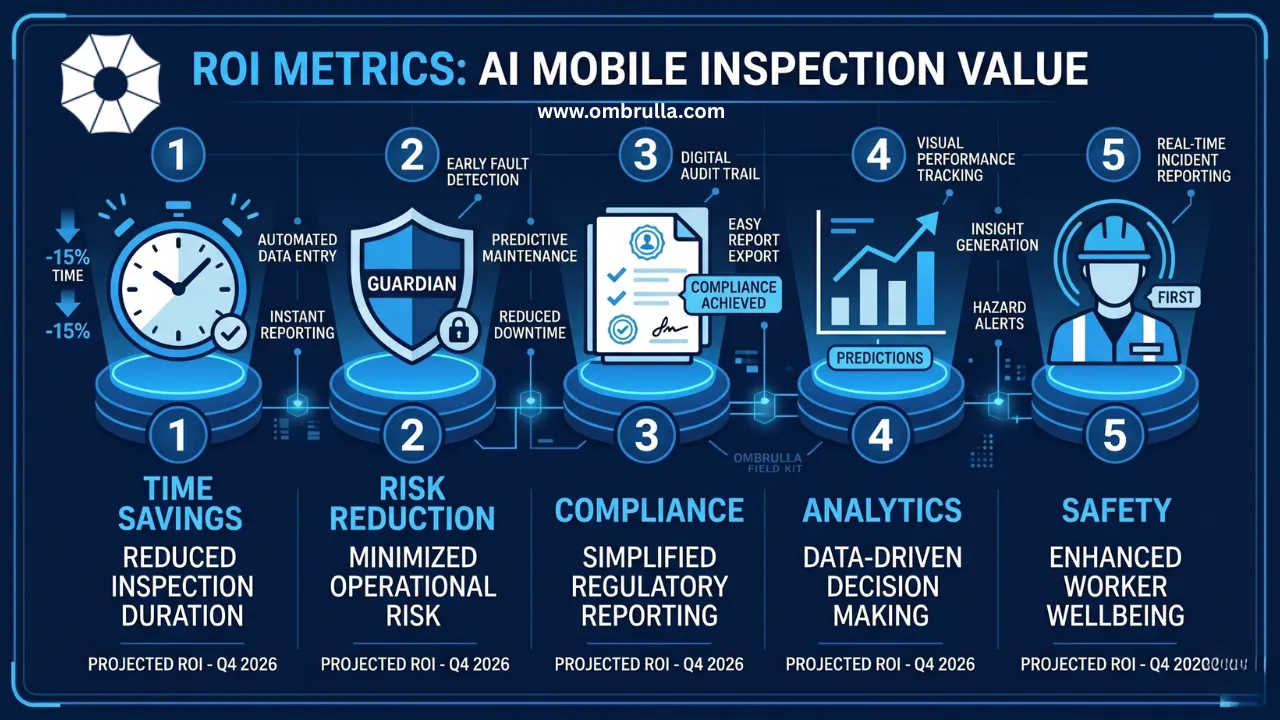
Business infographic highlighting key ROI drivers for AI visual inspection, including scrap and rework reduction, warranty avoidance, labor reallocation, compliance value, and throughput gains.
The Four ROI Levers of AI Visual Inspection

Industry Applications

AI visual inspection is not a single use case; it adapts to very different defect types, environments, and risk profiles across industries, which is part of why the underlying market has grown across so many sectors simultaneously rather than concentrating in one.
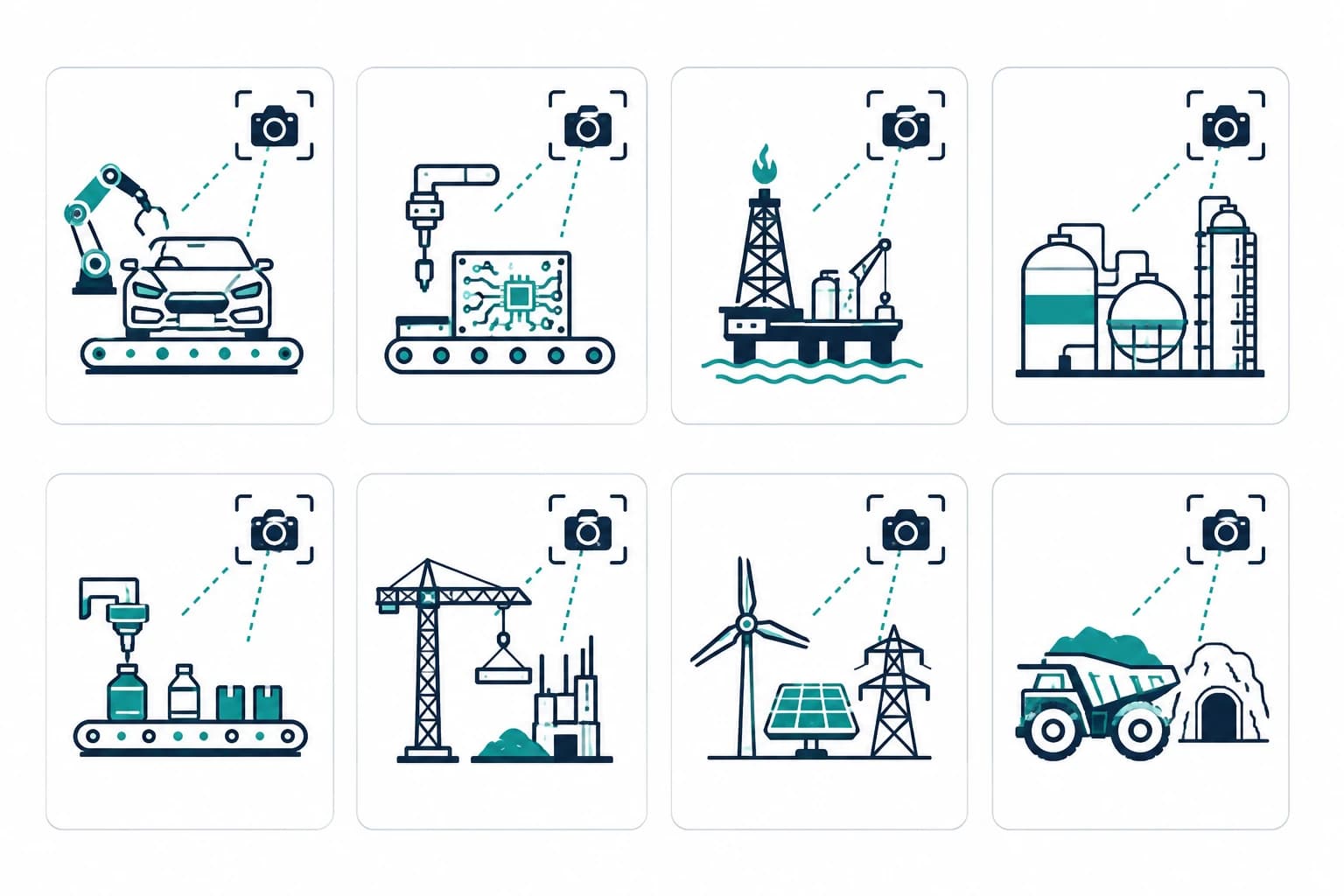
AI-powered visual inspection across eight industrial sectors: automotive, oil and gas, chemical, packaging, construction, energy, and mining, each paired with a camera/AI scan motif
AI Visual Inspection Across Industries

Automotive manufacturing

Surface finish, weld quality, paint defects, and assembly verification (missing fasteners, mis-routed harnesses) across high-volume lines where a single escape can trigger a costly recall and where 100% inspection coverage is increasingly an OEM requirement.

Oil & gas assets

Corrosion, pipeline coating defects, weld integrity, and structural anomalies, often combined with drone or fixed-camera inspection in hazardous or hard-to-access environments — reducing the risk exposure of sending personnel into confined spaces. Explore AI infrastructure inspection for industrial assets for more on this pattern.

Chemical processing

Vessel and pipe integrity checks, packaging seal verification, and label/compliance verification in environments where a missed defect carries safety, not just quality, consequences.

Packaging

Fill-level verification, seal and label inspection, print quality, and foreign-object detection at very high line speeds — one of the highest-throughput, highest-ROI use cases due to sheer unit volume.

Construction and infrastructure

Structural inspection of welds, concrete surfaces, and material quality, increasingly paired with drone-captured imagery for bridges and large infrastructure assets.

Energy

Solar panel and wind turbine blade inspection, transformer and switchgear condition monitoring, often in remote or elevated locations where manual inspection is expensive, slow, and sometimes unsafe.

Mining

Conveyor and equipment condition inspection, ore quality visual sorting, and safety-critical structural checks in harsh, dusty environments where camera and lighting robustness matter as much as the AI model itself.

Evaluation Criteria for Choosing a Platform

Not all AI visual inspection platforms are built the same way, and the architectural and commercial differences between them materially change both cost and achievable ROI. A disciplined evaluation should score every vendor on the same criteria, applied to a proof-of-concept on your own parts rather than a generic demo. See our guide to choosing the right AI visual inspection system for the full selection process.

  • -
    Detection accuracy and false-positive rateOn your actual defect types — not a vendor's published benchmark on a generic dataset.
  • -
    Edge vs. cloud inference latencyAnd what happens to the line if network connectivity drops.
  • -
    Ease of integrationWith existing MES, ERP, SCADA, and quality management systems via documented APIs.
  • -
    Model retraining workflowCan your own quality team relabel and retrain on new defect types, or does every change require the vendor?
  • -
    ScalabilityAcross additional lines and plants without re-architecting the deployment.
  • -
    Cybersecurity postureEspecially for cloud-connected or OT-network-integrated deployments.
  • -
    Total cost of ownershipOver 3–5 years — hardware, software licensing, integration, training, and ongoing support — not just the initial quote.
  • -
    Vendor support model and SLAParticularly for line-down scenarios where inspection is a bottleneck station.

Weighting these criteria against your own operation's priorities — a semiconductor line will weight accuracy and false-positive rate far higher than a construction-materials plant, which may weight ruggedness and connectivity independence higher — produces a far more useful vendor shortlist than comparing price sheets alone.
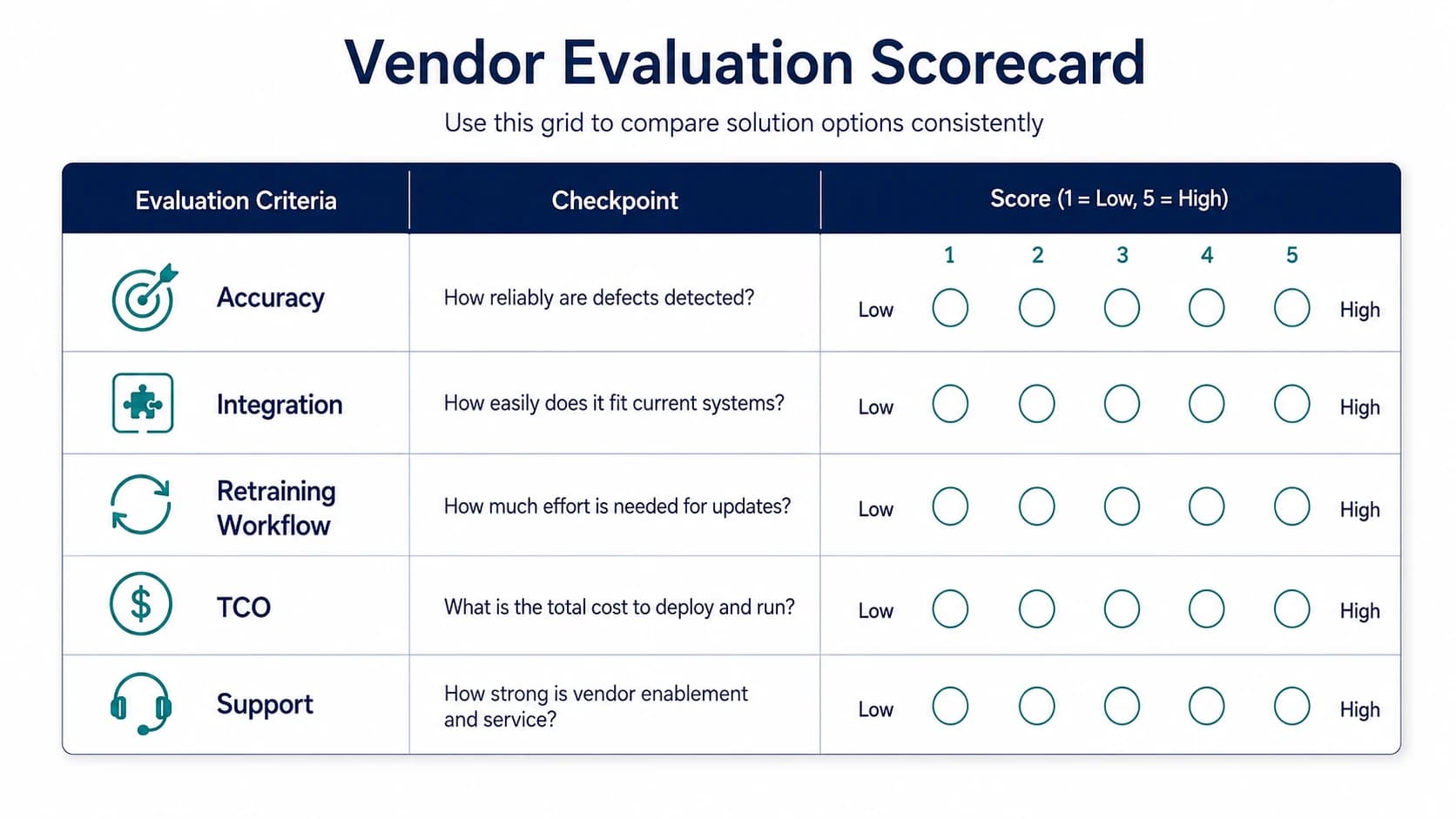
Vendor evaluation scorecard matrix with rows for evaluation criteria including accuracy, integration, retraining workflow, total cost of ownership, and support, with a subtle visual scoring scale
AI Visual Inspection Vendor Evaluation Scorecard

Best Practices: Implementation Roadmap

A focused pilot on one production line typically takes six to twelve weeks from data collection to go-live, with full multi-line rollout following a phased six-to-eighteen-month roadmap.

Phase 1: Assess

Establish the baseline: current defect escape rate, false-reject rate, inspection labor cost, and cost of poor quality by category. This baseline is what every later ROI claim will be measured against, so it is worth getting right before evaluating vendors.

Phase 2: Pilot

Select one production line with a well-understood, high-frequency defect type — not the hardest problem in the plant. Collect and label a representative image dataset covering normal variation, train and validate the model, and run it in shadow mode before it makes autonomous rejection decisions.

Phase 3: Validate

Compare pilot-line results against the baseline for a full production cycle, including different shifts and lighting conditions, since accuracy on a day shift can degrade on a night shift. This is also the point to validate MES/ERP integration and confirm the retraining workflow works for your own team.

Phase 4: Scale

Roll out to additional lines and plants in a phased sequence, prioritizing lines with the highest cost of poor quality first so early wins fund later phases. Build change management into every phase — early communication about inspectors' evolving role correlates with faster, smoother adoption.

Common mistakes to avoid

  • -
    Skipping the baselineTrying to prove ROI retroactively almost never survives a skeptical financial review.
  • -
    Piloting on the hardest defect typeInstead of the highest-value one, which delays the first credible proof point unnecessarily.
  • -
    Treating the model as “done” after go-liveBudget time and ownership for ongoing retraining as products and processes change.
  • -
    Under-investing in change managementLosing floor-level buy-in quietly undermines even a technically successful deployment.
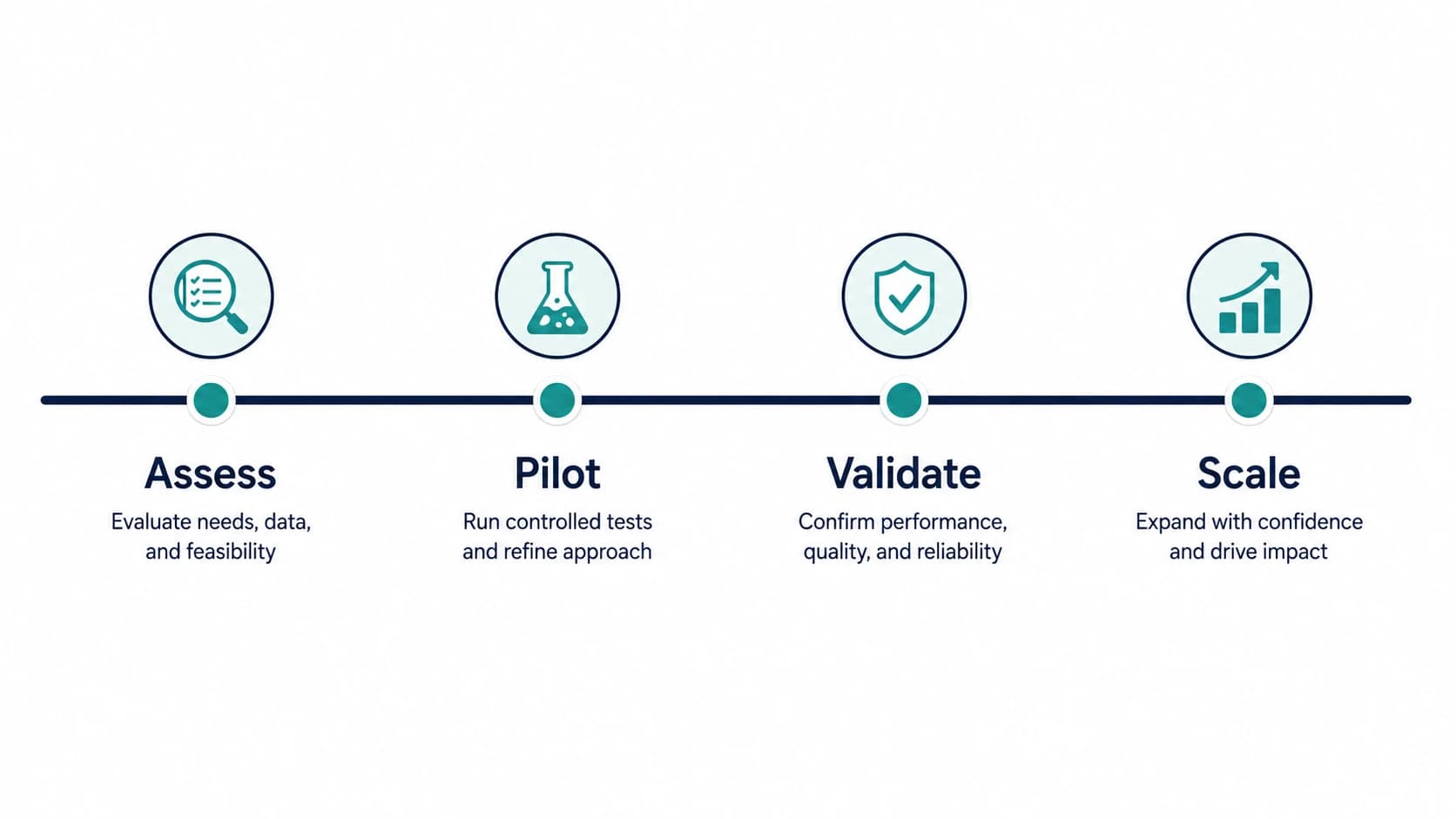
Four-stage implementation roadmap timeline showing Assess, Pilot, Validate, and Scale as connected milestone markers along a line
AI Visual Inspection Implementation Roadmap

AI Visual Inspection vs. Manual Inspection vs. Traditional Machine Vision

Traditional machine vision relies on fixed rules and thresholds; AI visual inspection uses trained deep learning models that generalize to new, unseen defect types without manual reprogramming. For a deeper comparison, see AI visual inspection vs traditional inspection methods.

DimensionManual InspectionTraditional Machine VisionAI Visual Inspection
Typical detection accuracy~70–85% under real conditionsHigh on known defects; poor on unprogrammed ones97–99.5%+ on trained defect types
False-positive rate15–25%, rises with fatigueModerate; sensitive to lighting/threshold driftTypically under 10%
Consistency across shiftsDegrades with fatigue and time-of-dayConsistent if conditions are stableConsistent regardless of shift or duration
Flexibility to new defect typesHigh — human judgment adaptsLow — requires reprogramming rulesHigh — retrainable on new labeled examples
Throughput / line speed fitLimited to a few hundred parts/hourHigh, but rigid to part variationHigh, and adaptive to part variation
Best fitLow-volume, highly customized, judgment-heavy inspectionHigh-volume, highly standardized parts with stable defect typesHigh-volume production with defect variability or evolving quality requirements

In most real plants, the answer is not “AI replaces everything” — it is a hybrid: AI inspection handles the high-volume, well-defined inspection load at 100% coverage, traditional machine vision continues to serve narrow, highly stable checks where it is already cost-effective and depreciated, and human judgment remains valuable for genuinely novel or highly customized inspection decisions that don't yet have enough labeled examples to train on.

A related comparison: predictive vs. preventive maintenance

Executives evaluating AI visual inspection often ask the same ROI question about predictive maintenance, and the logic is closely related. Preventive maintenance services equipment on a fixed schedule regardless of actual condition, which wastes labor on healthy equipment and still misses failures that occur between scheduled intervals. Predictive maintenance uses sensor and process data — increasingly including visual inspection defect patterns — to service equipment based on actual condition, catching degradation earlier and avoiding unnecessary maintenance on equipment that does not need it. The two disciplines share an underlying pattern: both replace a fixed, sample-based, or calendar-based process with continuous, data-driven decisioning, which is precisely why manufacturers increasingly plan AI visual inspection and predictive maintenance as a single AIoT investment rather than two separate initiatives.
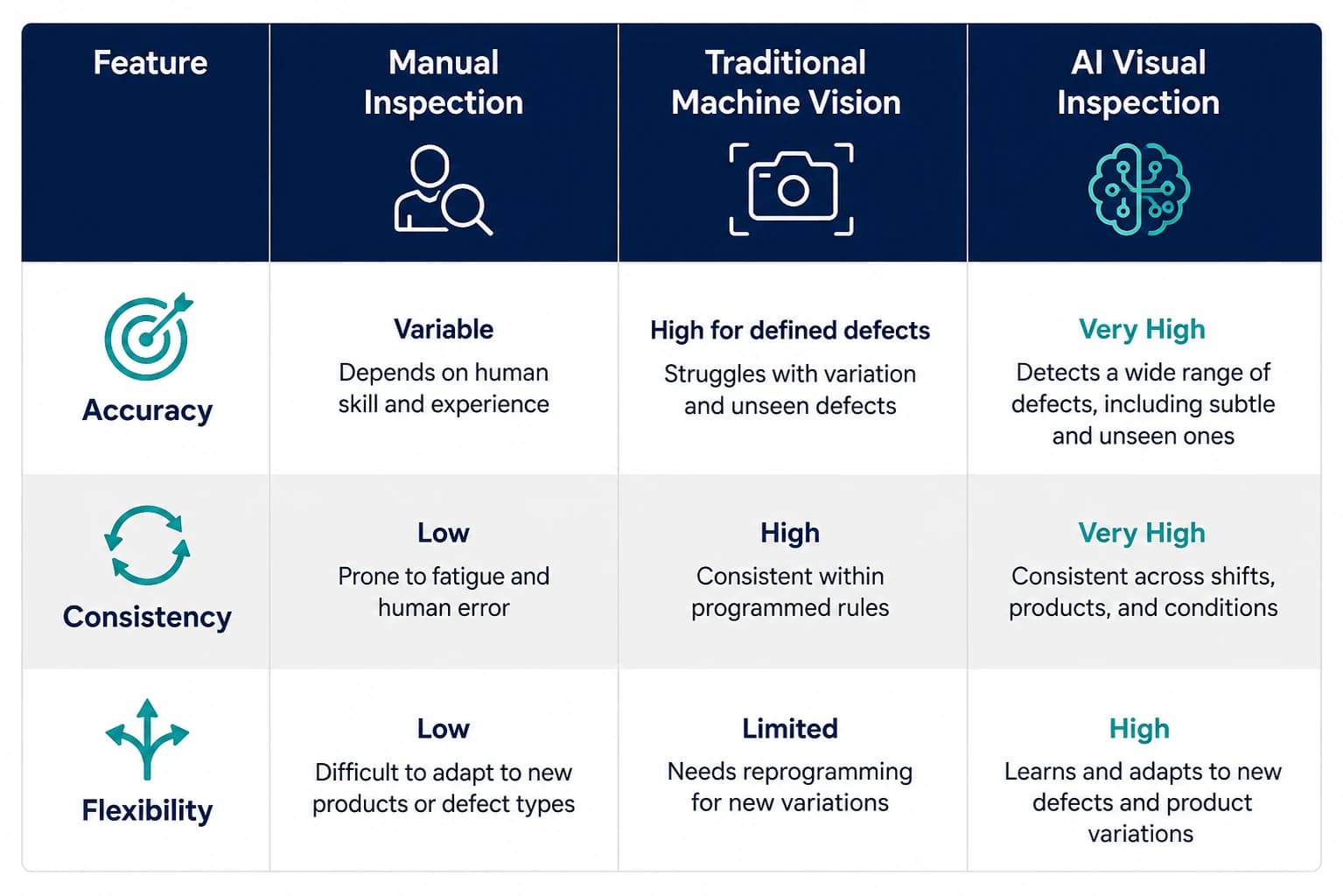
Comparison table graphic showing Manual Inspection, Traditional Machine Vision, and AI Visual Inspection across accuracy, consistency, and flexibility, highlighting AI visual inspection as highly accurate, consistent, and adaptable
Manual vs. Machine Vision vs. AI Visual Inspection

Real-World Benchmarks and Lessons Learned

Public, verifiable benchmarks consistently point in the same direction. Independent research on automated defect detection systems has documented accuracy exceeding 95% for larger, visible defect classes such as cracks and delamination, with continued research narrowing the gap on smaller, harder-to-see defects that fall below typical human visual thresholds. Industry analyses report false-positive rates falling from the 40–50% range common in legacy, rule-based automated optical inspection systems down to roughly 4–10% with modern deep learning models — a difference that directly determines how much manual re-verification work a quality team still does after the AI system flags a part.

Vendor and industry case material — including Intel's own published smart-manufacturing computer-vision inspection work — has cited multi-million-dollar annual savings from inline AI inspection, driven primarily by reduced scrap and faster defect triage rather than software cost alone. Separately, industry benchmarking on AI-driven defect detection reports inspection cycle times running 30–50% faster than legacy methods and production throughput gains around 25%, with even a fractional yield improvement translating into millions of dollars in annual savings at full production volume.

The consistent lesson: manufacturers that treat AI visual inspection as a data and process initiative — not just a camera-and-software purchase — are the ones who hit their payback targets.

Ombrulla can share facility-appropriate reference examples and, where permitted, named client outcomes during a scoping conversation; this article intentionally uses industry-wide, independently sourced benchmarks rather than unverified figures so the numbers here hold up under your own capital committee's scrutiny.
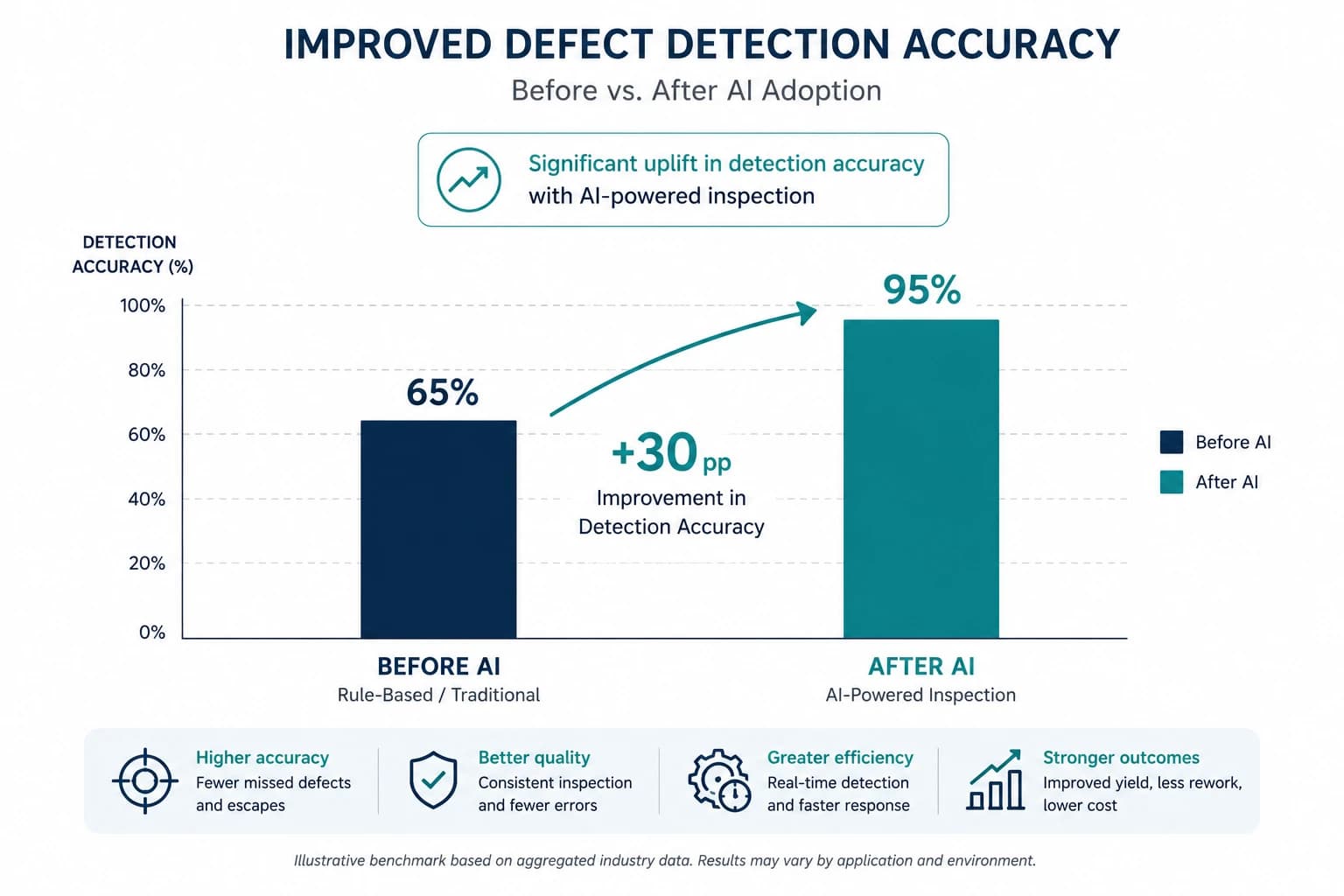
Before and after bar chart illustrating a general improvement in defect detection accuracy after AI adoption, with clearly labeled axes and illustrative percentage markers
Defect Detection Accuracy: Before vs. After AI Adoption

How Ombrulla Helps

Ombrulla works with plant, quality, and digital transformation leaders as an Industrial AI and AIoT partner — helping translate the framework above into a facility-specific ROI model and implementation plan, rather than a generic product pitch.

TRITVA

TRITVA — Ombrulla's computer vision-based inspection capability, applied to defect detection, dimensional verification, and quality monitoring on production lines — built around the evaluation criteria and roadmap outlined above.

PETRAN

PETRAN — Ombrulla's predictive maintenance capability, which extends visual inspection data into equipment health monitoring — closing the loop between the defect patterns TRITVA identifies and the machine conditions that cause them.

AI Consulting

A structured assessment of your cost of poor quality, inspection process, and data readiness, producing the baseline and business case a capital committee needs before any technology decision is made.

AIoT Solutions

Connecting visual inspection, predictive maintenance, and broader sensor data into a unified industrial AI layer, so quality and reliability data reinforce each other instead of living in separate systems.

The goal of an initial conversation with Ombrulla is not to sell a platform — it is to help you build the ROI case above with your own numbers and decide, with evidence, whether and where to start.
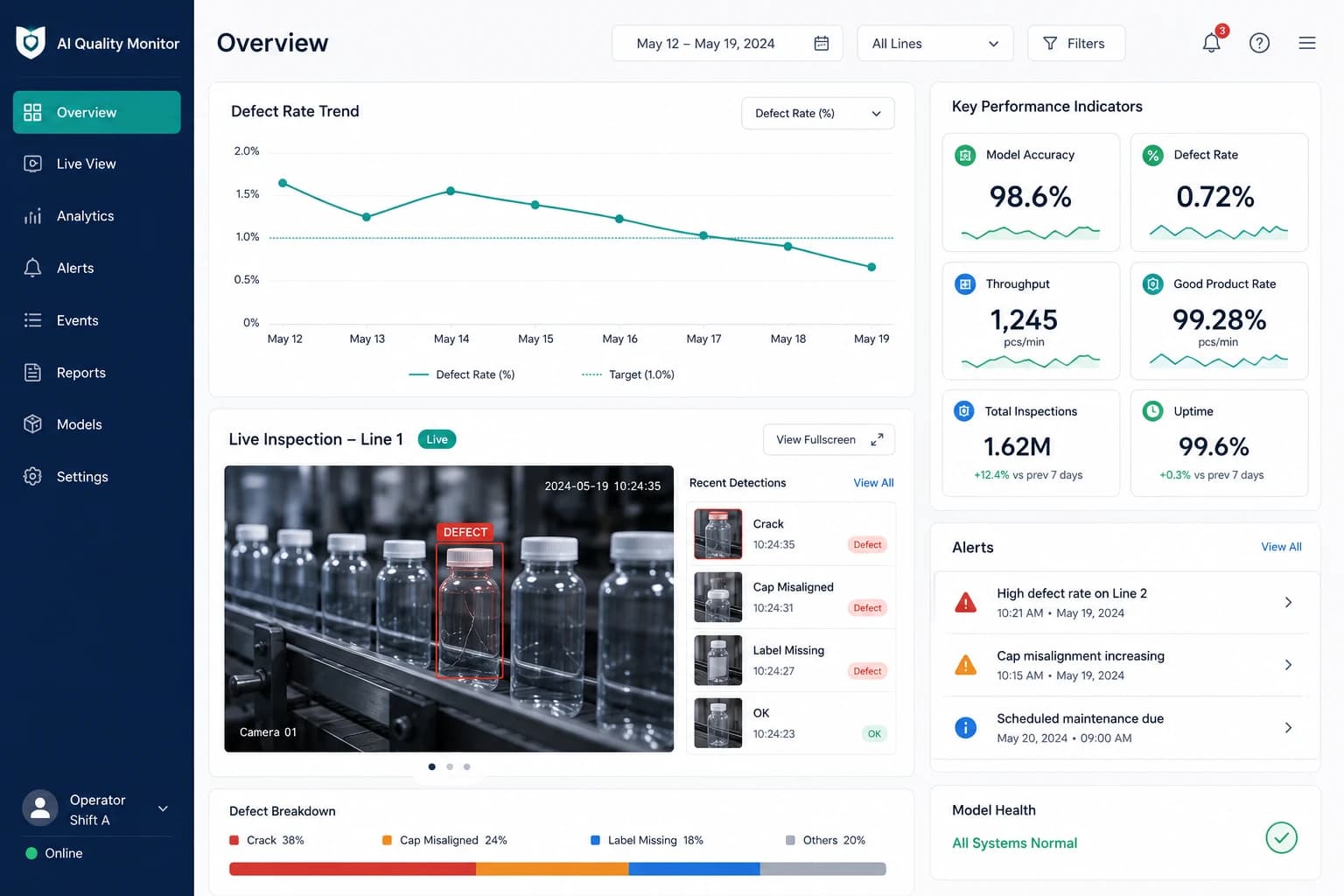
AI quality monitor software dashboard showing a live defect-rate trend line, a production-line camera feed thumbnail, and a panel of KPI tiles for accuracy, throughput, and alerts
Ombrulla AI Quality Monitor Dashboard

Frequently Asked Questions

Is AI visual inspection worth the investment for a mid-size plant?

Usually yes, if the plant has a measurable cost of poor quality and enough part volume to justify the integration effort. A focused pilot on the highest-cost defect type is the lowest-risk way to test the assumption before a wider rollout.

How much does an AI visual inspection system cost?

Cost varies widely by line complexity, camera count, and deployment model (capex hardware vs. subscription software), so most manufacturers evaluate cost against expected annual savings rather than a fixed benchmark price. Most report payback within 6–18 months.

Can AI visual inspection detect defects that humans miss?

Yes — particularly small, subtle, or fatigue-related misses. AI systems do not lose attention over a shift and can be trained to detect defects below typical human visual thresholds, such as sub-millimeter surface cracks.

Does AI visual inspection eliminate the need for quality inspectors?

Rarely entirely. Most manufacturers redeploy inspectors into exception handling, root-cause analysis, and quality engineering — work that benefits from human judgment and that AI systems cannot perform on their own.

What is the difference between AI visual inspection and automated optical inspection (AOI)?

AOI is often used specifically in electronics manufacturing and can range from rule-based to AI-based; “AI visual inspection” is the broader term for any system using trained deep learning models rather than fixed rules, typically with lower false-positive rates.

How accurate does an AI model need to be before it's ready for production use?

There is no universal threshold — it depends on the cost of a missed defect versus a false rejection for your specific part. Most manufacturers run the model in shadow mode until accuracy is validated on real production data.

What happens if the AI model encounters a defect type it wasn't trained on?

A well-designed system flags low-confidence classifications for human review rather than silently passing or rejecting the part, and that flagged data becomes the next batch of training examples.

Does AI visual inspection work in harsh environments like oil & gas or mining?

Yes, with appropriate hardware — ruggedized cameras, adequate lighting, and often edge inference to avoid connectivity dependence — AI inspection is increasingly used for corrosion and structural monitoring in harsh, remote environments.

How does AI visual inspection support ISO 9001 compliance?

By generating a timestamped, digital inspection record for every unit rather than a sample, AI inspection makes traceability and audit evidence substantially more complete than manual, sample-based logging.

Can AI visual inspection integrate with our existing MES or ERP system?

Most modern platforms offer standard APIs for MES, ERP, and SCADA integration; the complexity depends more on how customized your existing systems are than on the AI platform itself, so it should be scoped during assessment, not the pilot.

How is AI visual inspection different from predictive maintenance?

Visual inspection assesses product quality at a point in time; predictive maintenance uses sensor and process data — including defect patterns — to forecast equipment failure before it happens. The two are complementary and increasingly unified under one AIoT strategy.

What's the biggest risk of delaying an AI visual inspection investment?

Continuing to carry an unmeasured, and typically underestimated, cost of poor quality — while competitors who have already adopted 100% inline inspection improve first-pass yield and free inspection labor for higher-value work.

Do we need a data science team to run an AI visual inspection program?

No, not for most modern platforms. No-code labeling and retraining tools let quality engineers manage day-to-day model updates, with vendor support reserved for initial deployment and more complex scenarios.

Next Steps: Executive Checklist

Before the next capital committee meeting, an executive sponsoring an AI visual inspection investment should be able to answer:

  • -
    What is our current, measured cost of poor quality — by category, not estimated as a single number?
  • -
    Which single line or defect type would deliver the fastest, most defensible pilot ROI?
  • -
    What is our realistic total cost of ownership over 3–5 years, not just the initial quote?
  • -
    Who owns the retraining workflow once the model is in production — us or the vendor?
  • -
    What is the plan to redeploy inspection labor into higher-value quality work?

If two or more of these cannot be answered with confidence today, the next step is not a vendor demo — it is a structured AI readiness assessment that produces the baseline and business case first, so every subsequent vendor conversation is grounded in your own numbers rather than a generic pitch deck.

Book an AI Readiness Assessment with Ombrulla to establish your facility's cost-of-poor-quality baseline and build a facility-specific ROI model before evaluating vendors.

Conclusion: The Question for 2026 Is Speed, Not Whether

AI visual inspection has moved past the pilot-project phase and into standard industrial practice, and the reason is straightforward arithmetic: the cost of poor quality most manufacturers already carry — typically 15–20% of revenue — is larger than the investment required to meaningfully reduce it, and the technology has matured to the point where 97–99%+ detection accuracy is achievable in real production environments, not just in a vendor lab.

The executives who build the strongest business case are not the ones with the most sophisticated technology — they are the ones with the clearest baseline, the most disciplined pilot, and a realistic plan for scaling and for the people whose roles will change along the way. That is a solvable problem with a well-understood roadmap, not a leap of faith, and the roadmap in this guide reflects patterns that have held consistently across industries and plant sizes.

The question for 2026 is no longer whether AI visual inspection delivers ROI — the industry-wide evidence on that is now well established. The question is how quickly your organization can build a defensible, facility-specific version of that business case and start capturing the return.