

Ombrulla - home
AI Visual Inspection Defect Taxonomy: Manufacturing, Automotive, Oil & Gas & Infrastructure | Complete Guide

AI Visual Inspection Defect Taxonomy for Manufacturing, Automotive, Oil & Gas and Infrastructure

Zara Elizabeth - Business Development Associate - Ombrulla

Zara Elizabeth

Business Development Associate

Jun 30, 2026

The Definitive Industry Reference Library for AI-Powered Quality Intelligence.
Introduction

Introduction: The Hidden Cost of Unstructured Defect Data

Every manufacturing plant, pipeline network, bridge, or tyre factory produces defects. That is an industrial reality no organisation can fully eliminate. What organisations can control – and where artificial intelligence creates transformative value – is how fast, consistently, and accurately those defects are identified, classified, and acted upon.

Yet here is the challenge that most AI visual inspection deployments face before they even train a single model: the data is a mess. Defects captured by one inspector as a 'scratch' are labelled 'surface mark' by another. 'Corrosion' appears tagged as 'discolouration', 'rust patch', or 'coating failure' depending on the region, the shift, or the operator. When that inconsistent data flows into a machine learning pipeline, the model learns noise – and quality suffers at scale.

This is precisely why a well-architected AI Visual Inspection Defect Taxonomy is not an administrative nicety. It is the strategic foundation on which every reliable AI inspection system must be built. A taxonomy transforms ambiguous field observations into structured, machine-readable knowledge – enabling models to detect faster, classify more accurately, and integrate cleanly with ERP, MES, and asset management platforms.

This article delivers a comprehensive, industry-specific defect taxonomy library spanning Automotive, Manufacturing, Oil & Gas, Infrastructure, and Tyre/Rubber sectors. It includes annotation guidelines, bounding-box standards, severity frameworks, AI model suitability notes, and image generation prompts – giving AI engineers, quality managers, and operations leaders everything they need to move from unstructured inspection data to intelligent, auditable defect intelligence.

What Is an AI Visual Inspection Defect Taxonomy?

A defect taxonomy is a structured, hierarchical classification system that organises all known defect types within a given domain into clearly defined, mutually exclusive, and collectively exhaustive categories. In the context of ai visual inspection, a taxonomy serves three primary functions:

  • -
    Data StructuringIt provides the controlled vocabulary for labelling training datasets, ensuring that every annotator uses the same language to describe the same phenomenon.
  • -
    Model Architecture GuidanceIt informs how classification layers within a neural network are structured – whether as flat multi-class classification, hierarchical softmax, or ensemble detection pipelines.
  • -
    Business Logic MappingIt links defect types to downstream actions – triggering repair workflows, quarantine flags, maintenance alerts, or regulatory notifications – based on predefined severity rules.

Key Principle – Taxonomy Hierarchy

A well-designed defect taxonomy should be organised into three levels to support both high-level defect visibility and detailed root cause analysis.

LevelDescriptionPurpose
1. Domain CategoryThe high-level industry, asset, product, or component group where the defect occurs.Helps classify defects by operational area, such as manufacturing, infrastructure, energy, automotive, or specific equipment groups.
2. Defect FamilyA group of related defect types that share similar characteristics, causes, or inspection methods.Supports structured alerting, trend analysis, and maintenance or quality prioritisation.
3. Defect InstanceThe specific, annotatable defect subtype with measurable attributes such as size, shape, depth, severity, location, or confidence score.Enables fine-grained detection, annotation, model training, root cause analysis, and corrective action.

Taxonomy Design Principles

Before diving into the industry-specific libraries, it is worth establishing the principles that govern a production-grade taxonomy:

  • -
    Mutual ExclusivityNo defect should reasonably belong to two different classes without clear discriminators. For example, 'rust' and 'corrosion' might both appear in an infrastructure taxonomy, but they must be differentiated by measurable criteria – surface oxidisation depth, area coverage, or structural impact – to prevent labelling ambiguity.
  • -
    Hierarchical VersioningTaxonomies evolve as new defect types emerge and manufacturing processes change. Version-controlled taxonomy documents (v1.0, v1.1, v2.0) ensure that datasets labelled under different versions remain traceable and comparable over time.
  • -
    Severity NormalisationEvery defect type should carry a standardised severity code that can be applied consistently across inspectors, sites, and shifts. A three-tier system – Critical, Major, Minor – is the most widely adopted and integrates cleanly with ERP escalation workflows.
  • -
    Annotation LinkageEach taxonomy entry must specify the corresponding annotation type (bounding box, polygon, keypoint, semantic mask) to ensure that data labelling tools and downstream training pipelines are aligned.

Universal Severity Framework

To ensure consistency across different inspection models and business logic, a universal severity framework is applied to all defect categories:

Severity CodeLabelDefinitionDefault Action
S1CriticalImmediate safety or structural risk; renders the item unusable or unsafe.Immediate halt, quarantine, regulatory notification
S2MajorSignificant quality deviation; impacts function, performance, or aesthetics at a grade that fails product specification.Reject or rework; escalate to quality team
S3MinorCosmetic or marginal deviation that does not impact function or safety; may require monitoring.Log, monitor, pass with annotation

Industry 1: Automotive Defect Taxonomy

The automotive sector demands the highest cosmetic and structural precision of any manufacturing discipline. A single body panel passes through more than twenty quality checkpoints from pressing to final line-off. AI visual inspection in automotive must handle a wide range of defect types across painted surfaces, sub-assemblies, and fully assembled vehicles.
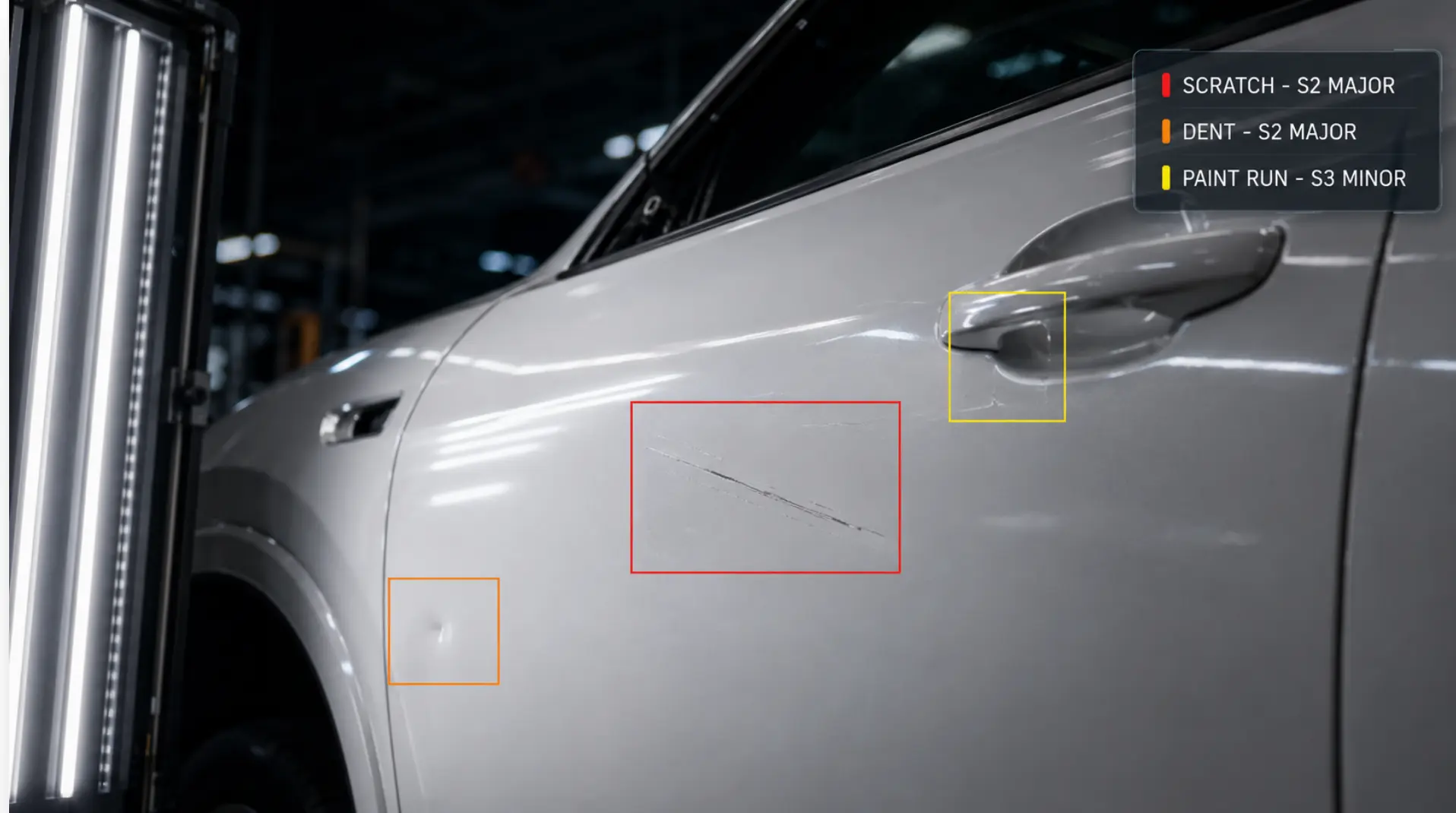
Automotive Defect Taxonomy illustrating various defects across painted surfaces and sub-assemblies
Defect TypeSub-TypeDescriptionAnnotation TypeSeverityAI Model Suitability
ScratchMicro-scratch, deep gouge, keyingLinear surface disruption to clear coat, base coat or metal substrate.Bounding Box / PolygonS1–S2CNN + High-res camera (4K+)
DentPanel dent, crease dent, hail damageLocalised deformation of sheet metal causing concave or convex shape deviation.Polygon + depth mapS1–S23D point cloud + CNN
Paint DefectRun, orange peel, fish-eye, blister, oversprayImperfections in the paint layer affecting finish, adhesion or appearance.Bounding Box / Semantic maskS2–S3ResNet / EfficientDet under raking light
Assembly MismatchPanel gap variance, flush misalignment, clip misfitIncorrect spatial relationship between assembled components exceeding tolerance specification.Keypoint / Measurement overlayS1–S2Keypoint detection + metrology AI
Missing PartsAbsent fastener, missing trim, absent sensorRequired component absent from its specified location on the assembly.Classification / Presence detectionS1YOLO object detection (presence/absence)

Automotive Annotation Guidelines

  • -
    Scratches and DentsUse tight bounding boxes that fit the defect perimeter within 5 pixels on each side.
  • -
    Paint DefectsFor paint defects with irregular boundaries, use polygon annotation with a minimum of 8 anchor points.
  • -
    Assembly MismatchUse keypoint annotations at the gap's two opposing edges, with a measured pixel distance recorded in metadata.
  • -
    Missing PartsMark the expected location with a centred bounding box labelled with the absent component's part code.
  • -
    Required MetadataAll automotive annotations must carry: (a) defect class, (b) severity code, (c) camera station ID, (d) part number, (e) timestamp.

AI Model Note – Automotive Paint Inspection

For automotive paint AI defect detection, raking-light camera setups deliver better accuracy than diffuse-light setups, with typical mAP improvement of 18–24%.

A dual-lighting inspection rig is recommended, alternating between:

Lighting TypePurpose
Diffuse LightCaptures colour and surface consistency.
Raking LightHighlights scratches, dents, waviness, and micro-defects.

For high-speed production lines running at 60+ parts per minute, YOLOv8 or RT-DETR models are well-suited for real-time defect detection and quality alerts.

Industry 2: Manufacturing Defect Taxonomy

In discrete and process manufacturing environments – from metal fabrication and injection moulding to PCB assembly and pharmaceutical packaging – defects can originate from raw material inconsistencies, tooling wear, process drift, or environmental contamination. The defect taxonomy must be granular enough to enable root cause correlation.
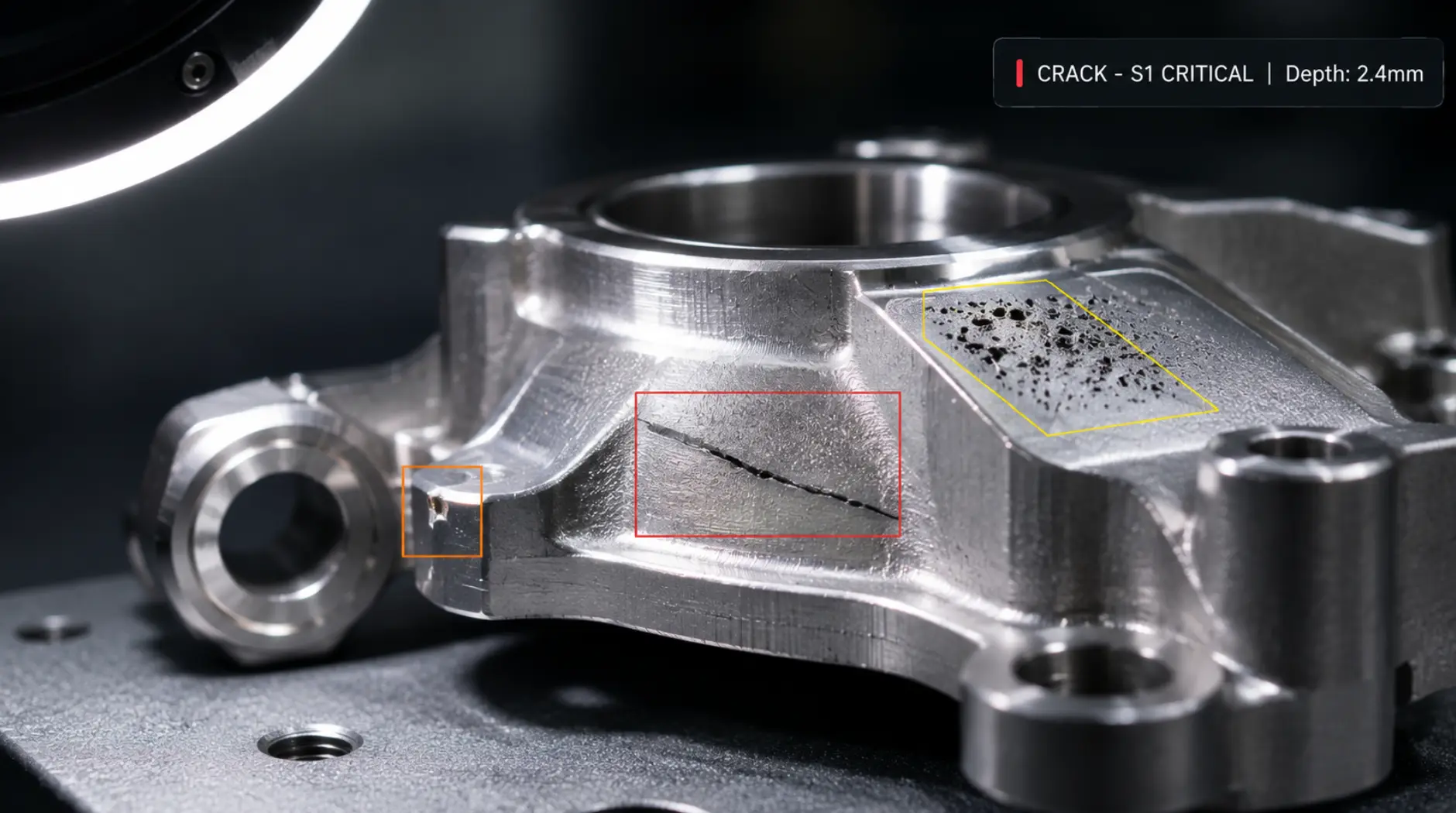
Manufacturing Defect Taxonomy illustrating various discrete and process defects
Defect TypeSub-TypeDescriptionAnnotation TypeSeverityAI Model Suitability
CrackSurface crack, sub-surface crack, fatigue crackLinear or branching fracture in material substrate, visible on surface or detected via sub-surface imaging.Polygon / Skeleton annotationS1U-Net segmentation; anomaly detection for sub-surface
BurrMachining burr, trim burr, cast burrUnwanted raised material edge resulting from cutting, drilling or moulding operations.Bounding Box + Edge maskS2–S3High-resolution CNN with structured light
Surface DefectPit, porosity, inclusion, scale, delaminationUnplanned variation in surface texture, composition or continuity impacting function or aesthetics.Semantic segmentation maskS1–S3EfficientNet / ViT with multi-spectral imaging
Dimensional AnomalyOver/under-dimension, out-of-round, flatness deviationMeasured geometry falling outside specified tolerance range for length, diameter, flatness or profile.Measurement overlay / KeypointS1–S2Metrology AI + 3D vision (structured light / laser)

Manufacturing Annotation Guidelines

  • -
    CracksCracks must be annotated with skeleton (centreline) annotations, not bounding boxes, to accurately represent directionality and length for root cause analysis.
  • -
    BurrsBurr annotations should capture both the burr location (bounding box) and the affected edge (polyline) to enable tooling wear correlation.
  • -
    Dimensional AnomaliesRequire paired keypoint annotations: the nominal reference edge and the measured deviation point, with delta value in millimetres recorded in annotation metadata.
  • -
    Surface DefectsSurface defects that cover >5% of a component face should be annotated with semantic segmentation masks rather than bounding boxes.

AI Model Note – Manufacturing Inspection

For dimensional anomaly detection, AI vision performs best when combined with inline metrology data from CMM systems.

Recommended workflow:

TierMethodPurpose
Tier 1AI Vision InspectionFast screening of dimensional anomalies.
Tier 2CMM VerificationPrecision validation of flagged parts.

For surface defect detection on textured metallic components, Vision Transformer (ViT) models can deliver 6–12% higher sensitivity than CNN-based models in benchmark studies.

Recommendation: Use AI vision for rapid detection and CMM/metrology integration for high-confidence dimensional validation.

Industry 3: Oil & Gas Defect Taxonomy

In oil and gas – spanning upstream exploration assets, midstream pipelines, and downstream refinery infrastructure – defects are not merely a quality issue. They are a safety, environmental, and regulatory imperative. The consequences of undetected corrosion or insulation failure on a high-pressure hydrocarbon pipeline can be catastrophic, making AI visual inspection a critical component of integrity management programmes.
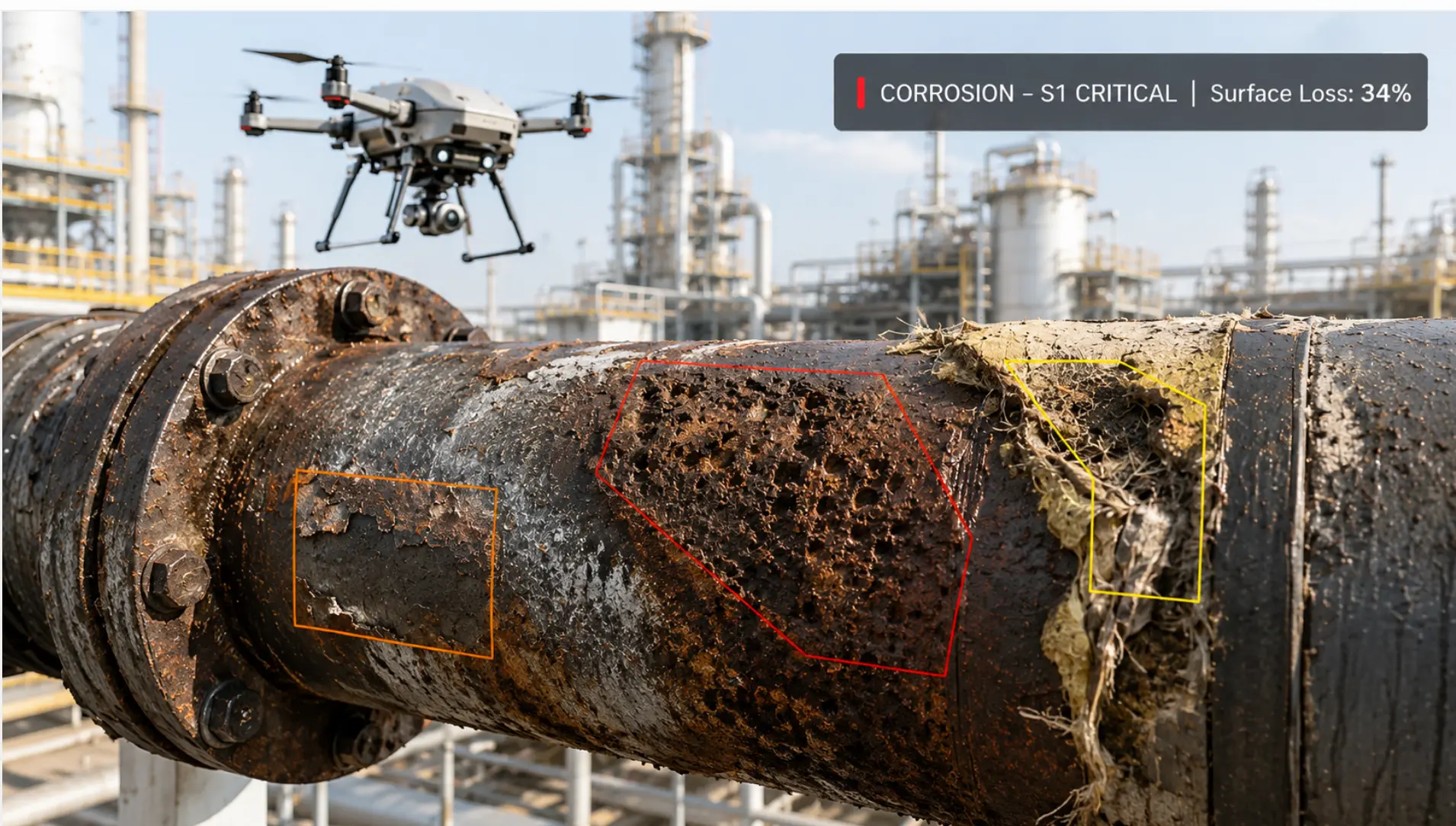
Oil & Gas Defect Taxonomy illustrating corrosion, coating loss, leakage, and insulation damage
Defect TypeSub-TypeDescriptionAnnotation TypeSeverityAI Model Suitability
CorrosionGeneral corrosion, pitting corrosion, crevice corrosion, galvanic corrosionElectrochemical degradation of metal surface due to environmental exposure, resulting in material loss.Semantic segmentation + depth estimationS1–S2U-Net / DeepLab + multi-spectral / thermal
Coating LossDisbondment, holiday, blister, chalkingFailure or absence of protective coating layer that exposes substrate to corrosive environments.Polygon / Semantic maskS1–S2EfficientDet + UV fluorescence imaging
Leakage SignsStaining, crystalline deposit, wet patch, hydrocarbon sheenVisual indicators of fluid escape from containment – including product staining, mineral deposits or hydrocarbon surface sheen.Bounding Box + temporal change detectionS1Change-detection CNN + thermal IR camera
Insulation DamageWeathered jacket, exposed insulation, CUI (corrosion under insulation) suspectDegradation of thermal insulation system allowing moisture ingress or exposing pipe substrate to environment.Polygon + classification labelS1–S2Thermal imaging AI + RGB fusion model

Oil & Gas Annotation Guidelines

  • -
    Corrosion PatchesCorrosion patches must be annotated with semantic segmentation masks that capture the full affected area, not point-and-click bounding boxes, due to the irregular spread of corrosion boundaries.
  • -
    Leakage SignsLeakage sign annotations must include a temporal sequence reference – linking the current frame annotation to a baseline inspection image – to enable change detection models to calculate progression rate.
  • -
    Coating Loss HolidaysCoating loss holidays (pinhole defects) should be annotated with circular polygon annotations no smaller than 16×16 pixels at the inspection camera resolution.
  • -
    CUI Suspect ZonesCUI suspect zones should trigger a dual annotation: one label for the visible insulation jacket damage, and a second provisional label flagging potential substrate corrosion pending thermographic or UT verification.

AI Model Note – Oil & Gas Inspection

For leakage detection and corrosion classification, RGB camera data performs best when fused with thermal infrared imaging.

Recommended approach:

Inspection InputPurpose
RGB ImagingDetects visible corrosion, coating damage, leakage marks, and surface anomalies.
Thermal InfraredIdentifies temperature variations linked to leaks, insulation defects, and early-stage CUI.

RGB + TIR fusion models can reduce false negatives by up to 31% for early-stage CUI detection compared with RGB-only methods.

Recommendation: Use drone-mounted AI inspection systems that capture RGB + thermal data and send defect class, severity, and GPS location directly to the asset integrity system for automated work-order creation.

Industry 4: Infrastructure Defect Taxonomy

Infrastructure inspection – bridges, tunnels, roads, dams, retaining walls, and utility structures – represents one of the fastest-growing domains for AI visual inspection. Ageing assets, constrained maintenance budgets, and safety obligations are driving a rapid shift from periodic manual inspections to continuous AI-powered structural health monitoring.
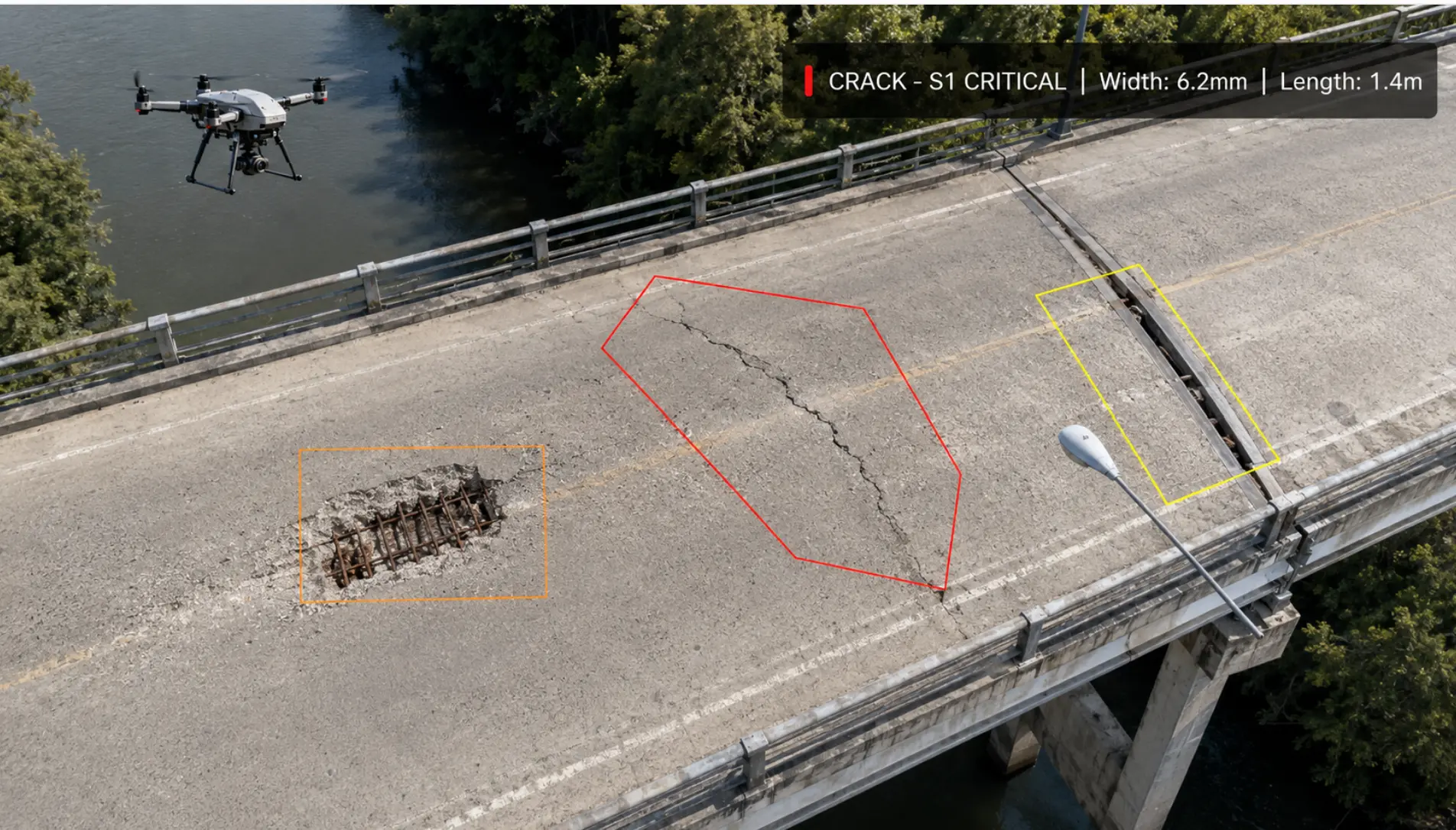
Infrastructure Defect Taxonomy illustrating various structural defects
Defect TypeSub-TypeDescriptionAnnotation TypeSeverityAI Model Suitability
CrackHairline crack, structural crack, map (alligator) cracking, longitudinal/transverseFracture in concrete, masonry or asphalt substrate – classified by width, depth, orientation and pattern.Skeleton + polygon annotationS1–S3DeepCrack / U-Net segmentation; width measured via calibrated imagery
SpallingSurface spalling, delamination, exposed rebarDetachment of surface concrete layer, often exposing underlying reinforcement to environmental attack.Polygon / Semantic maskS1–S2EfficientDet + 3D point cloud for depth estimation
Rust / StainingRebar rust staining, efflorescence, biological stainingSurface discolouration indicating subsurface corrosion or moisture-driven mineral migration.Bounding Box / Semantic maskS2–S3HSV colour space classification + CNN
DeformationSettlement, heave, buckling, tilt, differential displacementMacro-level geometric change indicating structural movement beyond design limits.Keypoint + 3D deformation mapS13D reconstruction + temporal change-detection AI
Joint DamageExpansion joint failure, seal loss, misalignment, debris accumulationFailure or degradation of designed movement accommodation joints critical to structural performance.Bounding Box + classificationS1–S2YOLO object detection; classification head for joint condition rating

Infrastructure Annotation Guidelines

  • -
    CracksCracks must be annotated with skeleton annotations capturing the full crack path, with crack width measured at three points (start, midpoint, end) recorded in metadata.
  • -
    SpallingSpalling areas require polygon annotations with minimum 12 anchor points, capturing the outer boundary of concrete loss. Exposed rebar should receive a separate nested annotation.
  • -
    DeformationDeformation annotations are best handled with 3D point cloud overlays, but where 2D imagery is used, paired keypoint annotations (reference point + displaced point) with distance metadata are required.
  • -
    GPS and GIS LinkageAll infrastructure annotations should carry GPS coordinates (lat/lon/elevation) to enable GIS integration and asset management system linkage.

AI Model Note – Infrastructure Inspection

For crack detection in bridges and concrete assets, models trained only on laboratory datasets often underperform in real-world conditions due to variations in texture, weathering, lighting, stains, and surface ageing.

Recommended training approach:

Data SourcePurpose
Lab Crack DatasetsUseful for initial model training and controlled defect learning.
In-Situ Field DataEssential for real-world accuracy across actual bridge decks and concrete surfaces.

At least 40% of training data should come from field inspection images.

Recommendation: Use drone-based inspection with AI defect detection + photogrammetric 3D reconstruction to create digital defect overlays for integration with BIM and asset management platforms such as Bentley AssetWise and IBM Maximo.

Industry 5: Tyre / Rubber Defect Taxonomy

Tyre and rubber product manufacturing is one of the most precision-intensive segments of the industrial economy. A tyre with an internal ply defect or an incorrect splice may perform correctly for thousands of kilometres before catastrophically failing at high speed. AI visual inspection in this sector must combine high-resolution surface imaging with sub-surface sensing modalities to provide complete quality assurance.
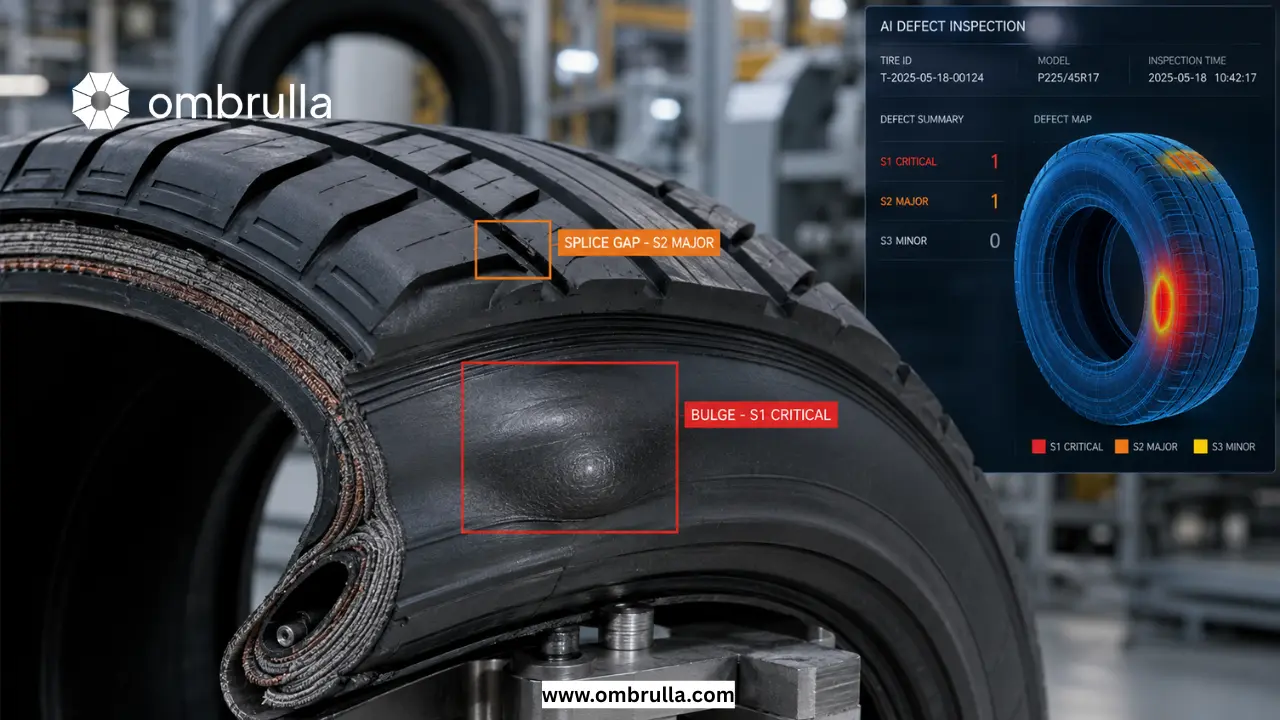
Tyre / Rubber Defect Taxonomy illustrating surface and subsurface defects
Defect TypeSub-TypeDescriptionAnnotation TypeSeverityAI Model Suitability
BulgeSidewall bulge, tread bulge, inner liner bulgeLocalised protrusion of tyre surface caused by internal structural weakness or air pocket.Elliptical polygon + 3D profileS13D laser profilometry + CNN classification
Splice GapOpen splice, misaligned splice, under-lap, over-lapJoining defect at the belt or ply termination point where material ends meet incorrectly.Bounding Box + width measurementS1–S2High-speed line-scan camera + CNN detector
Ply DefectPly separation, ply fold, missing cord, broken cordStructural defect within the reinforcing ply layers affecting tensile integrity and pressure retention.Semantic mask (X-ray / shearography frame)S1X-ray AI + shearography interferometry analysis
Sidewall IssuesCut, scuff, blister, marking error, open crackSurface or structural anomalies on the tyre sidewall affecting appearance, labelling accuracy or structural integrity.Polygon annotationS1–S3High-resolution CNN + raking-light line scanner

Tyre/Rubber Annotation Guidelines

  • -
    BulgesBulge annotations should use elliptical polygon overlays with semi-major and semi-minor axis measurements recorded in metadata to enable volume estimation.
  • -
    Splice GapsSplice gap width must be annotated with two parallel polylines at the gap edges, with gap width in millimetres captured as a metadata attribute.
  • -
    Ply DefectsPly defects visible on X-ray or shearography imagery require semantic segmentation masks and must be labelled with the ply layer number as a sub-attribute.
  • -
    Sidewall Marking ErrorsSidewall marking errors (incorrect DOT code, misprinted labelling) should be classified as a separate defect sub-type from structural sidewall defects and annotated with bounding boxes at character-level granularity.

AI Model Note – Tyre & Rubber Inspection

For tyre ply defect detection, X-ray imaging requires specialised CNN models trained on greyscale X-ray frames.

Recommended approach:

Inspection InputModel Strategy
X-ray FramesDetect ply separation, voids, cord misalignment, inclusions, and internal structural defects.
Specialised CNN ModelsTrain on tyre-specific greyscale X-ray datasets, with transfer learning from proven X-ray architectures.

Transfer learning from medical X-ray models can deliver strong results, with pilot datasets showing 89%+ sensitivity for ply defect detection.

Recommendation: Integrate real-time X-ray AI classification with the tyre building machine control system to enable immediate process correction and reduce scrap rates by up to 40%.

Annotation Guidelines & Bounding-Box Standards

Consistent annotation is the single most important factor in training a high-performing AI defect detection model. Poorly annotated data is worse than no data – it teaches the model incorrect associations that are difficult to diagnose and expensive to remediate. The following standards apply across all industry taxonomies covered in this article.

Annotation TypeWhen to UseTool StandardQuality Check
Axis-aligned Bounding Box (AABB)Object-level defects with roughly rectangular footprint (missing parts, burrs)COCO format JSON; 5px margin; no padding beyond defect boundaryIoU ≥ 0.85 between annotators
Oriented Bounding Box (OBB)Elongated defects at angles: scratches, cracks, corrosion streaksRotation-angle included in label file; DOTA or OBB-COCO formatAngular tolerance: ±5°; IoU ≥ 0.80
Polygon AnnotationIrregular defect boundaries: spalling, corrosion patches, paint blistersMin 8 anchor points for small defects; min 16 for large-area defectsPixel accuracy ≥ 90%; no self-intersecting polygons
Skeleton / CentrelineLinear defects: cracks, corrosion channels, splice gapsSingle-pixel centreline annotation; fork-points annotated at crack branchingEndpoint accuracy ±3 pixels; no gaps in annotation path
Semantic Segmentation MaskLarge-area defects or overlapping defect types: surface pitting, ply separationPer-pixel class labels; multi-class masks for co-located defectsMean IoU ≥ 0.82; edge precision ≥ 88%
Keypoint AnnotationDimensional anomalies, assembly mismatch, deformation reference pointsNamed keypoint pairs; pixel coordinates + real-world measurement in metadataKeypoint location error ≤ 2 pixels; measurement delta recorded

Quality Assurance in Annotation Workflows

  • -
    Three-Tier ReviewImplement a three-tier review pipeline: primary annotator → senior reviewer → automated consistency checker (using inter-annotator agreement metrics such as Cohen's Kappa > 0.80 or mean IoU > 0.82).
  • -
    Golden DatasetMaintain a 'golden dataset' of pre-labelled, expert-verified defect samples that annotators can reference during active labelling sessions.
  • -
    Dataset LineageVersion every annotation export alongside its corresponding taxonomy version to preserve dataset lineage.
  • -
    Consensus ResolutionFor critical (S1) defects, require 100% dual-annotator labelling with consensus resolution for all disagreements before dataset release.

AI Model Suitability Matrix

Selecting the right AI architecture for a given defect detection task is as important as the quality of the training data. The following matrix maps defect categories to recommended model architectures based on defect characteristics, production throughput requirements, and imaging modality.

Model ArchitectureBest ForThroughputKey StrengthIndustry Application
YOLOv8 / RT-DETRObject-level defects, missing parts, joint damage≥60 fpsReal-time speed; high recall at production line ratesAutomotive, Tyre, Infrastructure
U-Net / DeepLab v3+Area defects: corrosion, spalling, surface pitting5–20 fpsPrecise pixel-level segmentation of irregular boundariesOil & Gas, Infrastructure, Manufacturing
ResNet / EfficientNet (Classifier)Defect type classification after detection stageHighStable, well-understood; high accuracy on texture classificationPaint defects, surface grading, corrosion type
Vision Transformer (ViT)Complex surface textures, multi-class co-located defectsMediumLong-range feature attention; superior on subtle textured defectsManufacturing, Automotive
Anomaly Detection (PatchCore / PaDiM)Novel or low-frequency defects with limited training samplesMediumDetects out-of-distribution samples without defect-specific labelsAll industries; early deployment phase
3D Point Cloud CNNDents, deformation, dimensional anomalies, bulgesLow–MediumCaptures geometric deviation invisible to 2D camerasAutomotive, Tyre, Infrastructure

Deployment Recommendation – Two-Stage AI Inspection Architecture

For most industrial [AI inspection](https://ombrulla.com/solutions/ai-visual-inspection) deployments, a two-stage model architecture provides the best balance between speed and accuracy.

StageModel TypePurpose
Stage 1: Real-Time DetectionYOLO / RT-DETRFast defect flagging at full production-line speed.
Stage 2: Precision AnalysisSegmentation / Classification ModelDetailed defect typing, severity scoring, and root-cause support.

Recommended Approach: Use a fast detection model to identify suspected defects in real time, then apply a deeper segmentation or classification model only on flagged regions.

Business Benefit: This architecture maintains production throughput while improving defect classification accuracy and reducing unnecessary processing load.

Implementation Roadmap: From Taxonomy to Deployed AI Inspection

Building a production-ready AI visual inspection system requires more than training a neural network. The following five-step roadmap guides industrial teams from initial taxonomy design to full operational deployment.

StepPhaseKey ActivitiesDeliverable
1Taxonomy DesignDefine defect categories with SME input; assign severity codes; select annotation types per class; version-control the taxonomy document.Approved Defect Taxonomy v1.0 document
2Data Collection & AnnotationDeploy cameras/sensors at inspection stations; collect balanced defect samples (min 500 instances per class for deep learning); annotate per taxonomy standards; perform inter-annotator agreement review.Labelled training dataset with quality certificate
3Model Training & ValidationSelect architecture per AI model suitability matrix; train with augmentation (rotation, brightness, blur); validate on held-out test set; measure precision, recall, F1, mAP per defect class.Validated model with per-class performance report
4Edge Deployment & IntegrationDeploy model to edge compute (GPU-enabled edge server or smart camera); integrate defect events with ERP/MES via API; configure severity-based routing rules; conduct shadow-mode parallel run.Live AI inspection system running in shadow mode
5Continuous ImprovementMonitor model performance KPIs weekly (precision drift, false-negative rate); retrain on new defect samples quarterly; update taxonomy as new defect types emerge; review severity thresholds with quality team.Living AI inspection system with quarterly model refresh cadence

Frequently Asked Questions

What is the difference between a defect taxonomy and a defect ontology in AI inspection?

A defect taxonomy is a hierarchical classification structure that organises defect types into categories and sub-categories. A defect ontology is a more complex semantic model that also encodes relationships between defect types, their causes, affected components, and inspection methods. For most industrial AI deployments, a well-structured taxonomy is sufficient. Ontologies are typically employed in advanced digital twin platforms where causal reasoning across multiple asset systems is required.

How many labelled defect images do I need to train a reliable AI inspection model?

The minimum viable dataset size depends on the complexity of the defect and the model architecture. As a practical guideline: anomaly detection models (PatchCore, PaDiM) can operate with as few as 50–200 normal-sample images and perform well with zero or minimal defect examples. Object detection models (YOLO, EfficientDet) typically require a minimum of 300–500 annotated defect instances per class for acceptable performance. Segmentation models generally require 500–1,000+ annotated instances per class to achieve production-quality results. Data augmentation strategies – including synthetic defect generation using generative AI – can reduce these requirements by 30–50%.

Can one AI model cover all defect types across an entire factory?

Not reliably in a single model. Best practice is a modular architecture where specialised models are deployed per inspection station or per component type. A universal factory-wide model tends to make trade-offs that compromise accuracy on low-frequency but critical defect types. However, a shared taxonomy and standardised annotation pipeline across all station-level models allows centralised reporting, aggregate quality analytics, and consolidated model management through an ML operations (MLOps) platform.

How do I handle defects that span multiple taxonomy categories?

Co-located or overlapping defects – such as a crack that initiates corrosion, or spalling that exposes rusting rebar – should be annotated using multi-label annotation: each defect type present in a single image region receives its own annotation instance and class label. Training datasets for such scenarios should include compound defect examples explicitly, and the model architecture should support multi-class output per region. Post-processing logic should define escalation rules when co-located defects of different severity levels are simultaneously detected.

What imaging technology gives the best results for sub-surface defect detection?

For sub-surface defect detection, the imaging modality depends on the material: X-ray imaging is most effective for detecting internal ply defects in tyres and for weld inspection in metals. Ultrasonic testing (UT) combined with AI signal analysis is preferred for thick metal structures. Thermographic imaging (active or passive) is used to detect sub-surface delamination, CUI in oil and gas pipelines, and moisture ingress in concrete. Terahertz (THz) imaging is an emerging modality for detecting sub-surface defects in composite materials and coatings. In all cases, the resulting imaging data should be integrated into the same taxonomy-driven annotation and AI classification pipeline as visible-light imagery.

How should severity codes integrate with ERP and maintenance management systems?

Severity codes should map directly to maintenance priority levels within your ERP or CMMS (Computerised Maintenance Management System). A typical integration pattern: S1 (Critical) triggers an immediate work-order creation with a P1 priority flag and sends automated notifications to the maintenance manager and quality director; S2 (Major) creates a work order with a P2 priority and adds the item to the next shift's quality review queue; S3 (Minor) logs a record in the quality database and triggers a review at the next scheduled maintenance interval. This mapping should be configured at the AI inspection system integration layer rather than hardcoded in the model, to allow business rules to be updated without model retraining.

How do I maintain taxonomy consistency across multiple production sites or geographies?

Taxonomy governance is a critical operational discipline for multi-site deployments. Recommended practices include: publishing the master taxonomy as a version-controlled document in a shared quality management system; establishing a taxonomy review board that meets quarterly to evaluate proposed additions or modifications; using a centralised annotation management platform that enforces taxonomy-version locking on active labelling projects; and conducting annual cross-site annotation benchmarking exercises where the same defect image set is labelled independently by teams from each site, with inter-site agreement metrics reviewed by the taxonomy board.

What role does generative AI play in defect taxonomy and data augmentation?

Generative AI – including diffusion models and GANs – plays a growing role in defect taxonomy development and training data generation. In taxonomy design, large language models can assist in drafting initial taxonomy hierarchies by synthesising defect knowledge from technical standards (ISO, ASME, API), maintenance manuals, and historical inspection reports. In training data generation, image synthesis models can generate realistic synthetic defect images for rare defect types where field examples are limited, effectively solving the long-tail data scarcity problem that is common in industrial inspection. However, synthetic data must always be validated against real-world defect samples by domain experts before inclusion in production training datasets.

Ready to Build Your AI Visual Inspection System?

Our AI & IoT specialists work with manufacturing, oil & gas, infrastructure, and tyre/rubber organisations to design, annotate, and deploy production-grade AI visual inspection systems. From taxonomy governance to model deployment and MLOps integration – we cover the full lifecycle.

Schedule a Free 45-Minute AI Inspection Discovery Workshop