

Introduction
The industrial AI opportunity is enormous. Research consistently projects that AI-driven automation, quality intelligence, and predictive maintenance will unlock trillions of dollars in value across manufacturing, energy, and heavy industry over the next decade. The technology is mature. The use cases are proven. The ROI data is compelling.
And yet Gartner estimates that approximately 73% of industrial AI proof-of-concept projects never reach production deployment. The majority do not fail because the AI models are wrong. They fail because the architecture is wrong.
The architecture decision is where the long-term success or failure of an industrial AI programme is determined. A model that achieves 94% accuracy in a cloud-connected test environment but cannot run inference during a network outage in an underground mining facility is not a deployed AI system - it is an expensive experiment. A computer vision system that produces high-quality defect classifications but cannot push its findings to the MES for automated non-conformance record creation has not solved a business problem - it has created a new data island.
This white paper presents Ombrulla's Industrial AI Reference Architecture - a battle-tested, four-layer framework that we have developed and refined across deployments in discrete manufacturing, process industries, oil and gas, power generation, and infrastructure asset management. It covers every layer of the stack: from edge compute and sensor integration through data pipelines and MLOps to enterprise application integration and business intelligence.
Whether you are designing your first industrial AI deployment or rearchitecting a programme that has stalled at pilot stage, this white paper gives you the engineering blueprint, the decision frameworks, and the economic models to move from architecture design to production impact.
What Is Industrial AI Architecture - and Why It Is More Than Choosing a Cloud Provider
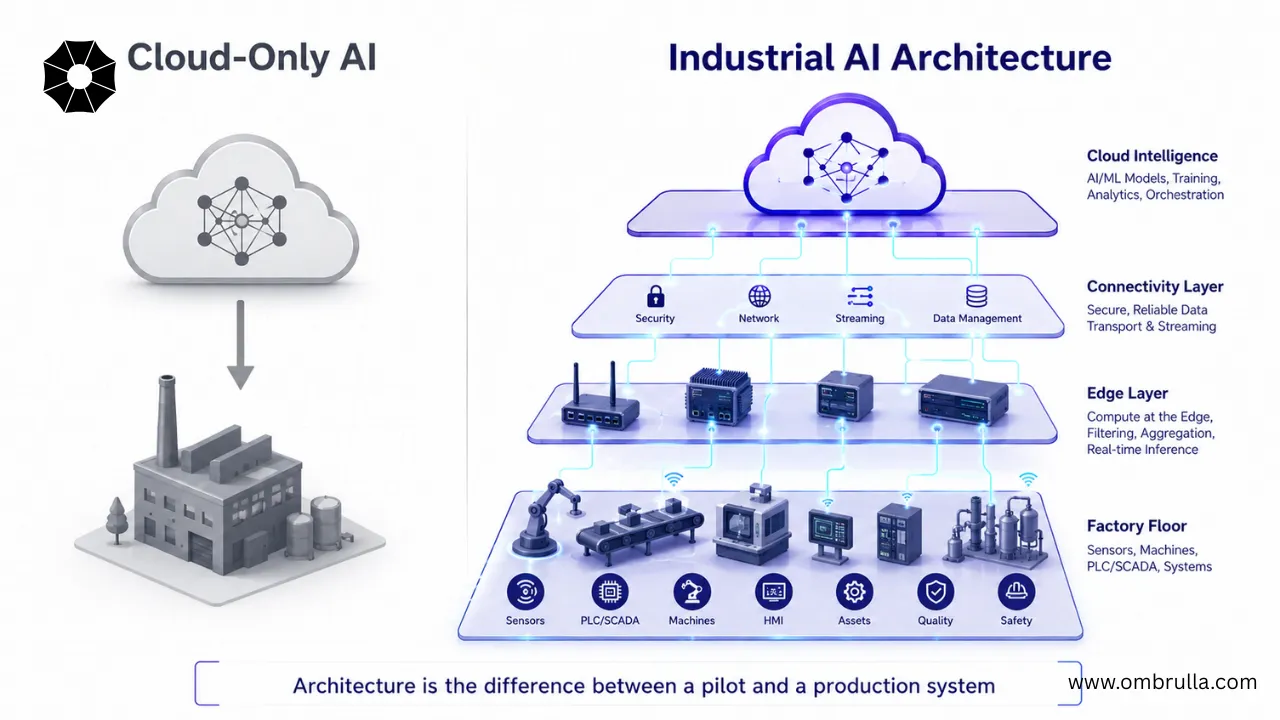
Industrial AI architecture is the holistic system design that defines how artificial intelligence capabilities are distributed, connected, managed, and governed across a physical industrial environment - from the sensor on the machine to the dashboard on the executive's screen.
It is fundamentally different from enterprise IT architecture and from consumer AI application design in three critical ways:
- - Latency constraints are physical, not just technicalA predictive quality model that takes 800ms to return a classification result is too slow to intervene on a production line running at 120 parts per minute. The architecture must bring intelligence to where the latency budget exists - often that means the edge, not the cloud.
- - Data is multi-modal and messyIndustrial environments generate time-series sensor data, machine event logs, maintenance records, image feeds, acoustic signals, and vibration spectra - often simultaneously and from systems with no common data schema. The architecture must handle this heterogeneity from day one.
- - Operational continuity is non-negotiableA factory cannot pause production while a cloud AI model is being retrained. A pipeline inspection cannot wait for 4G connectivity to be restored. The architecture must guarantee operational continuity independent of network availability.
What Is Industrial AI Architecture?
Industrial AI architecture is the structured design framework that specifies how AI models, data pipelines, compute infrastructure, and enterprise system integrations are organised across a physical industrial operation. A complete industrial AI architecture defines: where AI inference runs (edge, cloud, or hybrid), how operational data is collected and processed, how models are trained, versioned, and deployed, and how AI outputs integrate with ERP, MES, SCADA, and asset management systems.
The Ombrulla Industrial AI Reference Architecture
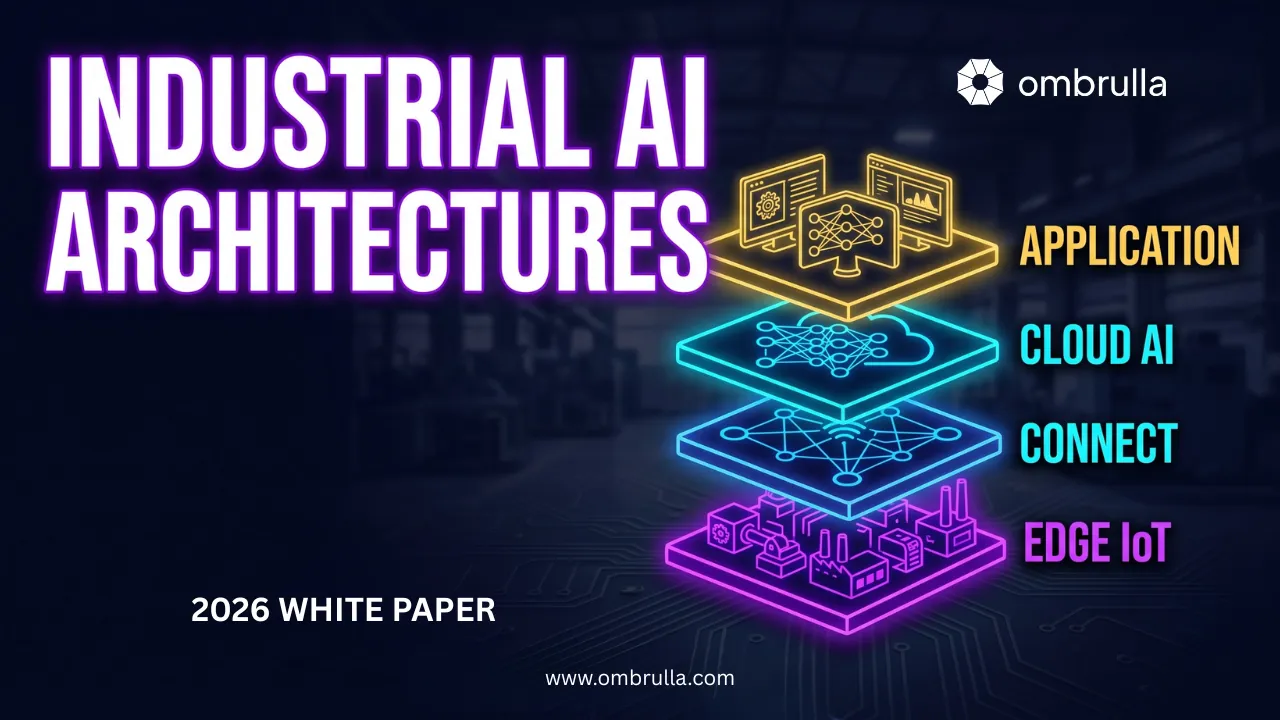
The Ombrulla Industrial AI Reference Architecture organises the full technology stack into four distinct but tightly integrated layers. Each layer has a specific responsibility domain, defined interfaces with adjacent layers, and clear engineering requirements that must be met for the overall system to function in a production industrial environment.
| Layer | Name | Primary Responsibility | Key Technologies |
|---|---|---|---|
| 1 | Edge Compute | Local data capture, real-time AI inference, pre-processing | Edge GPU servers, smart cameras, TF Lite, ONNX RT |
| 2 | Connectivity & Data Pipeline | Data normalisation, contextualisation, buffering, transport | OPC-UA, MQTT, Kafka, InfluxDB, Apache Spark |
| 3 | Cloud Intelligence | Model training, MLOps, experimentation, governance | MLflow, Kubeflow, Ray, PyTorch, Azure ML / AWS SageMaker |
| 4 | Application & Integration | Business application integration, visualisation, workflow automation | SAP, Maximo, SCADA, Power BI, REST API, GraphQL |
Layer 1 - The Edge Compute Layer: Intelligence at the Source
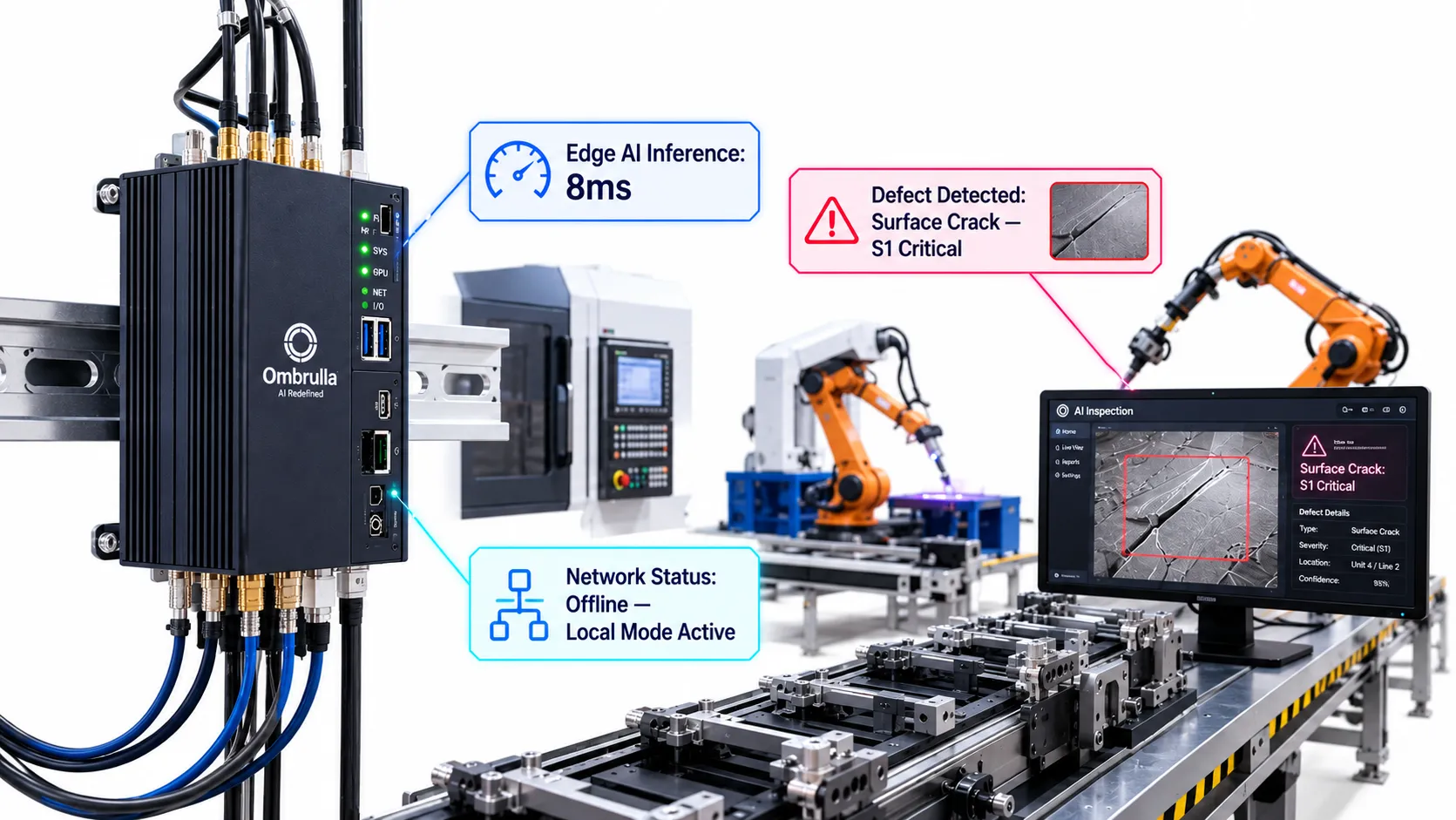
The edge compute layer is where industrial AI meets physical reality. It is the layer responsible for capturing raw operational data from machines, processes, and environments; running AI inference locally to generate actionable intelligence; and doing both with the latency, reliability, and connectivity independence that industrial operations require.
Getting this layer right is the single most critical architecture decision in industrial AI. A poorly specified edge layer will constrain the entire system above it - limiting the types of AI models that can run, the inference speeds achievable, and the operational continuity of the system.
Edge Compute Hardware Selection: IoT Hardware selection at the edge must balance AI inference capability with operational environment requirements. Ombrulla's hardware selection framework evaluates four axes:
| Evaluation Axis | Specification Requirement | Typical Options | Ombrulla Guidance |
|---|---|---|---|
| AI Compute | TOPS (Tera Operations/sec) sufficient for target model at target FPS | NVIDIA Jetson Orin, Intel Movidius, Qualcomm AI 100 | Minimum 20 TOPS for YOLOv8-class models at 30 FPS |
| Environment Rating | IP/ATEX rating matched to operational zone | IP67 enclosures, Zone 2 ATEX certified units | Never deploy consumer-grade hardware in plant environments |
| Thermal Management | Passive or active cooling rated for ambient temperature range | Industrial fanless designs; extended temperature range (-40 to +70°C) | Thermal throttling at edge kills inference latency SLAs |
| Connectivity Interfaces | OPC-UA client, PROFINET, EtherNet/IP, Modbus TCP, GigE Vision | Ruggedised switches; industrial Ethernet controllers | Match to existing PLC/SCADA protocol stack |
On-Device AI Model Deployment: AI models deployed to edge hardware must be optimised for the available compute envelope. Ombrulla's standard edge model preparation pipeline includes four stages:
- - Model compression: Pruning and knowledge distillation reduce model parameter count by 40–70% with minimal accuracy loss on industrial defect detection tasks.
- - Quantisation: Converting model weights from FP32 to INT8 or FP16 precision reduces memory footprint by 4x and accelerates inference by 2–4x on integer-optimised NPUs.
- - Framework conversion: Converting from PyTorch or TensorFlow training format to TensorRT, ONNX Runtime, or TF Lite for edge-optimised inference execution.
- - Benchmarking and validation: Each compressed model is benchmarked against the production inference latency budget and validated against the held-out test set to confirm accuracy is maintained within acceptance thresholds.
Edge AI Latency Standards
Ombrulla defines three edge inference latency tiers:
• Real-Time (< 10ms) - required for in-line process control and high-speed assembly inspection
• Near-Real-Time (10–100ms) - suitable for quality gate inspection and anomaly alerting
• Batch Edge (100ms–2s) - acceptable for periodic asset condition assessment and periodic report generation.
Model selection and hardware specification must be aligned to the latency tier required by each use case.
Layer 2 - The Connectivity and Data Pipeline Layer
Industrial environments are rich with data that is almost entirely inaccessible to AI systems in its raw form. PLCs speak proprietary protocols. Historians store data in formats designed for human review, not machine learning feature extraction. Sensors generate unlabelled time-series streams with no contextual metadata. The connectivity and data pipeline layer is the engineering discipline that transforms this raw operational data wealth into structured, contextualised, ML-ready datasets.
Industrial Protocol Integration
The connectivity layer must speak the native language of industrial control systems before it can aggregate and transform data. Ombrulla's standard protocol integration stack covers:
- - OPC-UA (IEC 62541): The preferred industrial standard for machine-to-machine communication, supporting both data access and alarm/event handling with a security model appropriate for OT environments.
- - MQTT over TLS: Lightweight publish-subscribe protocol preferred for IIoT sensor networks, remote assets, and constrained-bandwidth environments such as wireless sensor networks and satellite-connected field assets.
- - Modbus TCP/RTU: Ubiquitous legacy PLC protocol that remains the most widely deployed industrial communication standard globally; must be bridged to modern data pipelines via OPC-UA or MQTT gateway devices.
- - PROFINET / EtherNet/IP: Real-time industrial Ethernet protocols prevalent in discrete manufacturing; require certified gateway hardware for integration into data pipeline layers.
- - GigE Vision / USB3 Vision: Camera interface standards for industrial machine vision; provide high-bandwidth image data to edge AI inference engines.
Time-Series Data Architecture
The majority of industrial AI feature data is time-series in nature - vibration spectra, temperature trends, pressure waveforms, flow rates, and energy consumption profiles. The data pipeline layer must handle time-series data at scale with:
- - Time-series database (TSDB): Purpose-built storage for high-frequency sensor data. Ombrulla standardises on InfluxDB and TimescaleDB for on-premises deployments, and Azure Time Series Insights or AWS Timestream for cloud-native deployments.
- - Stream processing: Apache Kafka and Apache Flink provide the backbone for high-throughput, low-latency event stream processing - enabling real-time feature computation, anomaly detection triggers, and cross-sensor correlation at industrial data volumes.
- - Data contextualisation: Raw sensor readings acquire manufacturing context through enrichment with asset hierarchy, production order, shift, batch, and operator metadata - transforming a time-series value into a machine-learning-ready training sample.
Data Pipeline Design Principle
Industrial AI data pipelines must be designed for data quality at source, not data cleaning at training time. Every data quality problem that reaches the model training pipeline costs 10x more to remediate than problems caught and corrected at the ingestion layer.
Ombrulla implements automated data quality gates at the pipeline ingestion layer - validating signal range, timestamp continuity, sensor health, and contextual completeness before data enters the feature store.
Layer 3 - The Cloud Intelligence Layer: MLOps, Model Registry and Orchestration
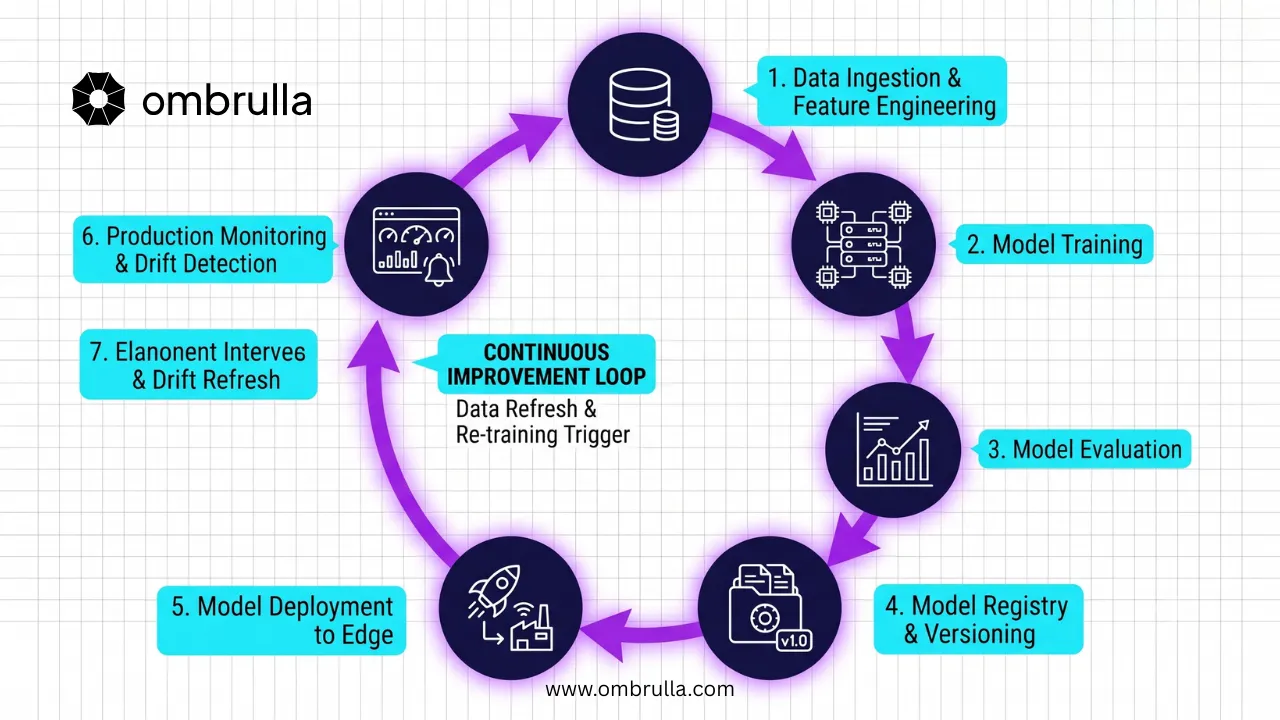
The cloud intelligence layer is the industrial AI programme's brain. It is where models are trained on aggregated operational data, evaluated against business performance metrics, versioned and governed through a model registry, and deployed to the edge and application layers through automated CI/CD pipelines.
Organisations that treat this layer as an afterthought - manually managing models in Jupyter notebooks, deploying model files via FTP to edge servers, or running retraining jobs on an ad hoc basis - consistently find that their industrial AI programmes degrade over time as production data drifts from the training distribution. Industrial AI at production scale demands a mature MLOps practice.
MLOps Platform Architecture for Industrial AI
Ombrulla's MLOps architecture for industrial deployments is built on three platform principles:
- - Experiment reproducibility: Every training run is tracked with full lineage - dataset version, hyperparameters, environment, and evaluation metrics - using MLflow or Weights & Biases. Any model can be reproduced exactly from its tracking record.
- - Automated model evaluation pipelines: New model versions must pass automated quality gates - minimum accuracy thresholds per defect class, latency benchmarks on target edge hardware, and regression tests against a curated validation dataset - before they are eligible for production deployment.
- - Model registry governance: The model registry maintains the approved production model for each use case, the challenger model under evaluation, and a full version history with deployment records. Model promotion from challenger to production requires explicit approval workflow with defined business owner sign-off.
Model Retraining Triggers
In industrial environments, model performance degrades over time due to three primary causes - all of which require different retraining strategies:
| Degradation Cause | Description | Detection Method | Retraining Strategy |
|---|---|---|---|
| Data Drift | Input feature distribution shifts due to process change, equipment wear, or seasonal variation | PSI / KS test on feature distributions vs training baseline | Scheduled retraining with recent production data |
| Concept Drift | The relationship between features and target labels changes - e.g. new defect morphologies appear | Precision/recall monitoring vs holdout labels; inspector feedback loop | Active learning retraining with newly labelled production samples |
| Novel Defect | A defect type appears that was not in the original training set; model outputs high-uncertainty classifications | Uncertainty quantification (MC Dropout, conformal prediction) alerts | Labelling sprint + targeted retraining for new defect class |
Layer 4 - The Application and Integration Layer
An industrial AI system that produces high-quality predictions but cannot act on them automatically is a reporting tool, not an operational system. The application and integration layer is where AI intelligence becomes operational consequence - triggering maintenance work orders, updating quality dashboards, adjusting process parameters, and feeding digital twins with real-time asset condition data.
Enterprise System Integration Patterns
- - ERP Integration (SAP, Oracle, Microsoft D365): AI-generated quality findings and maintenance alerts push directly to ERP via certified API connectors, creating non-conformance records, initiating procurement requests for spare parts, and updating cost centre reporting with AI-generated quality metrics.
- - MES Integration: AI quality gate decisions are embedded directly into production order flows - a Critical severity defect detection automatically parks the production order and requires quality engineer review before the line restarts. Pass results update OEE calculations in real time.
- - SCADA / Process Control Integration (via OPC-UA): AI model outputs feed back to process control systems as soft sensors - adjusting setpoints, triggering alarms, or initiating safe shutdowns based on predicted process deviations.
- - CMMS Integration (IBM Maximo, Infor EAM, SAP PM): Predictive maintenance AI generates CMMS work orders with pre-populated asset ID, fault code, recommended action, and estimated time-to-failure data - eliminating manual maintenance planning overhead.
- - Digital Twin Platforms (Bentley iTwin, Siemens Industrial Metaverse): Real-time defect findings and asset condition scores update the digital twin model, enabling 3D spatial visualisation of asset health across a facility or asset network.
Integration Architecture Principle
Never build point-to-point integrations between AI systems and business applications. An event-driven integration architecture using an enterprise service bus (ESB) or message broker (Apache Kafka, Azure Service Bus) creates a single, auditable integration layer that decouples AI systems from business applications - allowing either side to evolve independently without breaking integrations. This pattern is essential for industrial AI programmes that will scale across multiple use cases and facilities.
Vision-Powered Automation: Embedding Computer Vision Into the Architecture
Computer vision AI represents one of the highest-value application categories within the Ombrulla Industrial AI Architecture. The ability to give machines the capacity to see - and to make quality, safety, and condition decisions from what they observe - addresses inspection and monitoring challenges that neither traditional sensor systems nor rule-based machine vision can solve economically at scale.
Camera Infrastructure Architecture
Embedding computer vision into an industrial AI architecture requires camera infrastructure decisions that go well beyond selecting a lens and sensor. The key architectural considerations are:
- - Lighting design: Computer vision model accuracy is highly sensitive to lighting consistency. Industrial lighting architectures must provide controlled, reproducible illumination - typically structured light, ring light, or coaxial illumination for reflective surfaces; overdiffuse backlight for silhouette-based inspection. Lighting control should be synchronised to camera trigger signals.
- - Camera-to-AI pipeline latency: The full camera capture-to-inference-to-output pipeline must be profiled end-to-end. In high-speed inspection scenarios, the camera interface, image pre-processing, inference, and output steps must collectively complete within the inspection window defined by line speed.
- - Multi-camera synchronisation: Assembly and structural inspection use cases often require simultaneous capture from multiple camera angles. Hardware synchronisation via trigger cables or PTP (IEEE 1588) network synchronisation ensures frames from multiple cameras capture the same moment in the production cycle.
- - Image data management: A 10 Megapixel camera capturing at 10 fps generates approximately 3.6 TB/day of raw image data. The architecture must define image retention policies - raw images, compressed thumbnails, and only defect findings - appropriate to storage budget and regulatory requirements.
Vision AI Model Types by Use Case
| Use Case | Model Architecture | Output Type | Latency Tier |
|---|---|---|---|
| Surface defect detection | YOLOv8 / RT-DETR | Bounding box + class + confidence | Real-time (<10ms) |
| Defect area segmentation | U-Net / DeepLab v3+ | Pixel-level semantic mask | Near-real-time (20–80ms) |
| Assembly verification | YOLO + keypoint detection | Presence/absence + dimension | Real-time (<15ms) |
| Anomaly detection (novel defect) | PatchCore / PaDiM | Anomaly score + heatmap | Near-real-time (50–150ms) |
| Structural crack detection | DeepCrack / SegFormer | Skeleton + polygon + width | Near-real-time (30–100ms) |
| OCR / label verification | CRNN / TrOCR | Text string + validation flag | Real-time (<20ms) |
For a detailed breakdown of defect taxonomy by industry and annotation guidelines for training vision AI models, see Ombrulla's companion article: AI Visual Inspection Defect Taxonomy Library.
Edge vs Cloud vs Hybrid: Making the Right Deployment Decision
One of the most common questions Ombrulla's architecture team addresses in industrial AI engagement conversations is: 'Should we run this in the cloud or at the edge?' The honest answer is almost always: 'It depends on the use case' - and the decision matrix below provides the framework for making that determination systematically rather than based on vendor preference or existing infrastructure bias.
| Decision Factor | Edge Deployment | Cloud Deployment | Hybrid (Recommended) |
|---|---|---|---|
| Inference latency | <10ms achievable | 50–500ms typical | Edge for real-time; cloud for batch |
| Connectivity independence | Full - works offline | Requires reliable WAN | Edge inference; cloud sync |
| Model complexity | Constrained by edge compute | Unconstrained | Compressed model edge; full model cloud |
| Training data volume | Limited local storage | Unlimited cloud storage | Edge capture; cloud training |
| Data sovereignty | Data stays on-premises | Data leaves site | Sensitive data edge-only; aggregates cloud |
| CapEx vs OpEx | Higher CapEx (hardware) | OpEx (pay-per-use) | Balance based on TCO model |
| MLOps complexity | Complex edge deployment pipeline | Simpler - single environment | Most complex - requires robust OTA update |
Ombrulla's Hybrid Architecture Recommendation
For most industrial AI programmes at production scale, a hybrid architecture is the right choice: AI inference runs at the edge for low-latency, connectivity-independent operation; model training runs in the cloud on aggregated data from multiple sites; and a managed OTA (over-the-air) model update pipeline synchronises new model versions from cloud to edge during scheduled maintenance windows. This pattern captures the best of both deployment models while managing the complexity that hybrid architectures introduce through a mature MLOps practice.
MLOps for Industrial AI: Beyond the First Model Deployment
The field of MLOps - the engineering discipline of managing machine learning models in production - is still maturing in the industrial context. Most industrial organisations that have deployed AI models have done so with significant manual intervention at every stage of the model lifecycle. That approach does not scale.
Ombrulla's Industrial MLOps practice is built on four foundational capabilities that distinguish production-grade AI from research-grade deployments:
- - 1. Continuous Training Pipelines: Production industrial AI models must be retrained on a cadence that matches the rate of change of the underlying process. A continuous training pipeline automates: data ingestion from the feature store; dataset versioning and splitting; distributed training job submission; automated evaluation against defined quality gates; and model registration upon successful evaluation. The entire pipeline runs on a defined schedule and can also be triggered by drift detection alerts.
- - 2. OTA Model Deployment to Edge: Updating AI models on edge hardware distributed across multiple facilities requires an over-the-air (OTA) deployment pipeline that manages: model package creation and signing; staged rollout with canary deployment (deploy to 5% of edge nodes first, validate, then roll out to 100%); automatic rollback on performance degradation; and full audit trail of model versions deployed to each physical edge node. This is analogous to the OTA firmware update pipelines used in automotive and consumer electronics, adapted for industrial AI inference workloads.
- - 3. Production Monitoring and Drift Detection: The Ombrulla monitoring framework collects three categories of production signals from deployed industrial AI models: data distribution statistics (PSI, KL divergence) computed on incoming feature data vs training baseline; model output statistics (class distribution, confidence score distributions) compared to historical baselines; and business outcome metrics (defect escape rate, false positive rate, inspection cycle time) from downstream business systems. Deviations beyond defined thresholds trigger automated alerts and, for critical degradation, automatic rollback to the previous production model.
- - 4. Human-in-the-Loop Feedback: Industrial AI models improve fastest when they can learn from human expert corrections in production. Ombrulla implements human-in-the-loop (HITL) feedback loops that capture: inspector overrides of AI classifications (recorded as soft labels for review); quality engineer confirmations of AI-flagged defects (recorded as hard labels for retraining); and novel finding flags that route to the AI team for new class labelling. This continuous feedback mechanism creates a flywheel effect where model accuracy improves over time rather than degrading.
Economics of Industrial AI Architecture: TCO, ROI and Business Case Framing
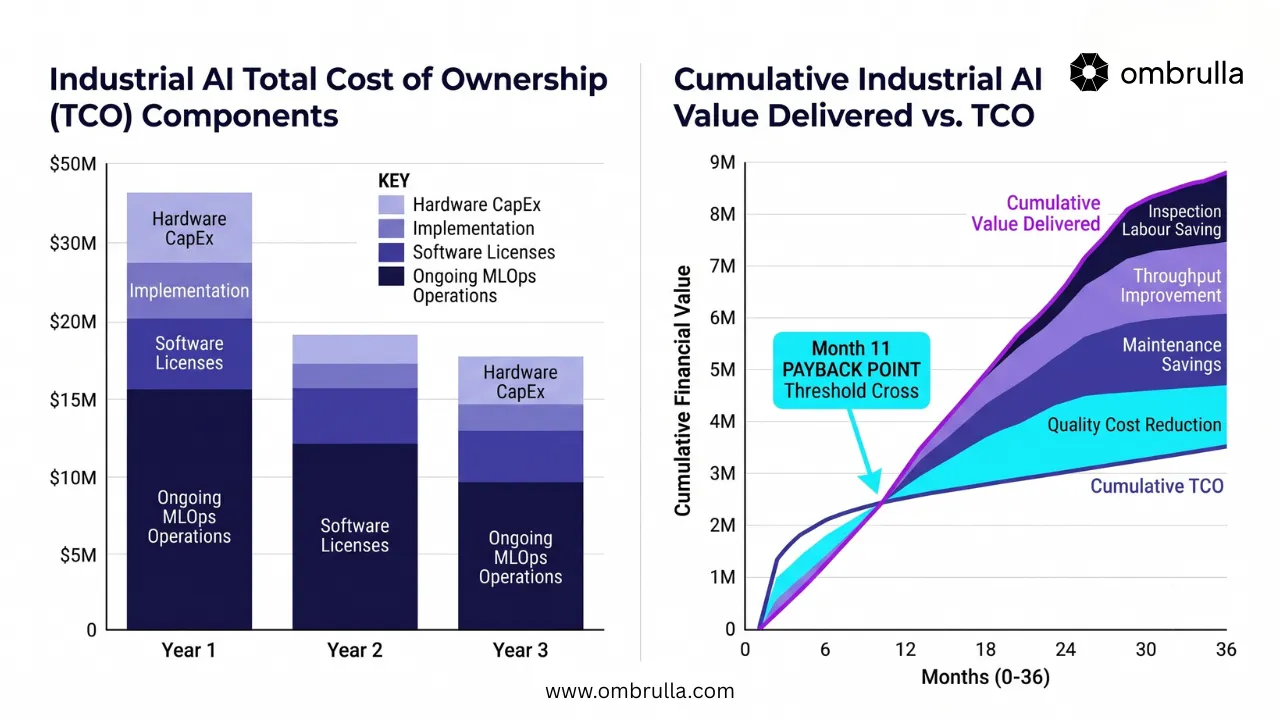
The business case for industrial AI architecture investment must be built on a rigorous Total Cost of Ownership model that captures the full cost of building, running, and evolving an AI programme - not just the software licence fee. At the same time, the value case must be grounded in operational data rather than vendor projections.
TCO Components for Industrial AI Architecture
| Cost Category | Year 1 (Build) | Year 2 (Operate) | Year 3 (Scale) |
|---|---|---|---|
| Edge Hardware | High CapEx: edge servers, cameras, networking | Maintenance, warranty, spare units | Incremental expansion CapEx |
| AI Platform (Cloud) | Platform onboarding, data pipeline build | Compute, storage, MLOps platform licence | Volume growth - manage with reserved instances |
| AI Model Development | Largest cost: data labelling, model training, validation | Ongoing retraining, new use case models | MLOps automation reduces marginal model cost |
| Integration Development | ERP/MES/CMMS connectors, API development | Integration maintenance, new system connectors | Reuse existing connectors across new use cases |
| Operations & Support | Internal AI ops team build or managed service | Ongoing AI ops, model monitoring, incident response | Shared ops team across growing use case portfolio |
Value Driver Framework
Industrial AI programmes deliver value through five distinct mechanisms, each of which should be quantified separately in the business case:
- - Defect escape prevention: The value of AI-detected defects caught before they reach customers or downstream processes. Quantify using historical warranty cost, scrap rate, and production rework data.
- - Unplanned downtime prevention: The value of AI-predicted failures caught before asset failure. Quantify using historical MTTR, average downtime cost (production loss + maintenance emergency premium), and OEE baseline.
- - Inspection labour productivity: The reduction in inspector time per inspection event multiplied by the fully loaded hourly cost and annual inspection volume.
- - Throughput improvement: The increase in production throughput enabled by faster, more accurate quality gates that eliminate conservative human over-rejection of borderline parts.
- - Data monetisation and compliance: The value of structured AI inspection records for regulatory compliance demonstration, insurance premium reduction, and asset resale value documentation.
ROI Benchmark Data
Across Ombrulla's industrial AI deployments, the following ROI benchmarks are consistently achievable in year two and beyond: Defect escape rate reduction of 25–45%; Unplanned downtime reduction of 20–35%; Inspection labour productivity improvement of 30–50%; Overall equipment effectiveness (OEE) improvement of 3–8 percentage points. Payback periods range from 8 to 18 months depending on asset criticality, inspection volume, and historical defect rate.
Implementation Phases: From Architecture Blueprint to Production AI
Ombrulla's industrial AI implementation methodology is structured into five phases, each with defined deliverables, quality gates, and success criteria. The phased approach ensures that organisational capability is built alongside technical capability - the leading cause of single-use-case AI deployments that never scale is the absence of the MLOps and data engineering capability required to operationalise a second and third model.
| # | Phase Name | Activities | Key Deliverables |
|---|---|---|---|
| 1 | Architecture Design & Discovery | Asset inventory, use case prioritisation, data landscape assessment, architecture pattern selection, technology stack selection | Industrial AI Architecture Blueprint, Use Case Prioritisation Matrix, Technology Stack Recommendation |
| 2 | Data Foundation Build | Edge hardware procurement and commissioning, connectivity layer deployment, data pipeline build, feature store configuration, historical data ingestion | Operational data pipeline producing ML-ready feature datasets; Edge compute layer fully commissioned |
| 3 | AI Model Development & Validation | Defect taxonomy definition, data labelling programme, model training and evaluation, edge model optimisation, shadow-mode deployment for parallel validation | Production-ready AI models for priority use cases, validated against live production data in shadow mode |
| 4 | Production Deployment & Integration | ERP/MES/CMMS integration build, business workflow automation configuration, operator training, go-live, hypercare support | Live AI system operating in production with full business system integration and automated workflow triggers |
| 5 | MLOps Operationalisation & Scale | MLOps pipeline build, continuous training pipeline configuration, production monitoring dashboard, HITL feedback loop, second-use-case initiation | Self-sustaining MLOps operating model; programme ready to scale to additional use cases and sites |
Ready to Design Your Industrial AI Architecture?
Let Ombrulla's architecture team turn your operational AI ambition into a production-grade deployment blueprint.
We work with manufacturing, energy, and heavy industry organisations to design, build, and operationalise industrial AI architectures that deliver measurable ROI - from the first edge sensor to the executive dashboard. Our engagements span architecture design, data pipeline build, AI model development, MLOps platform implementation, and enterprise system integration.
Start With a Free 60-Minute Industrial AI Architecture AssessmentFrequently Asked Questions
What is the difference between industrial AI architecture and enterprise AI architecture?
Enterprise AI architecture typically operates in a data centre or cloud environment with reliable connectivity, stable data schemas, and relatively forgiving latency requirements. Industrial AI architecture must additionally accommodate: physical operational environments with no guaranteed connectivity; heterogeneous machine data sources speaking dozens of proprietary protocols; hard real-time latency constraints imposed by physical process speeds; safety and regulatory requirements governing how AI outputs can influence physical process control; and operational continuity requirements that mean the AI system cannot go offline for updates without disrupting production. The industrial context adds an entire layer of engineering complexity - particularly at the edge compute and connectivity layers - that enterprise AI architecture patterns do not address.
How much data do we need before we can train our first industrial AI model?
The data requirement depends heavily on the AI approach chosen. For supervised learning defect detection models (CNN, YOLO-family), a minimum of 300–500 annotated instances per defect class is typically required to achieve production-acceptable accuracy - with performance improving meaningfully up to 2,000–5,000 instances per class. For anomaly detection approaches (PatchCore, PaDiM), 50–200 normal-condition samples may be sufficient, with zero defect examples needed at training time. For time-series predictive models (LSTM, gradient boosting), the data requirement is defined by the number of historical failure events rather than total samples - a minimum of 15–20 documented failure cycles is typically required. The good news is that most industrial organisations have more relevant data than they realise - it is often trapped in historian systems, maintenance records, and ERP quality modules rather than accessible to AI pipelines.
Can we deploy industrial AI without replacing our existing SCADA or PLC infrastructure?
Yes - and this is a critical point for industrial AI programme business cases. Ombrulla's architecture is specifically designed to be non-invasive to existing OT infrastructure. AI systems connect to existing PLCs and SCADA systems via standard industrial protocols (OPC-UA, Modbus TCP) using read-only data subscriptions - there is no modification to existing PLC programs or SCADA configurations. Sensors and cameras are added incrementally as needed for specific use cases. The AI layer sits alongside existing control infrastructure rather than replacing it. This approach preserves existing safety certifications, minimises OT team disruption, and allows the AI programme to be built incrementally without requiring a capital-intensive control system replacement.
How do we manage industrial AI across multiple manufacturing sites?
Multi-site industrial AI programmes introduce a new dimension of architectural complexity: how to share models and learnings across sites while respecting site-level data sovereignty, process variation, and network architecture differences. Ombrulla recommends a federated AI architecture pattern for multi-site deployments. Each site operates its own edge AI inference layer and local data pipeline. A shared cloud training environment aggregates anonymised feature data from all sites for global model training, producing foundation models that capture cross-site patterns. Site-level fine-tuning adapts global foundation models to site-specific conditions - equipment variants, local raw material characteristics, environmental factors. A central model registry governs which model version is approved for deployment to each site. This pattern enables both knowledge sharing across sites and site-level model customisation.
What cybersecurity measures are required for industrial AI systems?
Industrial AI systems introduce new cybersecurity attack surfaces at the OT/IT boundary that must be explicitly addressed in the architecture. Essential security measures include: network segmentation with a dedicated AI data acquisition network separate from the production OT network and the corporate IT network, connected via industrial DMZ (demilitarised zone); zero-trust access control for all connections between the AI layer and production systems; model integrity verification - AI model files deployed to edge hardware should be cryptographically signed to prevent tampering; data encryption at rest (AES-256) and in transit (TLS 1.3) for all AI training data and inference outputs; and audit trail management ensuring all AI system actions are logged in an immutable, tamper-evident log for forensic and regulatory purposes. IEC 62443 provides the industrial cybersecurity standard framework applicable to Ombrulla AI deployments in regulated industries.
How long does it take to deploy production-ready industrial AI?
A realistic timeline for a first industrial AI use case deployment, from architecture design to production go-live with business system integration, is twelve to twenty weeks for a well-resourced programme. Phase 1 (Architecture Design and Discovery) typically takes three to four weeks. Phase 2 (Data Foundation Build) takes four to six weeks, with hardware procurement being the most common timeline driver. Phase 3 (AI Model Development and Validation) takes four to eight weeks, heavily dependent on training data quality and availability. Phase 4 (Production Deployment and Integration) takes three to four weeks. The critical path is almost always data quality and data access - organisations that have invested in their data infrastructure prior to AI programme initiation typically achieve go-live in twelve to fourteen weeks; those building the data foundation from scratch typically take eighteen to twenty-two weeks for the first use case.
How does Ombrulla's Industrial AI Architecture differ from generic cloud AI platforms?
Generic cloud AI platforms - whether AWS SageMaker, Azure Machine Learning, or Google Vertex AI - provide excellent machine learning infrastructure for data science teams working in cloud environments. What they do not provide is the industrial-specific capability stack that separates a lab deployment from a production-grade industrial AI system: native industrial protocol integration (OPC-UA, Modbus, PROFINET), pre-built connectors for OT data historians and SCADA systems, edge AI inference pipeline management with OTA model update, ATEX-rated hardware reference designs, industry-specific pre-trained model libraries for defect types, integration patterns for SAP PM and IBM Maximo, and operational frameworks designed for OT team handover and sustainability. Ombrulla's architecture layers these industrial-specific capabilities above the cloud platform foundation, rather than replacing the cloud platform - giving clients the benefit of major cloud investment in AI infrastructure while adding the industrial-specific engineering that turns cloud AI capability into operational plant-floor intelligence.
What is the right organisational model to sustain an industrial AI programme?
Organisational design is as important as technical architecture for long-term industrial AI programme success. Ombrulla recommends a hub-and-spoke operating model: a central AI Centre of Excellence (CoE) responsible for the MLOps platform, model governance, data engineering standards, and AI capability development; and site-level AI champions - typically a combination of process engineers with AI skills and data engineers with manufacturing knowledge - responsible for site-level data quality, operator engagement, and use case identification. The CoE should be staffed with: an industrial ML engineer lead, a data engineering lead, a domain expert with operational manufacturing or engineering experience, and an AI operations engineer. This team of four to six people can sustainably operate a portfolio of ten to fifteen production AI models across multiple sites when supported by a mature MLOps platform.


